Showing posts with label Pop Culture. Show all posts

Thursday, August 11, 2011

Sincerity as a Marketable Product


"The secret of acting is sincerity. If you can fake that, you've got it made." - George Burns

Pop quiz! What is the one thing you probably know about Jewel?

Bzzt! Time's up. The answer is "while she was a struggling musician from Alaska she lived in her van."


Interesting, but living in your car is practically universal among musicians: Kurt Cobain, the founding members of Aerosmith, Kelly Clarkson and Eartha Kitt all did the same thing. In fact, musicians having it rough is the subject of a whole genre of jokes.

Q: What do you call a drummer with no girlfriend?
A: Homeless.

Yet with Jewel all you hear about over and over is how she lived in a van, which is really not that special or distinguishing as far as musicians go. By Jove! It's almost as if…call me crazy here…Jewel's van days are used as a part of her image, to make her sound sincere and arty.

Jewel, who proved with her poetry she's about as deep and arty as a pizza box, is one of the more offensive examples of a very offensive trend that suckers otherwise smart people: the persona packaged, sold and marketed of an authentic artist who isn't packaged, sold or marketed. I don't know what offends me more: this kind of hypocritical doublethink or the fact people fall for this kind of obvious fraud.

Paul Giamatti

Jenny: "Everything about you is a lie."
Neville Sinclair: "It wasn't lies, it was acting."
- The Rocketeer (1991)


Paul Giamatti is the ultimate example of what I mean. If you like Paul Giamatti because he is a regular guy and everyman actor as opposed to some blow-dried, image-centered and manufactured Hollywood phony…well, I hate to say it, hipsters, but you've been had! I mean it, you've been tricked!

Sincerity? "Regular guy?" Give me a break! Blue blood Paul Giamatti is as much a "regular guy" as George W. Bush, a scion of privilege, with a Dad that was a former commissioner of Major League Baseball.

What I find so offensive and hateful about Paul Giamatti is, not that his success was made possible by wealth and family connections. After all, success in life is about who you know, and I am fine with that and most grownup adults are fine with that. Only lobotomized permanent children like libertarians believe the world is a meritocracy all the time. As a counterpoint to Giamatti, take Sigourney Weaver, who in addition to her incredible talent and obvious professionalism, came from a wealthy showbiz family with her Dad as a former president of NBC who created the Tonight Show.

But Sigourney has never lied to the public and tried to be anything else; she has never created a fake Giamatti image and she revels in her obvious sophistication. She's proud of being Ivy League, with shout outs to Stanford in everything she does. And good for her, I say.


Rather, what I hate about Giamatti is his fandom is based on bamboozling the public into thinking blue-blood Giamatti is a regular working "real" schlub audiences can identify with who achieved in spite of Hollywood's shallow image and marketing machine, when he is in fact a pure creation of that image and marketing machine. He's the George W. Bush of movies. And like Bush, his cult of personality is centered around the worst attributes and vices of the public.

Envy and Spite at Work

There's the factor of envy and spite. Paul Giamatti is not handsome in the traditional, classical sense (although I've found no shortage of women that wouldn't want to get with him), so men aren't threatened by him. Remember how all the women of America hated Baywatch all through the 1990s?


This brings to mind another, crucial question. Who is manufactured? Who is sincere?

When I was a lot less self-aware and honest with myself than I am today, I found myself asking a more mature friend why I hated Leonardo di Caprio so much.

His response?

"You know exactly why. You just want a rational explanation."

To show the reasons people have for liking Paul Giamatti are totally illegitimate, based on a phony image, and utterly hypocritical, try this exercise. Why do you hate Justin Bieber so much?

Now, I'm not a fan of the Bieb since I'm hardly the target audience of his music and stage shows, but consider this. Bieber came from absolutely nothing, an unconnected non-showbiz family in Canada. He achieved fame as just another kid making videos on the internet, and he didn't get attention through slick advertising or marketing but by a sincere and spontaneous outpouring of viral support and attention.

If you can think of a beginning that's more Indie, I'd love to hear it, yet the hardworking Bieber is a "phony" because he arouses spite and envy the way the blowdried Leo di Caprio did before him, whereas rich kid Paul "Can I be an actor now, Daddy?" Giamatti, who really is a manufactured product and insincere phony, gets to be down to earth and authentic. The hypocrisy and spite of it all makes me absolutely sick.

You might say it's a matter of talent, but I don't think so. Caprio was obviously a gifted young actor even back in the day even if he did go "full retard" in Gilbert Grape, and look what happened.

Dane Cook is terminally unfunny and horrible, but you know, there are bushelfulls on bushelfulls of annoying stand-up comics – in fact, "obnoxious stand up comic" is practically a redundancy. Why is he singled out for hate? At the risk of pointing out the obvious, the reason is because he's good looking and confident in his delivery. Stand up comics, even the women (especially the women!), have to be slouchy, slobbish and have a sense of humor that is self-deprecating.


The power of envy and spite goes beyond showbusiness into the realm of politics. Ask yourself this: when was the last time someone with military experience or decoration beat a draft dodger or civilian in a presidential election? I'm just saying: decorated World War II heroes like George Bush Sr. and Bob Dole lost against dodger Clinton, and medal-wearing, heroic Vietnam vets like Al Gore, John Kerry and John McCain lost out to Ivy League AWOL civvies. The truth is, the majority of the American population have never been in the military and because of their own cowardice, resent vets for their service. I figured it was unwise of Kerry and McCain to trumpet their own record because it would only make the cowardly masses hate them more, and I was proven right in a way that can't really be argued with.

The Hipster Contrarian's Quest for "Authenticity"

The other factor at work, other than spite, is the hipster fascination with "authenticity." Here's a good working definition of indie music that just might apply to indie film, too. Indie music is whatever the mainstream doesn't like. Seriously, that's it. Remember former hipster fave Death Cab for Cutie, and how everyone talked about how they "sold out" when they were picked up by a big label, their sound was never the same? This is an especially ludicrous claim because every Death Cab for Cutie album sounds identical!

As Dr. David Thorpe put it:

"Upon the release of 2005's Plans, DCFC were immediately disavowed as sellouts by the same kids who'd called them rock's saviours the previous year. This of course is not unusual for indie culture, but often there is at least some legitimate complaint, as slick new producers and hot-shit session musicians are brought in to fag up a band's sound just enough so some 17-yr-old mall troll will buy the cd for his sister's birthday. But with Death Cab, indie culture's back-turning rings exactly like the pompous, exclusivist whining it is--because every Death Cab record is exactly the same."

In short, Death Cab didn't change one iota but their authenticity-obsessed and insecure hipster fans abandoned 'em because they became commercial and popular.

I'm reminded of this attitude a lot because Super 8, a Spielberg-inspired romp is raking in oodles of dough at the box office this summer, so it's now time for insufferable film pedants and contrarians everywhere to beat the deadest of all dead horses, how Spielberg and Lucas and William Friedkin and others are responsible for an "infantilization of cinema," as ghoulish bonershrinking harpy Pauline Kael put it years ago back when anyone listened to her.


In the contrarian mind of the film pedant, Lucas and Spielberg are guilty of the greatest crime imaginable: namely, they are successful.

Seriously, at the end of the day, that's what it is: resentment they made movies mass audiences love.

It's hard to imagine now, but there was a time when even oddball director David Lynch made blockbusters. David Lynch's Elephant Man was a bona-fide hit, and George Lucas even approached Lynch to direct Return of the Jedi. Lynch's Dune bombed so badly that era of his career came to an end. Lynch never did blockbusters, but instead chose to do gonzo, surreal pictures like Blue Velvet later on. Many of those films were truly great, and more power to him.

Lynch and Spielberg both made the kinds of movies they wanted to do. The only difference is that Spielberg's movies made hundreds of millions of dollars. Why should Spielberg's success be held against him, especially since he never "sold out" or tried to be desperately popular? This is undeniably true since Spielberg's always done the same kind of thing he's always done.

What can we learn from all this?


The quest or "authenticity" and hatred of image and "Hollywood" is a phantom, ephemeral chimera that goes nowhere, an intellectual dead-end that leads to nothing except pointless contrarianism. It also makes a person vulnerable to being tricked by frauds like Neville Paul Sinclair Giamatti. After all, the more you think you can't be manipulated by marketing, the more likely you are to be unaware of how it works and therefore vulnerable to manipulation by marketing.


One day, Paul Giamatti will steal that darned rocket pack, though!

Wednesday, June 22, 2011

Video Games, the single greatest subterranean source of pop culture

Try to imagine for just one minute that you didn't watch movies at all.

All your friends would drop weird quotes and references you didn't get. Trends would come and go in popular culture, and you don't know where they come from.

Fractured fairy tales with modern references and winking jokes to parents would be the norm in the book publishing world and you wouldn't understand why (thanks to the popularity of Shrek, among others).


One day, everyone would suddenly be into science fiction and aliens out of nowhere and talk about how "science fiction is back" (thanks to Independence Day).

You'd wonder why, one summer, the big panic, all everybody seems to talk about are asteroids smashing into the earth (thanks to several movies with that topic back in 1990-whenever it was).

In short, you would not be aware of a lot of what's going on around you. You'd be dimly aware there's a subterranean force of great influence but you wouldn't know what it is.

Well, don't imagine any more. That's how I – and a lot of other people - feel about video games.

Until I got a friend that played video games extensively, a lot of things were going on around me that I just didn't understand. The comparison between movies and video games is totally apt because the video game industry reached a tipping point a decade ago where more Americans spent more money on video games than on movies. That statistic shocked me, but all the gamers that heard about it weren't surprised.

For example, it struck me as strange that starting a few years ago, every nerd friend I had started to be a Russophile, admiring Russian culture and the USSR. At first I thought it was because Russians were the last bunch of white people to be really scary and tough, and the USSR was their heyday and high point. And while that speculation may be true, the answer is because a lot of video games were made with Commie and Russian bad guys.


Also, when did zombie apocalypses get so popular, anyway? Suddenly every friend I had started quoting zombie survival manuals. Obviously they were inspired by the anti-consumerist Romero movies and the supercool cult films like Army of Darkness…but those have been around for decades. Why were zombies and end of the world zombie scenarios suddenly the hot property now?

I never understood zombies. They were mindless, dumb and made from boring assholes: former accountants and travel agents. Vampires are also very trendy now, but Vampires I get: Vampire stories are full of cool crumbling castles, fog, and gaslight, Victorian atmosphere. Vampires are aristocratic, sociopathic megalomaniacs with a hefty dose of scary sexuality. The good Vampire baddies have so much personality they totally dominate the stories they're in, compelling and repellant at the same time like good baddies should be.


By contrast, zombies are mindless so they're more a force of nature or inanimate object. The single thing you never want in a story is one where characters are opposed by inanimate objects without personality, like a door lock or a security system, for instance. Conflict is only interesting between people and personalities that want opposing things.

Remember all the sequels to the Mummy back during the Universal days, when the Mummy was basically a mindless, speechless corpse driven like a robot by anyone wearing a certain ring? Wasn't that much less interesting and scary than the original film where Boris Karloff was an evil sorcerer creep who could barely pass for human, but who was driven by lost love?


I don't understand zombies, but I did understand why a zombie apocalypse would be appealing, at least to others. It's for the same reason people love disaster movies. Freud said nobody ever thought about disasters unless they long for them to happen at some level.

It reminds me of the Reagan administration's attitude to nuclear war, Jesus, and the environment. Everyone remembers James Watt, Secretary of the Interior, and how, when asked what his office's strategy was to preserve national parks for future generations, said that as the Rapture and end of the world would come soon there was no need to try to preserve national parks long-term. Thankfully, Reagan's enormous cowardice was greater than his hatred for living things and no war happened, but nonetheless, there is a personality type that looks forward to the end of the world because it means an absolving of adult responsibility.


On the other hand, the very things that bore me about Zombies – the fact they have no personalities and are totally mindless – are the most appealing thing about them to video game designers. One of the greatest problems with video games is how the enemies never act intelligently, never take cover, and just run into gunfire and keep on attacking even when wounded. That may not make sense with human enemies, but with mindless hordes of neverending zombies, it's what makes them scary!

Not just that, but like with movies, if one video game does really well and is a surprise hit, everyone tries to imitate it. So before you know it, there were a billon zombie shooting games and all everybody was talking about were zombies.

As I try not to close an article without a few book reviews, it's interesting to note that the notion of the apocalypse goes before the 20th Century and back into the 19th. The idea that end of the world scenarios were a common theme in the literature of the 19th Century is very surprising to a lot of people, but it just goes to show how nihilistic Western culture actually is.

The Death of the Earth. J.H. Rosny (1910). The Rosny brothers were the single greatest geniuses of science fiction Belgium ever produced, and they dealt with mankind's beginnings (as in Quest for Fire and the Xipehuz) and mankind's end, as with the Death of the Earth, a future billions of years from now without living things where mankind is aware of their end and resigned to it - it's scary to find a world where the entire "fire" has gone out from mankind. In the moving final pages, the untold billions of generations that passed on the earth end with a single pair of eyes that shut closed. One of Rosny's preoccupations (that of evil living minerals) is on display here, just like his greatest inhuman creations, the Xipehuz.


Beyond Thirty. Edgar Rice Burroughs (1915). See how far you can hear this shlocky premise before you crack a smile: World War I so totally destroyed Europe that hundreds of years later it was a totally unknown bombed out no-man's-land that reverted to stone age savagery filled with escaped zoo animals like lions. An American captain becomes the first to explore unknown Europe and saves a hot cave girl, the last queen of England. The idea World War I would have continued forever is laughable enough (as is the idea America would never get involved), but it's almost shocking to imagine the same ERB who wrote the gung-ho beat-back-the-devil Hun-basher Tarzan the Invincible would also write a story that tsk-tsks Europe for going to war and praises isolationism.

The Last Man. Mary Shelley (1826). When Napoleon was defeated, the bad guys won. The attempts to "franchise out" the French revolution and create a Republican united Europe failed, and the reactionary and aristocratic elements of Europe prospered. This was a lost generation of young geniuses like Byron crushed underfoot by snotty, dull and untalented moralists, and it doesn't surprise me the reaction to this novel about the end of the world would be horror by the Mrs. Lovejoy-types that ruled Europe. Basically, the Last Man ended Mary Shelley's career and remained forgotten until it was rediscovered a couple decades ago. Unlike Frankenstein, which was moody and atmospheric from the get-go, it wasn't immediately obvious the Last Man is about an end of the world scenario (my personal favorite failed prediction is the idea that Greece would still be fighting for independence against the Turks in the 21st Century), which made this story all the more shocking when the premise is revealed.


The Last American. J.A. Mitchell (1889). Some Persian explorers discover the lost city of Noo-Yok in America. Amazing to me how the cheesy conventions of the end of the world story are already here at this early stage: we even get a look at the crumbled Statue of Liberty. America and Western civilization is wrecked and mangled. What happened? The answer is something that would never occur to a 21st Century person: a weakening of the immune system that left us vulnerable to punishing winters. I guess the 19th Century was more rural than we thought. Thankfully, this book is short and its prejudices are innocent unlike the ultra-vile racist fascist Jean Respail's "Camp of the Saints," which has neither of those two virtues.

Monday, March 28, 2011

Everything you know about these figures is wrong!

There are some figures in pop culture that are no longer characters but are symbols, their names used as verbs. Here’s the problem, though: often everything we know about those characters is wrong, as the characters have been almost totally misrepresented.


The Perils of Pauline


The Perception:

Pauline, according to pop culture, was a silent film heroine who was usually captured and tied to train tracks or a saw mill. She was symbolic of the virginal damsel in distress (and light bondage).

The Reality:

Here’s the thing, though: Pauline often was placed into dangerous situations, but she usually got herself out of them.

It would be crazy to say she was a feminist character or even a really strong woman, but for the time she was a little naïve but smart, scrappy and competent and typically solved her own problems. There were some occasions that she needed a rescue but these were occasional, not constanty.

Pauline was an adventurous female that wanted to be a writer, independently wealthy, and when she got married, she wanted to see the entire world from China to Paris and everywhere in between. Her evil accountant wanted to rob her blind, so he ensured she always faced some mishap.

And while we’re at it, Perils of Pauline is often described as the first of the cliffhanger serials. Only it didn’t have cliffhanger endings! Pauline experienced a problem or life-threatening in an episode and at the end typically solved it. There were no episode cliffhangers.

Incidentally, check out this serial from 1919, featuring both Pauline actress Pearl White as an antiquities thief that duels with Werner Oland as a Chinese gangster. It’s interesting in that both characters are thieves unlike other serials, and also that it features Pauline and Charlie Chan matching wits.


Horatio Alger


The Perception:

Horatio Alger was an archconservative who wrote hoary “rags to riches” stories where scrappy urchin shoe shine boys pull themselves up by their own bootstraps and become wealthy by the end. His stories are fantasies that gloss over real inequality and create a very damaging American mythology.

The Reality:

Horatio Alger’s most famous works like “Ragged Dick” (ha, ha) were all about shoe shine boys and other scrappy underdog kids, but they were not rags to riches stories but have realistic endings where the kids get into middle class respectability in professions like clerk or accountant. He did not write any stories where a kid became Dale Carnegie!

And far from writing stories where a character achieves their status exclusively “by their own bootstraps,” the majority of Horatio Alger stories featured a mysterious wealthy stranger who takes notice, secretly, of some good deed the hero does and works to benefit him in secret.

Let me repeat that: even in Horatio Alger novels, getting ahead is all about who you know!

Seriously, guys! Sure, I am tired of privileged nepotism beneficiaries like Bill Kristol saying poverty and lack of education aren’t real problems because anybody can be a millionaire, so it’s basically the poor’s own fault and they don’t deserve pity. But don’t use imagery of Horatio Alger, who didn’t write the kinds of stories people think he did and if he was guilty of anything, it was being formulaic and a little lazy. Michael Moore wrote a chapter in his slacker-aimed political book “Dude, Where’s My Country?” called “Horatio Alger Must Die.” This was, by the way, also where Moore published his deeply unimpressive Saudi/Bush family connections, which he honestly expected to shock everyone in Fahrenheit 9-11, but instead got a big, fat “why is this important?” from everyone.

What’s more, Horatio Alger was far from an archconservative. He was a Unitarian Minister, which means if he lived today he’d drive a VW van. His later books were often Westerns that were often banned by Church groups because of their extreme and surprising violence. And finally, it’s very likely Horatio Alger was homosexual. Yeah, I know, that’s often said about a lot of figures, but with Alger it’s better substantiated than most: he had to leave the church because of allegations of sex with teenaged boys, not to mention many friends that he confirmed his sexuality with.


Rambo


Pop Culture’s Perception:

Rambo’s name is a byword for macho, testosterone fueled and brainless soldiery, and in foreign policy is often a symbol for right-wing aggression. In pop culture, Rambo is the ultimate pro-violence kill-crazy warhawk.

The Reality:

The actual character of Rambo, however, is nothing like that. In his first film, First Blood, John Rambo was a flashback-fueled veteran that went on a rampage as he was forgotten by society and unable to reintegrate into it. The final scene in the film was a vulnerable and somewhat pathetic Rambo breaking down crying about how he was a broken person that was the inevitable byproduct of war. It’s a mistake to say that the Rambo movies are anti-war, but Rambo was extremely cynical about it, even when he became a bow-wielding superman in the later films. Even in the violence-intensive later films, Rambo was still a tragic, pessimistic, doomed figure who had nothing in his life.

Rambo is the flip-side of Rocky Balboa. Whereas Rocky movies believed in America and the underdog, Rambo movies are always cynical and bleak, with Rambo as an expendable, Samurai-like, Zen figure that became war itself.

In the later films there was a lot of violence and mayhem and it’s easy to misinterpret that. Kurt Vonnegut once said that there was no such thing as an anti-war movie, because all war movies glorify war somehow.


Tarzan


The Perception:

In the movies and television shows, Tarzan is typically a monosyllabic caveman that lives in a crummy treehouse, a wild man that’s a little on the slow side.

The Reality:

Two things about reading the original Tarzan novels take everyone by surprise: Tarzan is intelligent, and Tarzan is violent.

Tarzan taught himself to read with books left by his castaway parents when he had no spoken language, and in the book series later learned to speak perfectly a dozen languages including French and German. He could pass for a distinguished gentleman (at least on the surface, anyway), which made his savage nature all the more dichotomous and surprising when he ripped his nobleman’s clothes off to rush into the primitive. Return of Tarzan had some shocking images of a heartbroken Tarzan spending time in Paris smoking cigarettes, drinking absinthe and going to art galleries.

And for that matter, Tarzan didn’t have a treehouse. He lived with Jane in a sizable and wealthy plantation house in Africa, a compromise Tarzan was extremely unhappy with, but which he did to keep Jane happy.

Finally, Tarzan was a superwarrior of tremendous strength with a surprising bloodthirstiness that was animalistic – nature red in claw and fang. In Beasts of Tarzan, he actually killed a deer by sinking his teeth in until he drew blood. Tarzan was explosive and strong and a little scary and intense. To my knowledge, these two attributes give Tarzan his mystique and make him intriguing, but I’ve yet to see ‘em in any TV or movie version of Tarzan.

By the way, what do Tarzan and Horatio Alger have in common? Both were published in the first pulp magazine in existence. The Argosy got its start publishing Alger's serials. By the 1910s it changed its name to "All-Story Weekly" where Burroughs printed, in serial form, the Tarzan novels.

Friday, October 8, 2010

The bad guys have a point

Hey, remember the evil Senator bad guy from the first X-Men movie? We're all supposed to view him as some ugly fascist type, but the thing is, he was mostly right.
"There's a girl in Illinois that can walk through walls. What's to stop her from going into a bank vault?"

I know he's supposed to be a bad guy, a cookie cutter fascist, but that's a pretty darn good point. Mutants can be dangerous and powerful and should be registered and controlled just like the government responsibly registers and controls firearms and explosives. I just don't get why this senator is supposed to be the bad guy of this movie. Jeez, they even went to the trouble to hire a guy that specializes in playing unlikeable assholes, Bruce Davidson, better known as the guy that abandoned Captain Picard when he was a Prisoner of War of the Cardassians.

Then you have the movie "I am Sam," the film that gave the world the ghoulish Dakota Fanning. It's supposed to be a feel-good airplane movie about how love triumphs, where a retarded man wants custody of his daughter. Now, no matter how much goodwill you might have toward a guy as charismatic as Sean Penn, the "bad guys" in the film are totally right: no responsible person could agree that a mentally challenged man shouldn't have full sole custody of a child.

Finally, we have the series True Blood, which a friend of mine lent to me on DVD. The movie explicitly compares vampires to the gays. That isn't in doubt; the show's metaphoric power comes from that. Because an artificial blood supplement has been invented, vampires don't have to feed on humans anymore, and they "come out of the coffin" (a pun that's typical of the show's ah, humor) and demand equal rights. The people that oppose Vampire rights on talk shows tend to be stiff religious types that mention the Good Lord a lot. Their point of view is predictably not that well developed. People that don't care for Vampires are usually (at the very least) unenlightened or downright ignorant.

The thing is, though, the bad guys are pretty much right and the comparison of Vampires to gays is pretty weak. A better comparison would be to registered sex offenders. How comfortable would you be with one in your neighborhood, especially if you have children? And for the same reason. Vampires have a biological, inarguable need for human blood. In the series, all Vampires have the ability to hypnotize others into doing their bidding.

And consider that the blood supplement was only invented two years before the show started. Unless a Vampire was only created after that two-year mark, and the overwhelming majority were not, that means that prior to two years, they had to get their blood from something. The reveal of Vampires should have been accompanied by the same scenario that occurred in former Communist and Fascist countries, where now that there's transparency, a corrupt judiciary and military could be prosecuted for past crimes.

Registered sex offenders are treated differently from other people for the following reasons:
  1. They have demonstrated by their actions to be a danger to society;
  2. They have drives and urges that make them a continuing danger even if they're incredibly conscientious.

Vampires in True Blood meet both of those criteria. If I lived near a Vampire, I'd want him to have a bright orange mailbox. So, yeah, you do your thing, Straw Man redneck godbotherer preacher that doesn't like Vampires!

Incidentally, the only thing I can remember about the show, the single image that stays in my head, is everyone saying "Sookie" with a breathy voice something like 30 times an episode. It reminds me of how the only concrete images I have of the X-Men cartoon from the 1990s was someone yelling "JEAAAAAAN!" every episode and Professor X screaming and fainting. It's sort of like how in Poltergeist III, it feels like someone yelled "Carol Ann!" 500 times, over and over, all through the film.


Thursday, May 13, 2010

If you don't get the joke, you're a part of it


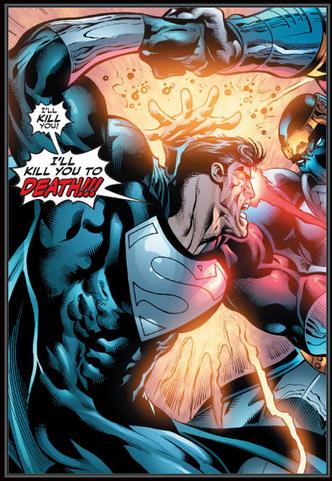
"I'll kill you! I'll kill you to death!"

A textbook example of the phenomenon where, "if you don't get the joke, you're a part of it" would have to be Superboy-Prime, a villainous character that goes on a lunatic rampage when other heroes break his insanely exacting standards of what constitutes heroism, and in so doing parodies lots of old school fans that think this or that hero is RUINED FOREVER by once in a while demonstrating their human nature. The character's whiny rants hit a little too close to home for many old school prudes.

What they don't get though, is that their "we are not amused" reaction actually increases the entertainment value of the character! It's sort of like how Bill O'Reilly's attempts to boycott records actually increase their sales.

The character's overused and played out, which goes to show that even the funniest jokes can eventually die from exhaustion. But for a while there, Superboy-Prime gave me a glorious schadenfreude explosion.

Another, more frustrating example of this phenomenon would be the absolutely savage Family Guy parody on South Park...for the simple reason that Seth McFarlane didn't play along, and said he thought the South Park satire was "very funny." I find that monstrously upsetting because...well, you're not supposed to get it and play along - that parody was an attack at your expense, so massive, so merciless that the only way McFarlane can just let it go is if he's either biting his tongue so as not to look like a humorless dick, or he honestly just didn't get it. Either way, it's disappointing.

I always thought that Family Guy's attempts at shocking humor were a little gutless because none of their shock-value gags were at the expense of anyone that enjoyed the show. For instance, a lot of their gags are based on spoofing uptight, prudish religious and fundamentalist nuts. My question is...what uptight, fundamentalist religious people watch Family Guy, anyway?

Tuesday, March 30, 2010

What can make a person happy?

It's amazing what can make a person just absolutely overjoyed.

I always looked forward to getting my first textbooks for a new college semester, because I love the sound of breaking the spine on a new book, for instance.

And when I saw the Verizon ad that use the jingle from the Big Red commercials, I was absolutely overjoyed for the rest of the day.

I'll admit, I loved these ads. I loved them because of their wholesome all-Americanism, like a Saturday Evening Post cover. I loved them because they showed couples in love, doing couple things like ice skating or camping. These ads must be depressing as hell to people that have just suffered a major breakup.


I always loved the "funny" couple in them most of all: usually a nerdy kid in a marching band with his bobby-soxer girlfriend or a Shriner that needs to run to join his parade. (Yes, in the 1988 ad, that was in fact the kid from "A Christmas Story!")


The amazing thing about these ads is how actually not-dated they look. The only notable exception is this one from 1994. God, doesn't it look so very "90210?"


...and possibly this one. It looks like the commercial was filmed in Jessica Fletcher's town of Cabot Cove.


These ads have to be the absolute pinnacle of advertising. I'm dead serious and not being either hyperbolic or sarcastic. They created a whole other reality, an alternate America, to sell products. A better America.

Wednesday, January 20, 2010

Oreo Barbie


I for one, love the Oreo Barbie doll for the multiple levels of unintentional humor, especially since most black Barbies always look like shallow upper-middle-class, materialism-minded BAPs anyway.

For a bit of background: a Caucasian Barbie was sold as a tie-in promotion to Oreo cookies (these crosspromotions are relatively common - remember Pepsi Optimus Prime?), and it sold so well that they decided to do a black version of the same doll. And apparently nobody stood up and said this was the most terrible idea in history.

I swear, Mattel must have the most hilariously clueless people on the face of the earth, like every level is staffed and headed by Larry David. It's like almost everything they do ends up either unintentionally offensive or a camp classic, like the George Michael looking "earring Ken" that is a top seller in the gay community. This sort of thing keeps on happening over and over, mostly when they try to make an effort to be "understanding." For instance, remember Barbie's friend Share-A-Smile Becky, a doll that had a pink wheelchair? The best part was that Share-A-Smile Becky's wheelchair didn't fit inside Barbie's dream house.

I had a friend that did a semester of study at the Mattel accounting office, and those of us in my college clique were thrilled to hear his stories about that workplace. The company that make Barbie really does have a hilariously reactionary, regressive and paranoid corporate culture. The office is like a throwback to the 1950s: it has a fully stocked bar, and sexual harassment was rampant. Minorities aren't exactly overrepresented, either...this is one of those situations where if only one black person had pointed out that a black Oreo Cookie Barbie was a terrible idea, the idea might have stopped before it got too out of hand.

Coming out of this climate, it's no surprise they keep on putting their foot in their mouths.