Showing posts with label Video Games. Show all posts

Saturday, December 15, 2012

The 1988 Taito Arcade Game Version of Superman


Coming soon to a dive Italian take-out pizza and subs joint near you!

Isn't it enraging that the only good Superman game ever made was never, ever released for home consoles?

Not only that, it's the only Superman game ever made that used the trademark John Williams music from the movies. Just listen to it. There's even a hilariously "action-y" up-tempo version of the dopey love scene music on one stage.


Though it doesn't use any known Superman bad guys, it nonetheless feels like a Superman story: a fiendish green warlord leads a global alien invasion, one that apparently is only interested in attacking America's most scenic locations like the Las Vegas strip and San Francisco's Chinatown.

 The aliens include a giant loincloth wearing Harryhausen cyclops,


 Jumping bunny women;


 Spider-monsters that trap you in a web;


 Apparently the one thing the aliens all have in common is, when defeated they break up into the into the Outer Limits horizontal lines that Unicron used to create Galvatron.


 So far, so good: you have a science fiction themed global alien menace, an element of travel. Everything you need for a good Superman game.

 This looks like a job…for Superman! And red Superman!


Wait! Who the heck is this guy? Is this possibly a reference to Superman-Red and Superman-Blue, the Imaginary Story from 1967?


If so, kudos. But I doubt it, since it's traditional for beat 'em up games to have a co-op mode, with a second player created by a palette swap (see also: Double Dragon, Altered Beast). The presence of a Red Superman may just be an especially chutzpah filled example of video game adaptations' greatest motto: "to hell with it, nobody will notice." 


This reminds me of how, when you were a kid, you'd play Superman on the playground and everybody wanted to be Superman. If Superman comics were like our playground games, there would be approximately 500 Supermans flying around out there arguing who hit who.

 But it gets more interesting, because have a look:


 Unused sprites left in the game show a second playable female character. Possibly Supergirl? There might have been an idea to make Player 2 Supergirl, but palette swaps were easier. And besides, in an era of zero female game characters, some chauvinistic boys might not have liked playing a girl - even Supergirl.

 (FYI, or those unaware, it's actually easier to leave in unused or unfinished content in a game rather than eliminate it totally, because if you yank something out it might create problems with programming it's "attached" to. So it's usually easier to just block something out. But those who get their hands on the game code can sift through it line by line like bread crumbs and find all kinds of surprises. There are many interesting examples, like an unused, incomplete level in Sonic 3, or like the fact Legend of Zelda: the Ocarina of Time, a fantasy game, has a futuristic tiny starfighter Arwing from "Starfox" that was added in to test the flight physics.)


 The game doesn't stiff you when it comes to Superman's powers, and doesn't cheaply dole them out in ways like putting them on limited uses, or linking them to power ups. It's possible to lift and throw cars, and the game is even built around the element of flight, with it going vertical instead of the weird 3-D perspective seen in brawler games like Double Dragon, which means your punches end up hitting only air because of an error in depth perception.


 There are levels that become flying stages where you soar upwards, which is a downright revolutionary use of space in a genre defined by The Eternal Quest to Go Right. There are even some Gradius or Lifeforce style 2-D "schmup" stages where you blast enemies with laser vision.


 The game is a lot like the movies in ways other than the music, especially in the sense that Superman, instead of having his traditional powers, is basically like a genie, given additional bizarre powers for budget reasons. In the movies he could appear in several places simultaneously, use telekinesis, throw his S-shield as a cellophane trap…not to mention "Great Wall of China Vision" from Superman IV.


 In the tradition of the movies, Superman can apparently also either throw his fists (like Voltron?) or his fists can create charged up fireballs in the shape of a fist. Not entirely sure what's going on there.

In general, the game is worth trying if you can find a cabinet, even if it doesn't have any of the Superman enemies, supporting cast, or even Kryptonite, though the last one is annoyingly overused. The fact it is unavailable is a crime, and a sign of how totally possible it is to "lose" video game culture. Like movies in the silent era, they just weren't seen as important enough to preserve or keep in circulation.

Monday, August 8, 2011

8-Bit Video Game Reviews: "The Krion Conquest"


The Krion Conquest is one of the most intriguingly unique games I've played, which is ironic because the only thing any reviewer ever says about it is that it is a Mega Man rip-off. Well, Krion Conquest was obviously based on the engine of Mega Man…but isn't that in and of itself pretty unique? A whole 8-Bit library could be filled with nothing but Super Mario Bros. and Contra rip-off platformers, but there are other games nobody ever borrowed from, so it's interesting to encounter one that uses similar mechanics. Remember Battle for Olympus, which was a gameplay copy of, of all things, the odd one out of the Zelda series, the side-scroller Zelda 2: the Adventure of Link? If you rip off something nobody ever rips off, that's an act of creativity in and of itself.

First things first: you play a female. In the eight-bit era. Wow.

I'm straining my brain and I can't think of any other game with a female playable character at the time, except maybe the bizarre "Athena." The main character, as seen in the gorgeous box art, is a foxy female witch.

The box art sold her as some curvaceous 1940's Betty Page type, which is odd because the actual game art shows her as some anime creature. This goes back to the days when Japanime seemed weird and unwelcome as opposed to being a selling point because it's "different" and "exotic," like French cinema.


Me, I've always been a red-blooded, meat-eating American, and if there's one thing I can't stand, it's the conventions of Japanese cartoons and video games, with androgynous heroes, talking rabbit sidekicks, and fifteen year old, flat-assed schoolgirls. So the way I see it, bring on Witch Betty Page!

The difference between Krion Conquest and Mega Man is like the difference between teaching someone to drive and getting hit by a car. The same ingredients are there in both cases (a car, wheels, a road, etc.) but they're all doing something totally different.


In Krion Conquest, unlike Mega Man, you begin play with all your weapons. What does that mean? If you only take away one thing from this review it is this: the game is not a traditional platformer like Mega Man or Super Mario where you run, dodge jump and shoot, but rather, you have to keep your thinking cap on because the game actively requires you to think about how to use your different powers.

That is why I find Krion Conquest so interesting: you don't just run and jump, but you have to actively use your brain and defeat enemies like a puzzle game. No critics of the game ever mention this, which is what prompted me to write this review: one of the most unique things about this gameplay go totally unmentioned. In this regard it's a predecessor of thinking games like Portal.

I wish more games like The Krion Conquest had been made: action games that aren't just spaceship-shoot-laser but also require some mental adroitness.


Take for instance this scene. There's an enemy in a pit up there you can't jump and reach, but he's quite capable of dropping bombs on you below. How do you get him? You have to perform a bit of billiard-ball trigonometry with a bouncing weapon, which works not unlike Captain America's rebounding shield.

There are other occasions where you have to cross distance on a broomstick, one of your many powers. A lot of critics of the game have slammed it because the control on the broomstick is so bad, you're better of setting the controller down and making it move by shouting bad language at your Nintendo. Well, yeah! The control on the broomstick is supposed to be hard, because that's part of the point of the broomstick, as a part of the puzzle-solving element of the game: you're supposed to know where to go in advance and place your broomstick in the perfect spot.


The point of this game is patience and using the right power at the right time. To that end, you approach most screens in a place of safety so you can look over the obstacles and come up with a strategy. Take for instance, this scenario here. This enemy shoots right at you. You should have the Shield Barrier charged immediately, so the instant you land you can have it charged, then shoot behind the barrier in total safety.


When it comes to control, Krion Conquest is something of an improvement over Mega Man in one crucial respect: you can shoot up. This isn't a little thing. Enemies that are impossible in the Mega Man games, like the diving helicopter-guys in the Cut Man stage, are easily dispatched here because you can shoot up.

In fairness, there are some powers that just don't come up at all. The Freeze ability requires you to charge the weapon up, and only freezes the enemy in place. There is literally no scenario in the game where this comes in handy. Likewise, the Fire power is a "kill everything on screen" ability, which has the terrible side effect of stealing a third of your life. In a grueling Mega Man style game where every level is an endurance test, this is never a smart idea.

I hear Krion Conquest had an even more unique and un-Mega Man-esque trait that was ultimately taken out of the American version of the game, a series of cutscenes in between levels. I would have loved to see this and I'm sorry it was removed! For one thing, while cutscenes are common today, this was absolutely unheard of in the 8-Bit era outside of the Ninja Gaiden games, where the cut scenes between levels turned the game into a big story. I understand the foreign versions of the game have cutscenes and I would very much like to see them restored to the game at some future date.


From what little we see, the game is set in the astounding futuristic year 1999. Whoa! Those were heady days, back in 1999, what with the the Euro, Woodstock '99, Spongebob Squarepants...though with the boy bands, Pokemon craze, and Star Wars: Episode I, weren't things on earth bad enough without robot invaders?

All in all, Krion Conquest and Mega Man are similar in the sense that all human beings are similar…what is important and what ultimately truly matters are the unique, distinctive differences.

Wednesday, June 22, 2011

Video Games, the single greatest subterranean source of pop culture

Try to imagine for just one minute that you didn't watch movies at all.

All your friends would drop weird quotes and references you didn't get. Trends would come and go in popular culture, and you don't know where they come from.

Fractured fairy tales with modern references and winking jokes to parents would be the norm in the book publishing world and you wouldn't understand why (thanks to the popularity of Shrek, among others).


One day, everyone would suddenly be into science fiction and aliens out of nowhere and talk about how "science fiction is back" (thanks to Independence Day).

You'd wonder why, one summer, the big panic, all everybody seems to talk about are asteroids smashing into the earth (thanks to several movies with that topic back in 1990-whenever it was).

In short, you would not be aware of a lot of what's going on around you. You'd be dimly aware there's a subterranean force of great influence but you wouldn't know what it is.

Well, don't imagine any more. That's how I – and a lot of other people - feel about video games.

Until I got a friend that played video games extensively, a lot of things were going on around me that I just didn't understand. The comparison between movies and video games is totally apt because the video game industry reached a tipping point a decade ago where more Americans spent more money on video games than on movies. That statistic shocked me, but all the gamers that heard about it weren't surprised.

For example, it struck me as strange that starting a few years ago, every nerd friend I had started to be a Russophile, admiring Russian culture and the USSR. At first I thought it was because Russians were the last bunch of white people to be really scary and tough, and the USSR was their heyday and high point. And while that speculation may be true, the answer is because a lot of video games were made with Commie and Russian bad guys.


Also, when did zombie apocalypses get so popular, anyway? Suddenly every friend I had started quoting zombie survival manuals. Obviously they were inspired by the anti-consumerist Romero movies and the supercool cult films like Army of Darkness…but those have been around for decades. Why were zombies and end of the world zombie scenarios suddenly the hot property now?

I never understood zombies. They were mindless, dumb and made from boring assholes: former accountants and travel agents. Vampires are also very trendy now, but Vampires I get: Vampire stories are full of cool crumbling castles, fog, and gaslight, Victorian atmosphere. Vampires are aristocratic, sociopathic megalomaniacs with a hefty dose of scary sexuality. The good Vampire baddies have so much personality they totally dominate the stories they're in, compelling and repellant at the same time like good baddies should be.


By contrast, zombies are mindless so they're more a force of nature or inanimate object. The single thing you never want in a story is one where characters are opposed by inanimate objects without personality, like a door lock or a security system, for instance. Conflict is only interesting between people and personalities that want opposing things.

Remember all the sequels to the Mummy back during the Universal days, when the Mummy was basically a mindless, speechless corpse driven like a robot by anyone wearing a certain ring? Wasn't that much less interesting and scary than the original film where Boris Karloff was an evil sorcerer creep who could barely pass for human, but who was driven by lost love?


I don't understand zombies, but I did understand why a zombie apocalypse would be appealing, at least to others. It's for the same reason people love disaster movies. Freud said nobody ever thought about disasters unless they long for them to happen at some level.

It reminds me of the Reagan administration's attitude to nuclear war, Jesus, and the environment. Everyone remembers James Watt, Secretary of the Interior, and how, when asked what his office's strategy was to preserve national parks for future generations, said that as the Rapture and end of the world would come soon there was no need to try to preserve national parks long-term. Thankfully, Reagan's enormous cowardice was greater than his hatred for living things and no war happened, but nonetheless, there is a personality type that looks forward to the end of the world because it means an absolving of adult responsibility.


On the other hand, the very things that bore me about Zombies – the fact they have no personalities and are totally mindless – are the most appealing thing about them to video game designers. One of the greatest problems with video games is how the enemies never act intelligently, never take cover, and just run into gunfire and keep on attacking even when wounded. That may not make sense with human enemies, but with mindless hordes of neverending zombies, it's what makes them scary!

Not just that, but like with movies, if one video game does really well and is a surprise hit, everyone tries to imitate it. So before you know it, there were a billon zombie shooting games and all everybody was talking about were zombies.

As I try not to close an article without a few book reviews, it's interesting to note that the notion of the apocalypse goes before the 20th Century and back into the 19th. The idea that end of the world scenarios were a common theme in the literature of the 19th Century is very surprising to a lot of people, but it just goes to show how nihilistic Western culture actually is.

The Death of the Earth. J.H. Rosny (1910). The Rosny brothers were the single greatest geniuses of science fiction Belgium ever produced, and they dealt with mankind's beginnings (as in Quest for Fire and the Xipehuz) and mankind's end, as with the Death of the Earth, a future billions of years from now without living things where mankind is aware of their end and resigned to it - it's scary to find a world where the entire "fire" has gone out from mankind. In the moving final pages, the untold billions of generations that passed on the earth end with a single pair of eyes that shut closed. One of Rosny's preoccupations (that of evil living minerals) is on display here, just like his greatest inhuman creations, the Xipehuz.


Beyond Thirty. Edgar Rice Burroughs (1915). See how far you can hear this shlocky premise before you crack a smile: World War I so totally destroyed Europe that hundreds of years later it was a totally unknown bombed out no-man's-land that reverted to stone age savagery filled with escaped zoo animals like lions. An American captain becomes the first to explore unknown Europe and saves a hot cave girl, the last queen of England. The idea World War I would have continued forever is laughable enough (as is the idea America would never get involved), but it's almost shocking to imagine the same ERB who wrote the gung-ho beat-back-the-devil Hun-basher Tarzan the Invincible would also write a story that tsk-tsks Europe for going to war and praises isolationism.

The Last Man. Mary Shelley (1826). When Napoleon was defeated, the bad guys won. The attempts to "franchise out" the French revolution and create a Republican united Europe failed, and the reactionary and aristocratic elements of Europe prospered. This was a lost generation of young geniuses like Byron crushed underfoot by snotty, dull and untalented moralists, and it doesn't surprise me the reaction to this novel about the end of the world would be horror by the Mrs. Lovejoy-types that ruled Europe. Basically, the Last Man ended Mary Shelley's career and remained forgotten until it was rediscovered a couple decades ago. Unlike Frankenstein, which was moody and atmospheric from the get-go, it wasn't immediately obvious the Last Man is about an end of the world scenario (my personal favorite failed prediction is the idea that Greece would still be fighting for independence against the Turks in the 21st Century), which made this story all the more shocking when the premise is revealed.


The Last American. J.A. Mitchell (1889). Some Persian explorers discover the lost city of Noo-Yok in America. Amazing to me how the cheesy conventions of the end of the world story are already here at this early stage: we even get a look at the crumbled Statue of Liberty. America and Western civilization is wrecked and mangled. What happened? The answer is something that would never occur to a 21st Century person: a weakening of the immune system that left us vulnerable to punishing winters. I guess the 19th Century was more rural than we thought. Thankfully, this book is short and its prejudices are innocent unlike the ultra-vile racist fascist Jean Respail's "Camp of the Saints," which has neither of those two virtues.

Friday, May 6, 2011

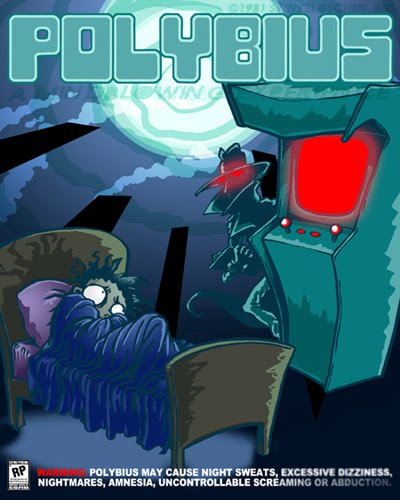
Polybius - the world's spookiest video game


One of my all-time favorite, spookiest urban legends involves a mysterious arcade game whose existence was never substantiated, Polybius. It's a great window into the early days of video games, a horror story that developed around the anxiety people have around a new, unfamiliar technology seen as scary, youth-corrupting and addictive.

It's easy to imagine the Polybius story as a schoolyard telephone game that got bigger and bigger, a pearl that formed around the sand grain of a real life scientific phenomenon that was poorly understood at the time: some people go into epileptic fits when certain lights flash in sequence.

These days we all know about how flashing lights and intense concentration lead to epileptic seizures, but imagine how terrifying it must have been to see something like that happen in the early days of video games. You're at an arcade with a friend and in front of dozens of witnesses he foams at the mouth and collapses to the ground in a fit after constantly playing a video game.

Imagine seeing all this and not understanding why it happened.

Because the game, Polybius, if it existed at all, was put out by a manufacturer that can't be traced and no machines exist, it's very possible there's no basis for it at all. Nonetheless, the fears the game played on were very real, and the story tells us a lot about what people were afraid of at the time.

The usual versions of the urban legend goes something like this: in 1981, seven arcades in rural Portland, Oregon received a mysterious black with green joystick, undecorated arcade game named "Polybius" after the Ancient Greek founder of modern cryptography. The company that produced it was the previously unknown Sinneslöschen Publishing (a German term meaning "sensory-extinguishing").

Introducing a game in limited quantities isn't suspicious in and of itself since it was normal to test market arcade games before a wider release, and because the gaming industry was very new at the time, it wasn't uncommon for unknown publishers to get into the action either. The game itself was innovative by all accounts: most people (supposedly) remember the game being a Tempest-like tunnel-shooter.


According to the urban legend, the trouble started immediately after the game arrived, those that played it suffered from feelings of dread, terrifying nightmares, night sweats, an inability to sleep due to constant screaming, and amnesia or memory loss. Different stories say that many people just stopped playing video games, and one became an anti-video game activist. One teenager first became moody and violent after playing Polybius constantly and even committed suicide.

Many people reported seeing men in black suits around the Polybius machines, not collecting quarters but removing data of some kind. A few reported the screen flashed with subliminal messages - "Obey," or "Work Eight Hours, Play Eight Hours, Sleep Eight Hours."

And mere weeks after it first appeared, Polybius machines were taken away and never heard from again. No arcade collector owns a Polybius machine, and the general consensus is that either Polybius never existed or the evidence is inconclusive about it ever existing.

What was Polybius, if it even existed? What's the truth behind the legends?

One of the more interesting theories is that Polybius might be a confused memory of the vector-graphics tube-shooter Tempest (interesting that the gameplay should be described as a lot like Tempest!), which had to be revamped because it gave vulnerable people seizures.

It is entirely possible that instead of some scheme by an X-Files agency, Polybius was just an ordinary game. According to this interview with a guy that claims to be the designer of Polybius, the game was test-released in Portland, Oregon, and as a result of a boy that got an epileptic seizure from the game, a panicky company, not used to selling something like video games that was a lightning rod for parents' groups, overreacted and pulled the plug on the Polybius's wider release and scrapped all the arcade machines that exist. The "men in black suits" were people from corporate that examined the machines for safety purposes.

Without a single working copy of the game it's difficult to take the story seriously, but nothing in it was all that outrageous or unbelievable: just a game a lot of people took time and effort to create that was the victim of a rumor mill because of a poorly understood real-world medical reaction, the litigation for which made the parent company overreact and yank all the machines out. The story of a kid who got sick from a game was passed around by a local rumor mill and became bigger and bigger, and the removal of the machines was seen as confirmation of all the scary stories.

Everything about this story, from the power the threat of litigation has on cowardly companies, to the tragic way creative people get trampled, to the lack of paranoia or conspiracy...it all has the unpleasant stink of believability. Without proof, it's all hard to believe especially with the way people try to attach themselves to a famous story like that of Polybius, but reading the interview, my bullshit detector never went off once. I sincerely hope Steven Roach's story will put an end to this over the top urban legend once and for all.