Sunday, July 3, 2011

Keep on winning, Charlie!


Mr. Charlie Sheen, I want you to know you have one supporter in the person of a Mr. Julian Perez.

A lot of people have gone about you saying a whole lot of weird and eccentric things about tiger blood, but that's because this nutty Oliver Cromwell puritan country doesn't know panache when they hear it...I mean, "tiger blood?" That's a cool turn of phrase.

As nearly as I can determine, your so-called "crazy" public statements can be reduced to the following bullet points:
  1. Being rich and famous is actually a lot of fun.
  2. It is possible to periodically enjoy, indeed, even overindulge at times, in illegal drugs without being a self-destructive "addict."
  3. Two-and-a-Half Men was actually a badly made, unfunny show.

Well, shoot, Chuck! I'd agree with all of those bullet points, and I can personally vouch for #3 being absolutely and inarguably true.

Your problem is twofold: telling it like it is in a notoriously truth-averse culture, and being utterly unrepentant about it.

If I had any piece of advice to give you, it's this: remain utterly unrepentant. Sure, it's easy to create a second career after a tremendous meltdown by suckering the rubes and pretending to give up drugs and wild women and find Jesus. Protestants have a built-in narrative about the drug addict criminal who goes too far and then needs to be "saved." As Mark Twain once said, "churchgoers love a rapscallion." This is so built into their mental hardware as true, such a soft spot, that they'll accept absolutely ludicrous claims that conform to that, especially James Frey's book where as a rich upper class white kid, he seriously claimed to be a drug kingpin and stone cold criminal.


When I read James Frey, I was amazed not that he was ultimately exposed as a monumental liar, but that anyone was ever gullible enough to believe he was anything else. His lies are not only ridiculous, but pure schmaltzy pap and melodrama. There's one part in Frey's book where he becomes bunkmates with a huge but ulimately goodhearted and illiterate black prisoner. Frey then teaches him how to read, obviously. But then the pair read War and Peace together, and weep at the powerful moments. Now this I have to call shenanigans on, since I can read anything and I've tried on a number of occasions to start War and Peace but I never get more than a few pages in.

This can be you, Charlie: pimping the great Protestant addiction novel. A fate worse than death, if you ask me.


Despite that, an even more glorious fate can await you: that of the living counter-argument to the claim drugs and hard living will kill you eventually. Growing old is inevitable, but growing boring and cowardly is optional. Take Hunter S. Thompson, smart and tough - the one honest man of his generation. The entire craven, cowardly generation of the 1970s, on rewriting their history, tried to shift their experiments with drugs into "addiction." Every so often there were rumors that Thompson OD'd on this or that, but it never happened. Thompson remained unpenitent at great cost to himself, but the ultimate payoff was he didn't end up an aging sell-out.

I don't get why everyone laughs about you claiming you cured your addiction with sheer force of will and the power of your mind. That's the only thing that can truly fix anything about human behavior, including addiction.

In short, Charlie: keep on winning.

Wednesday, June 22, 2011

Video Games, the single greatest subterranean source of pop culture

Try to imagine for just one minute that you didn't watch movies at all.

All your friends would drop weird quotes and references you didn't get. Trends would come and go in popular culture, and you don't know where they come from.

Fractured fairy tales with modern references and winking jokes to parents would be the norm in the book publishing world and you wouldn't understand why (thanks to the popularity of Shrek, among others).


One day, everyone would suddenly be into science fiction and aliens out of nowhere and talk about how "science fiction is back" (thanks to Independence Day).

You'd wonder why, one summer, the big panic, all everybody seems to talk about are asteroids smashing into the earth (thanks to several movies with that topic back in 1990-whenever it was).

In short, you would not be aware of a lot of what's going on around you. You'd be dimly aware there's a subterranean force of great influence but you wouldn't know what it is.

Well, don't imagine any more. That's how I – and a lot of other people - feel about video games.

Until I got a friend that played video games extensively, a lot of things were going on around me that I just didn't understand. The comparison between movies and video games is totally apt because the video game industry reached a tipping point a decade ago where more Americans spent more money on video games than on movies. That statistic shocked me, but all the gamers that heard about it weren't surprised.

For example, it struck me as strange that starting a few years ago, every nerd friend I had started to be a Russophile, admiring Russian culture and the USSR. At first I thought it was because Russians were the last bunch of white people to be really scary and tough, and the USSR was their heyday and high point. And while that speculation may be true, the answer is because a lot of video games were made with Commie and Russian bad guys.


Also, when did zombie apocalypses get so popular, anyway? Suddenly every friend I had started quoting zombie survival manuals. Obviously they were inspired by the anti-consumerist Romero movies and the supercool cult films like Army of Darkness…but those have been around for decades. Why were zombies and end of the world zombie scenarios suddenly the hot property now?

I never understood zombies. They were mindless, dumb and made from boring assholes: former accountants and travel agents. Vampires are also very trendy now, but Vampires I get: Vampire stories are full of cool crumbling castles, fog, and gaslight, Victorian atmosphere. Vampires are aristocratic, sociopathic megalomaniacs with a hefty dose of scary sexuality. The good Vampire baddies have so much personality they totally dominate the stories they're in, compelling and repellant at the same time like good baddies should be.


By contrast, zombies are mindless so they're more a force of nature or inanimate object. The single thing you never want in a story is one where characters are opposed by inanimate objects without personality, like a door lock or a security system, for instance. Conflict is only interesting between people and personalities that want opposing things.

Remember all the sequels to the Mummy back during the Universal days, when the Mummy was basically a mindless, speechless corpse driven like a robot by anyone wearing a certain ring? Wasn't that much less interesting and scary than the original film where Boris Karloff was an evil sorcerer creep who could barely pass for human, but who was driven by lost love?


I don't understand zombies, but I did understand why a zombie apocalypse would be appealing, at least to others. It's for the same reason people love disaster movies. Freud said nobody ever thought about disasters unless they long for them to happen at some level.

It reminds me of the Reagan administration's attitude to nuclear war, Jesus, and the environment. Everyone remembers James Watt, Secretary of the Interior, and how, when asked what his office's strategy was to preserve national parks for future generations, said that as the Rapture and end of the world would come soon there was no need to try to preserve national parks long-term. Thankfully, Reagan's enormous cowardice was greater than his hatred for living things and no war happened, but nonetheless, there is a personality type that looks forward to the end of the world because it means an absolving of adult responsibility.


On the other hand, the very things that bore me about Zombies – the fact they have no personalities and are totally mindless – are the most appealing thing about them to video game designers. One of the greatest problems with video games is how the enemies never act intelligently, never take cover, and just run into gunfire and keep on attacking even when wounded. That may not make sense with human enemies, but with mindless hordes of neverending zombies, it's what makes them scary!

Not just that, but like with movies, if one video game does really well and is a surprise hit, everyone tries to imitate it. So before you know it, there were a billon zombie shooting games and all everybody was talking about were zombies.

As I try not to close an article without a few book reviews, it's interesting to note that the notion of the apocalypse goes before the 20th Century and back into the 19th. The idea that end of the world scenarios were a common theme in the literature of the 19th Century is very surprising to a lot of people, but it just goes to show how nihilistic Western culture actually is.

The Death of the Earth. J.H. Rosny (1910). The Rosny brothers were the single greatest geniuses of science fiction Belgium ever produced, and they dealt with mankind's beginnings (as in Quest for Fire and the Xipehuz) and mankind's end, as with the Death of the Earth, a future billions of years from now without living things where mankind is aware of their end and resigned to it - it's scary to find a world where the entire "fire" has gone out from mankind. In the moving final pages, the untold billions of generations that passed on the earth end with a single pair of eyes that shut closed. One of Rosny's preoccupations (that of evil living minerals) is on display here, just like his greatest inhuman creations, the Xipehuz.


Beyond Thirty. Edgar Rice Burroughs (1915). See how far you can hear this shlocky premise before you crack a smile: World War I so totally destroyed Europe that hundreds of years later it was a totally unknown bombed out no-man's-land that reverted to stone age savagery filled with escaped zoo animals like lions. An American captain becomes the first to explore unknown Europe and saves a hot cave girl, the last queen of England. The idea World War I would have continued forever is laughable enough (as is the idea America would never get involved), but it's almost shocking to imagine the same ERB who wrote the gung-ho beat-back-the-devil Hun-basher Tarzan the Invincible would also write a story that tsk-tsks Europe for going to war and praises isolationism.

The Last Man. Mary Shelley (1826). When Napoleon was defeated, the bad guys won. The attempts to "franchise out" the French revolution and create a Republican united Europe failed, and the reactionary and aristocratic elements of Europe prospered. This was a lost generation of young geniuses like Byron crushed underfoot by snotty, dull and untalented moralists, and it doesn't surprise me the reaction to this novel about the end of the world would be horror by the Mrs. Lovejoy-types that ruled Europe. Basically, the Last Man ended Mary Shelley's career and remained forgotten until it was rediscovered a couple decades ago. Unlike Frankenstein, which was moody and atmospheric from the get-go, it wasn't immediately obvious the Last Man is about an end of the world scenario (my personal favorite failed prediction is the idea that Greece would still be fighting for independence against the Turks in the 21st Century), which made this story all the more shocking when the premise is revealed.


The Last American. J.A. Mitchell (1889). Some Persian explorers discover the lost city of Noo-Yok in America. Amazing to me how the cheesy conventions of the end of the world story are already here at this early stage: we even get a look at the crumbled Statue of Liberty. America and Western civilization is wrecked and mangled. What happened? The answer is something that would never occur to a 21st Century person: a weakening of the immune system that left us vulnerable to punishing winters. I guess the 19th Century was more rural than we thought. Thankfully, this book is short and its prejudices are innocent unlike the ultra-vile racist fascist Jean Respail's "Camp of the Saints," which has neither of those two virtues.

Monday, June 20, 2011

Are you a nerd poseur?


At what point is someone so non-participatory and unknowledgeable in nerd culture that no matter how they describe themselves they cannot be considered to be a true nerd? I mean, what's the threshold, the minimum passing requirement for nerd know-how? At what point does someone stop being a nerd and just becomes a poseur?

A nerd poseur! Until recently the very idea was laughably unthinkable. Who the hell ever heard of that? Until recently, nobody ever intentionally set out to be a nerd, the way people set out to be punk rockers or gangstas. Being a nerd was an accident, something that just happened because you were an outcast and outsider, and fantasy worlds, or math and science, became fixations to mentally escape a world that was unpleasant.

How things have changed! Nerd culture has taken over the world. Even attractive and wealthy people who never got an asthma attack in their lives try to be nerds. And comic book movies are Hollywood's biggest tent-pole genre now, the summer's bread and butter with two or three superhero movies a month. If you told me that would happen eight years ago, I would have burned you as a witch.


Let me describe to you something that happened to me when going to see Green Lantern with four or five supposed nerds.

Of the lot, I was the only one that read or knew anything about Green Lantern comics. Now that in and of itself doesn't mean anything since there are many different kinds of nerds into different things, and anyway, I'm more of a True Believer myself. Alright, no problem.

Then later on, there were promos for remakes of two old-school cult movies: a new Conquest of the Planet of the Apes (which many consider to be the best one of the lot) and Fright Night.

I was the only one that knew either of these were remakes. Now, Green Lantern is one thing but that's the point at which I started to wonder if something was up.

If I could go on a digression here for a minute, I don't see the point of remaking Fright Night, because as enjoyable a movie as the original Fright Night was, it was all the more interesting and original in the context it was released. The year Fright Night came out, slasher movies dominated horror films and it had been over two decades since Hammer made any of their gothic horror films. It's hard to imagine now, but there was a time in pop culture where the classic horror monsters like Vampires were so passé and old fashioned, that a vampire-themed monster horror film was incredibly refreshing and a change of pace.


That's the entire movie: a guy thinks his neighbor is a Vampire and because supernatural-type horror and Vampires are so laughably off the pop culture radar, nobody believes him – not even the pathetic has-been host of an old-timey horror show. It was like the Kingdom Come of gothic horror, with old school guys, wrinkles and all, come back to show the punks how it's done. Don't you get it? In a world of True Blood where Vampires are popular and everywhere, the entire idea behind Fright Night makes no sense.

The worst was yet to come, however. In conversation I brought up Lord of the Rings, and I realized that in a group of five nerds, I was the only one that read the entire series. It reminded me of that Twilight Zone episode where the ending was a guy realizes everyone in a bar is a werewolf but him. My God, even science fiction and Heinlein fans that hate fairies and dragons, who have never thrown dice with more than six sides in their lives…even they have read Lord of the Rings.


I mentioned before there is an absolute bare minimum needed to qualify as a nerd. Would anyone disagree that Lord of the Rings would be on there?

I doubt anything will come of this observation, though. When gangsta rap went mainstream, a lot of people became gangstas who didn't have the credibility to pull it off. In short, their sincerity was in question. The reason nothing like that will ever happen to nerds is nerds, as outcasts ourselves, we understand what it's like to be excluded from things and nerd cultures have an anxiety about ever excluding anybody.

Say you're a nerd and that's enough to be one – whether it's true or not.

Friday, June 3, 2011

Hero System Review Tuesday: "The Ultimate Vehicle"


This book was written by Bob Greenwade (who the hell is that?) and Steve Long. This is both an accusation and assignment of blame.

I saved this one for last because this one is quite possibly the worst book put out for the entire 5th Edition, which is irritating because it's one of the most necessary. It is the only truly unplayable book ever released for 5th Edition, and possibly the worst thing ever put out under the Champions/Hero System title.

The book is full of baffling headscratchers that make it practically unusable. My favorite is how practically every single jet vehicle has an enormous -1¾ limit to represent they have a damaging effect when their movement power is in use (jet planes burn things behind them).

Something having a damaging effect has a limitation on it? It's like a "limitation" one of the deviously sadistic minmaxing "Knights of the Dinner Table" crew would come up with, simultaneously saving points and doing damage. Heck, I have no idea where they coughed up the outrageous -1¾ figure because in the superhero genre book, doing property damage under you when you use your earth-movement powers is a miniscule -¼ if it's a limit at all, and I don't think it is. I've always been of the opinion that if someone else has to pay the cost of something, it's not a limitation. Call it a limitation version of the "tragedy of the commons."

By the way, destroyers and submarines only have a "mere" -¾ limitation for their damage-dealing screws and propellers. While manatee-killing is a very real problem facing our oceans, I somehow doubt your player characters will be inconvenienced at the -¾ level by the occasional contact with "Nature's Speedbumps." By the way, in a perfect example of how limitations in this supplement were assigned by throwing darts at a wall, airplanes with the very serious problem of stall velocity only have that as a -¼ limitation (which affects turn mode, requires constant movement, and can be a disaster in the event of Drains) and requiring a takeoff and landing is a -1.


It's also insane what they choose to give a limitation. I can't literally think of any occasion damaging exhaust is a problem, but I can think of one big limitation on planes: someone smashes or gums up a wing the whole thing goes out of control and flies like a filing cabinet. No Restrainable-esque limitation for that, though! Restrainable is, incidentally, a -½ limit, so stall velocity is a lot more damaging and gives you back a lot less. Good going, Bob Greenwade.

This reminds me of an old aviation joke. The job of a propeller is to keep the pilot cool. Turn it off, and watch him sweat.

It gets worse. The character sheet for the M1A1 Abrams tank has a DEF of 20. Now, stop and think about that. That means that on the balance, a 100 Active Point Energy Blast, or STR 100 character, will not do any damage at all. Hell, even Grond, the Champions Universe's Brand X answer to the ultrastrong Incredible Hulk, has STR 90. Considering the point value for above average, powerful superheroes is 70-90 Active Points in a power, that means a single M1A1 tank can easily shrug off an entire party of higher power player characters. Considering RPG-7 rounds, which do 4d6 Killing damage, can mangle a tank on a straight-shot, this is a little amazing.

To quote Jason Sartin: "saying this book should be burned is an insult to fire."

Oh yeah: elevators, missiles and torpedoes are built as vehicles. What?

Personally, I always thought having to pay points to have headlights and an FM radio was really pushing it, so you can imagine how delighted I was to see that an Anchor (an anchor!) actually is something boats have to pay points for! Really!

You need to charge players to have elevators and anchors? I'm actually surprised the book doesn't make you pay for bathrooms. Things necessary to the normal functioning of a vehicle aren't worth points.

I expect better from published materials than this amateur hour stuff. This book is typical of where new players go insane with the Hero System, and I mean literally insane because it is nothing short of a mental illness: they figure they have to pay points for everything, and I mean everything.

I remember once a player wanted to play a fish themed aquatic hero that tasted bad. You know how there are some fishes that taste bad and predators automatically spit them back out? He went crazy with how to represent something so trivial, including Mind Control with Persistent.

I was like…"For the love of God, Brian…Mind Control? Really? If we really, really, really want to make this something other than a zero-point feature, like red hair, we can buy it is as a low level perk, like the Fuzion did. Sure, it was a bad game and an unworthy heir to Champions, but at least it handled stupid stuff like this pretty well."

One player of mine wondered if he had to pay points for another player character as a Follower or Contact.

Another thought he might have to pay points to be a dark-skinned character because he was then pretty much immune to sunburn.

This is where you can go literally insane with a system like Champions – if you're wondering if being a lightskinned redhead is a disadvantage or advantage or start paying points for boat anchors, you have literally lost perspective and gone totally mad, a full-on mental disorder. The Vehicles guide totally embraces that madness. It's like the Necronomicon for the simultaneously clueless and anal-retentive.

And as if that wasn't bad enough, no other book used the rules in the Vehicle Guide (someone correct me if I'm wrong and the fantasy books did – I didn't read them and really, neither did anybody else). Nobody else gave an insane (-1¾) power break to every single jet vehicle. Nobody else treated elevators and anchors as things you have to pay points for. The Vehicle Guide is isolated from the rest of the entire system in a way that makes me think of the court orders on registered sex offenders.

There's a howler on practically every page. The "flying carpet as a vehicle" idea was, um, interesting, especially for something that is pretty much a textbook example of an OAF at most. Let me know when you can roll up and carry with you your Volkswagen beetle, though.

On that note, the book also broke the 11th Commandment of the Hero System: thou shalt not build suits of power armor as vehicles! I could see powergamers the world over lick their chops hungrily at this ugly, broken, heretofore nonexistent precedent. That's the part that baffles me...despite it being a book on Vehicles, it's a little unclear on what counts as an actual vehicle at all.

I feel a little guilty going after elevators, flying carpets and suits of power armor built as vehicles because though it was a misfire of an idea, and one that might have been responsible for the big change in 6th Edition where it's impossible for a vehicle to have a vehicle, nonetheless it had the guts to think outside the box. It was a misfire, but a spectacular misfire. When you go off the beaten path, sometimes you find new things never seen before. On the other hand, what happened here was this book went so far off the beaten path it got so lost that Jimmy Hoffa couldn't find it.

Another one of my favorite bits was how every modern fighter plane had both electronic countermeasures (bought as a Suppress) and electronic counter-countermeasures, which is bought as a Suppress for Suppress. When I explained this to my game table, there was an awkward moment because my players assumed I was joking and then realized I wasn't. One of the most pursued and pointless chimeras of the Hero System is figuring out the "correct" way to build something, but if everyone you explain how you built something responds with a "wait, seriously?" you're probably not doing it right.

Anyway, as even a casual Tom Clancy war porn reader would tell you, the pace of avionics development is so extreme countermeasures useful in one decade are out of date and nearly useless the next, though the book treats countermeasures as an absolute set number for every vehicle. They mumble something in the back about how this is probably not a good idea, but no guidelines are presented.

There are moments where I seriously wonder if the guy that wrote this ever actually played any tabletop games ever in their lives. The "missile lock is bought as a Detect" gave me that feeling in that it makes characters aware of something incredibly obvious, especially if you're playing on a map, which by the way, 5th Edition Champions assumes you are.

Imagine this at your game table.

GM: (moves enemy planes onto the game map) "Captain Rick, just when you think you're in the clear, your radar screen flashes with the red of hostile MiG fighter planes. You can see them screaming through the air at you and their muzzles flash."
GM: "Roll your Missile Lock Detect."
PLAYER: (rolls dice) "7."
GM: "You get missile lock from the enemy planes."
PLAYER: "…Really? Gee whiz, I never would have guessed, almighty GM. That was 5 points well-spent. Can I roll Combat Piloting or do I need a Detect (Ground) so I don't hit it?"
GM: "Yeah, yuck it up, smartass. They're heading right for you."
PLAYER: "Hey, you know missiles are vehicles now, right? You *DID* put them on the initiative chart…right?"
GM: (grumbles, as he rifles through his papers and places missile tokens on the map)
PLAYER: (watching) "Well, I'm sure glad I rolled that all-important Detect. By the way, I'm using my electronic countermeasures."
GM: "They use their electronic counter-countermeasures."
PLAYER: "I use my electronic counter-countermeasures."
GM: "Alright, I got a 36 on one and a 42 on the second and…damn it, what subtracts from what again?"
PLAYER: "I'm not sure. By the way, I spend my next phase doing a flyby so I hit a MiG with my Killing Attack exhaust."
GM: "Good thing for you no manatees can fly, or that limitation would *really* sting right about now...."

See what I mean when I say this is unplayable?

In conclusion, authors of the Ultimate Vehicle, Bob "Who?" Greenwade and Steven "I should know better" Long, I hate your product more than any other book ever released for any system ever, and that includes that World of Darkness splatbook "Gypsies" that gave a real-world ethnic group superpowers.

By the way, I was just as confused by the name Bob Greenwade (who the hell is that?), until I did a google search and discovered this book is his only published RPG work except for some Haymaker! fanzine articles. On his personal page on Haymaker! he's humbly self described as having a "genius-level IQ," which considering "The Ultimate Vehicle," I *really* doubt. The worse a game designer, the greater and more insane tendency to make extravagant claims about themselves. Remember when the creator of SenZar said he could punch ten times in a second and had a nothing short of superhuman weightlifting bench?

(Note: Pardon the lateness of this review, which didn't come on a Tuesday.)

Monday, May 30, 2011

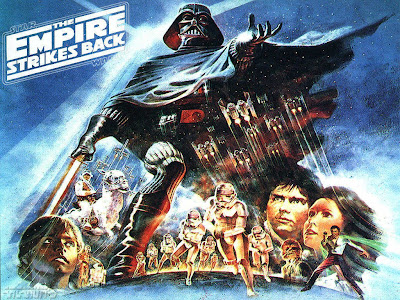
Leigh Brackett's original 1978 "Empire Strikes Back" script


Leigh Brackett's original script for "The Empire Strikes Back" is something I've sought after in a lifetime of being a Star Wars fan. This wasn't just another movie, it was the high point of the entire franchise. What secrets did the script contain?

Recently, I read it and I got a chance to find out. It was not what I was expecting at all.

Who is Leigh Brackett?


Leigh Brackett was all of seventy years old when she wrote the original script for the Star Wars Sequel (the name hadn't even been picked up), and one of the many people from Hollywood's Golden Age who was tapped in the 1970s when blockbuster, mass market pictures came back into vogue, just like "Exorcist" director William Friedkin was a student of Howard Hawks.

Brackett wrote the scripts for arguably the greatest Western and film noirs of all time: Rio Bravo and the Big Sleep.


Brackett is one of those authors, like Hemingway, that's bigger than the stories they wrote. She always "power-dressed," long before that expression came into vogue, loved driving her red sportscar way too fast on California curves. There was a famous story were Leigh played volleyball with the boys in Muscle Beach, California and held her own.

Saying you're a fan of pulp science fiction of the Golden Age is tantamount to admitting you're a fan of Leigh Brackett, just like saying you like Silver Age Marvel Comics means you like Jack Kirby. People forget that the vaguely denigrating term "space opera" started out as praise, a way of separating the wheat from the chaff, a way of telling apart the usual hokey "Adventure" sex-and-shooting romps from the Leigh Brackett-type moody, atmospheric adventure science fiction thrillers.


It was especially shocking to read Leigh Brackett and discover she wrote (anti-) heroes in a voice shockingly similar to Star Wars's scene-stealing, coolest character, Han Solo. One particular antihero character, Rick in "Nemesis from Terra," had a moment so "Han Solo" it was a little chilling, especially when you imagine it was written in 1944.

While on the run in a cave network under Mars with his lady friend, he reached in the darkness and grabbed her.

"Which wrist did I grab?"

"Left."

"We go left. And baby, we'd better hope you're lucky!"

Since the prequels came out, I had another reason to want to read the Leigh Brackett script for "Empire Strikes Back." With the prequels, it was absolutely inarguable that George Lucas had absolute creative control. And those lousy movies were the result? A lot of fans started to wonder if maybe George's role in the success of the original movies was a little overrated. If Star Wars wasn't great because of his contributions, then who else was it? Laurence Kasdan? "Empire Strikes Back" director Irving Kirschner? Producer Gary Kurtz?


It's become a common argument among fans that Leigh Brackett, not George Lucas or screenwriter Laurence Kasdan, was responsible for the strong story of "The Empire Strikes Back." In an interview in Starlog around 1980, George Lucas claimed that it was Leigh Brackett's idea that Darth Vader was Luke Skywalker's father. Ever since Brackett's death in 1978, Lucas has given her a gradually smaller and smaller role in the history of Star Wars; currently Lucasfilm claims that Brackett's script was rejected in its entirety as unsuitable, and George Lucas only kept her name on the script credit as a favor to her widower husband, "Planet Smasher" Ed Hamilton. That's a pretty interesting claim considering that the screen writers' guild rules determines when a writer gets credit!


The Structure

First things first: the basic structure of the Brackett script is ultimately identical to the finished film. The differences are in the details.

All the beats of the final film are there: Luke is captured on an ice planet, the Rebels have to evacuate because of upcoming Imperial attack (although in this script the Rebels can't buy a break and get a double-whammy of Imperial troops and unstoppable, unfriendly ice monsters as well), and there's an escape into asteroids, Han and the Princess fall in love, and Luke goes to train as a Jedi Knight under some mysterious weirdo. All roads lead to Cloud City, where Darth Vader has captured Han and Leia due to Lando selling them out, and ultimately the climax is a lightsaber duel between Luke and Darth Vader where Luke is tempted by evil.


Yoda is there (named "Minch," a froglike old bog planet dweller that trained Obi-Wan), as is the Emperor…here he's his usual self as a hood wearing old sorcerer. Apparently this was the point where the idea the Emperor was a powerless figurehead pawn of a powerful military junta, present in the original Star Wars novelization among other pre "Empire Strikes Back" places, was ditched.

One of my favorite scenes shows something I was always curious about: Darth Vader's castle. Darth Vader has some gargoyle-like pets that he feeds, delighting in their greed and cruelty.


Lando

The most surprising element of the script had to do with Lando, here called Lando Kadar. As opposed to a charming but untrustworthy rake who tried to go legit and became successful, Lando in Leigh Brackett's script is a man who "went native," like Jake Sully in "Avatar," accepted by and becoming a leader of a tribe of primitives who live on the Cloud world and fly aerial manta rays.


A lot of people believe Lando was created for a very cynical reason: a big criticism of the original Star Wars was there weren't any black people in it. But there's not a single word about Lando's race in the script. The description of Lando Kadar is that he was so good looking, like Rudolph Valentino, he seems almost a little unreal.

Originally we hear that Lando Kadar was some kind of refugee from the Clone Wars. That's when the bombshell is dropped: Lando Kadar was a clone, from a planet of clones.


Han Solo, Dialed Back


One of the more disappointing things about the script is that Han Solo in this movie is a seriously subdued, "big brother" figure that seems very bland, without his trademark pride, gambler's arrogance, coolness and desire for independence. Han Solo is strongly on the Rebels' side, and isn't conflicted about it at all. Some of his character defining moments, like running the blockade of Imperial ships, leading them into an asteroid field and so on, are absent. This was one of the biggest surprises because practically every single hero Leigh Brackett ever wrote was basically Han Solo. Obviously I wouldn't expect a first draft to be perfect, and a few more rewrites were needed.

Han got a really interesting piece of business: we learn his estranged stepfather was a wealthy interstellar shipping magnate that might be the most powerful person in the galaxy after the Emperor and Darth Vader, and the Rebels need his help. This mission is set up at the end, where Han leaves in the Falcon. I always thought this was interesting because what little we've heard about Han's stepfather reminds me of the Fu Manchu-esque Prince Xizor in "Shadows of the Empire," who was also a shipping magnate and was also the third most powerful and influential guy in the galaxy.


There is one important character that isn't mentioned at all: Boba Fett, and there was no dark cliffhanger with Han Solo trapped in chocolate. Considering the original version of the Star Wars script had Darth Vader as an evil, quiet and menacing bounty hunter, I'm inclined to think this might have been Lucas's idea.


Luke Skywalker is "Rocky"

It's hard to imagine how a boy pilot who blew up the Death Star could possibly be an underdog again after proving himself in such an amazing way, but the Brackett story knocks Luke down a peg in the beginning to build him up. By the end of the story he's humbled, more aware of his shortcomings, but also more adult and wise.

The story starts with Luke getting his ass kicked by ice monsters, just like in the final film. And it goes downhill from there – he tells Leia he loves her and she rejects him, because of her duties (leaving him to think "she's a princess and I'm a farm boy from Tattooine"). And then, in a very subtle way, she leaves Luke to "help out" (ha, ha) Han Solo…


One of my favorite parts of the original Brackett script was how Luke drew his lightsaber to fight an ice monster and got his ass kicked.

Han Solo then tells Luke that Ben Kenobi was a good guy but he filled Luke's head with nonsense, and even for the Jedi Knights, lightsabers were entirely ceremonial weapons and are not the most practical in real fights. This is really funny to me, because I always found the idea that someone with a sword was invincible against people with guns was just a little unbelievable, and come the prequels, the lightsaber was so overused and overpowered it became boring. To have someone at this early stage flat out say they're romantic and sentimental but not a very practical weapon, well, it rings absolutely true.


Therefore, when Luke starts training on the unnamed bog planet, when the ghost of Ben Kenobi tells him he has potential and greatness, Luke was a little suspicious of him. "I'm nobody," he says.

Leigh Brackett's Star Wars sequel script had an infinitely more complex and intriguing view of the Force than the later films. When Luke asks what the Dark Side of the Force is, Yoda tells them the Dark Side isn't something external, but your own personal Dark Side and worst characteristics, insecurities, wrath, hatred and vices. Giving in to these traits is destroying yourself.


Was Darth Vader Luke Skywalker's Father?

Short answer: no, not in this script.

If Luke being Darth Vader's son was Brackett's idea, it wasn't here. And it isn't just a question of that line not being there. In one scene on the bog planet, Obi-Wan introduces Luke to the ghost of his real dead father. The moment is as earth-shattering for Luke as it is for us.

Amazingly of all, Luke's Father tells him he has a sister, who in the script was given the name "Nellith."


During the final confrontation, hoping to unleash Luke's evil side, Vader taunts him with the knowledge that he killed his father.

"You don't stand a chance against me. …No more than your Father did, anyway."

Vader plays to Luke's vanity as well as his rage and wrath, hoping to get Luke to use the Dark Side so Luke could say he killed the great Darth Vader. In the end Luke gives in to wrath and rage, and as a result, he betrays his Jedi oath, a crushing moment where Luke believes he ought to die.

All in all, Darth Vader's temptation of Luke was much better done in this script because he had something to tempt Luke with.

Tuesday, May 17, 2011

Hero System Review Tuesday: "Conquerors, Killers and Crooks"


Maybe you're one of those that doesn't like the Champions Universe. You'd rather create your own, or say, set the game in your favorite comics world like the Marvel Universe.

I said the same thing myself. Don't worry, you'll set a game in the Champions Universe eventually. You will!

Either you'll realize it's insanely labor intensive to write out six or seven character sheets every single game and you find yourself wishing for support so you don't have to reinvent the wheel every time, or you'll get deep into the game world the more books you buy and realize you're left out of the fun with bad guys like Ankylosaur, Shrinker and Foxbat.

It's literally impossible for anyone that calls themselves a GM to read Champions, Killers and Crooks and not come up with five million ideas for your own group.


That brings me to the single most sterling recommendation for Conquerors, Killers and Crooks: because a roleplaying game is all about player characters, a Champions superhero setting is pretty much defined by who the villains are. Which leads to a very unusual situation in RPGs, where the villain book is the only really "required" sourcebook for an entire setting! If you want to set a game in the Champions Universe, this is the only one you really truly need for that Champions feel – the Champions Universe book itself and the Champions setting book are more or less optional, just for the completist. If you're on a budget, this is the book you need.


I love this book. I can't recommend it enough. It's useful for developing something a GM should have, which is an intuition about what makes someone dangerous and lethal and what makes for a cakewalk fight, something you may not have if you make your own bad guys from the beginning. For that reason it's good to peruse even if you don't intend to use the Champions Universe. One of the single most difficult and unpredictable things about a superhero game is the ability to determine challenge.


In general, this is a book you can "trust." If it says a villain is super-deadly and requires a team to fight, he probably does. A bad guy's DEX and CON ratings usually "feel" right. I've seen some dumb-ass, useless and unusable bad guy character sheets by energetic, prolific amateurs like Sam Bell where nobody's PD or ED was ever above 3 and if a DEX was 20, they must be a Dexmonkey King of the Ninja or something.

Best of all, Conquerors Killers and Crooks seems to be the one place that avoids the magic fetish everyone else writing in this cosmos seems to have. Magic villains are no more or less represented than any other kind of bad guy, like mutants or aliens. Color me surprised to see there was an American Indian character, Warbow, that (shocking for this edition) didn't have Shaman Ancestor Powers! It may be the case that a lot of these baddies were created before Champions was all-magic in the 5th Edition, so they're grandfathered in, in something close to their original forms. I'd hate to imagine what they'd be like if created just for this edition. Danish politician Fiacho would probably get his powers from the EPCOT version of Viking magic like every other asshole.

Come to think of it, the 5th Edition Dr. Destroyer does look a little like Sauron, doesn't he?


Friday, May 13, 2011

The strange case of Elizabeth Brady Cabot Winslow

She's got one of these over-the-top Boston Brahmin names, "Elizabeth Brady Cabot Winslow," which ranks up there with Thurston Howell III, and on her own blog on Friendster, she is self-described as "one of the 50-100 most intelligent people in the world."

Despite all that, she claims a giant conspiracy is against her - one that caused her to be electrocuted at a public telephone, among other things.

She gives a rapid-fire account of all the things she's done in the world: an editor for World Book Encyclopedia, she was a former Vegas showgirl and once stopped an entire sporting event when she entered because she was that gorgeous. She was a super-genius and member of MENSA besides, a polymath in many fields, and was the heir of a family that became the basis for the movie. A member of a rich and politically connected family, she has an alphabetically listed "enemies list." One of them, her cousin Ted Knappen, I was able to find. Just like she said, he was a vice-president of Greyhound Bus.

I have to admit, I was intrigued by this person's story - mostly because she used the term "impecunious" correctly. I can man-up and admit when I don't know something, and I had to get a dictionary and look that one up (it means "poor"). That's not exactly a word that rolls off the tongue of your usual bum.

Ms. Winslow's names and contacts were so specific that I found it unlikely her stories of being connected and from a good family were entirely false.

What I suspect happened to Ms. Elizabeth Winslow is, she was a genius, attractive and successful young woman who, around her mid-forties, was the victim of a very real medical condition: paranoid schizophrenia.

This condition alienated others and left her impoverished. Being poor, she lived in areas where there was a lot of crime and she was often the victim of crimes and robbery. In short, she isn't someone to make fun of, but a victim of mental illness that wrecked her promising life. I feel a great swell of pity for Elizabeth Winslow and I hope she finds the help she deserves.

There was one part of her story that I could check out personally. She claimed to have gone to Coral Gables High School for one year in 1959. I'm not a teacher anymore, but I knew the area and I substitute-taught there once and did observation hours as an undergraduate education student. For those that don't know, Coral Gables High School has the reputation of being a "rich kid" school in a "rich kid" area. Anyone that lives in the Coral Gables neighborhood, a district of Miami that is pretty wealthy, would in fact probably be well-off.

I managed to find two references to an Elizabeth Winslow in the 1959 Coral Gables Yearbook. She was indeed on the swim team, just like she said she was on her website. And it certainly is possible she was a Vegas showgirl.


Eizabeth Winslow is the second from the left on the bottom row.


More research may be needed; a wealthy, attractive and intelligent girl that fell into poverty due to mental problems would make for a good story.

Tuesday, May 10, 2011

Hero System Review Tuesday: "Champions Universe"


Do you like magic?

Well, apparently, so do Steven S. Long and Darren Watts, the people that brought the Champions Universe into the 21st Century.

Magic is (seriously!) responsible for all superpowers, even mutants and accidental origin types (say what?).

Atlantis is full of magic, and so are the Champions Universe's Mole Men equivalent race, who also use magic. The main martial artist NPC uses magic swords (possibly +3 Shocking Burst Vorpal, but let me check the DMG tables again). The other dimensions are filled with magic and the book even points out only mages are suited for interdimensional travel – which is weird because the most famous other dimensions in "real" comics are "alternate universes" and the Negative Zone. Depending on the sourcebook, there are more magic bad guys than any other origin. There's even a city full of magic, Vibora Bay – especially irritating in that it broke the Champions Universe's long-time prohibition against fictional, DC style American cities.

Almost every single hero outside of America gets their magic powers from the region's local magic folktale, representing the EPCOT version of that world culture. If you think this means the continent of Africa is packed with soul brothers with tribal lion-command powers, you'd be right.

Magic, magic, magic. I think Julius Schwartz is getting chafed from all the 360's he's doing in his grave.

This blew my mind. This was where I realized things were out of control. Just in case you think I was exaggerating above.


To summarize: "magic makes mutants and power armor work because of the Nazis."

Say what? By the way, this insane page is contradicted by the fact that later on they talk about how technology is relatively higher in the Champions Universe earth because of superheroic inventors. It's like even the book realizes how Medichlorians-level terrible an idea this is and rejects the idea like a viral infection mere pages later.

By the way, if the idea was to bring Champions in with the meta-setting, it choked there, too. There must have been at least as much magic during their Brand-X Conan or Middle Earth age in the meta-setting, and yet I'm betting there were no mutant powers and powered armor then. Maybe it's because there were no Nazis.

I know comics have wizardry involved from time to time but…how many super-mages are there in "real" superhero comics? I mean, can we do a head count here? Guys, this is disproportionate representation.

I play superhero roleplaying games because I've had about a bellyful of fairy-and-dragon fantasy games. I have great memories of running D&D games for my friends in middle school, but if I never run another D&D game again as long as I live it'd be too soon.


Despite the obvious raging boner the creators have for magic, the book is a pretty useful introductory guide to the Champions Universe, and explains what "Hunted: PSI, 8-" on character sheets actually means. It provides an introduction for newbies, and is a great place to start. I'd recommend it, but if you can get it by borrowing it once from your GM for a weekend so you know who ARGENT is, that'd be the best course of action. A lot of it is filler, naturally: a lot of the world setting is about characters that aren't important. Who the heck was Beowulf or MicroMax? The only character from the Justice Sentinels that stands out to me was Diamond, and that's because he was obviously inspired by the Thing.

One thing this book has going for it, though: that may be the awesomest cover of any roleplaying game product ever. They did George Perez in all the right ways!

Sunday, May 8, 2011

Julian Perez At the Movies: Thor


It's weird to say, but Thor is a smaller personal story than you'd expect. Compared to how "big" Iron Man 2 was, for instance, it had relatively fewer battles and special effects scenes and worked at a smaller scale than one would expect for someone like Mighty Thor. I was surprised at how short and tight the movie was.

The Thor movie is a lot like the first Iron Man in that it is about a guy who changes from the start of the movie to the end because he gets put through the wringer and realizes he made mistakes. Thor starts off as a hero with a lot of flaws: he's a bolsterous guy with a big personality but he likes to fight way too much, which is a problem for a guy who might be King, because a wise king shouldn't look for trouble.

He's proud and easily offended and haughty, and like a lot of proud people he gets revenge for insults a wise person might just ignore. At the end of the movie, Thor shows how he's changed because he actually fights to save some former enemies because he figures over the top retaliation isn't right!


The Science Fiction Elements


One dirty little secret about Mighty Thor that even comic book fans don't get at times is that Mighty Thor was never, ever entirely Tolkien or Gaiman esque mythic fantasy, but was kept off-balance and interesting because it had unusual and incongruous science fiction and a cosmic element to it that felt more science fiction than fantasy. Thor was never "Lord of the Rings," it was something weirder and cooler than that because it had alien invasions, giant unstoppable robots, and science fiction villains like Ego the Living Planet, Zarrko the Tomorrow Man, and the High Evolutionary and his Dr. Moreau beastman city.

It was almost Joseph Campbell mindblowing, with moments like a guy on a horse galloping through space. Jack Kirby always drew shining Asgard less as a giant Viking town than as yet another secret society future city, just like the Inhumans' Attilan.


Though Thor started out as based on Ancient Pagan stories, it was always something altogether different and it says something that the most interesting characters even in Thor's world of Asgard were totally without precedent in folklore: Beta Ray Bill – an alien with the power of Thor, the Enchantress and the Executioner, the Warriors Three, and so on. Even when something was taken from folklore, it was juxstaposed with either modern New York (like that Walt Simonson story where Thor chased the indestructible dragon Fafnir through the subway system and then fought him on the Empire State Building) or outer space (like that one where Thor, the Lady Sif and Beta Ray Bill fought Surtur the Fire-Giant, but he was leading an invasion of an alien planet).


After Stan Lee and Jolly Jack left Might Thor, super-literate English lit major Roy Thomas tried slipping in some classic references to pagan stories, like how Mighty Thor actually had a chariot pulled by goats – a detail most other writers "forgot" about mostly because it looked pretty stupid. The more folkloric a character is in Thor, the more likely they are to be dull in the comics. Balder the Brave, who in Pagan belief was a sort of Jesus-figure who died and came back to life, had no real personality in the comics apart from being a loyal friend.


All that brings me to this movie. They went in exactly the right direction with Thor, which astounded me: I figured they'd "play it safe" and do Thor like "Lord of the Rings" or "Narnia." Here, they made Thor even more science fiction than before: the other dimensions are now planets (apparently the Frost Giants now have their own planet), and the Rainbow Bridge of Bifrost is now a wormhole gadget that looks like the Asgardians borrowed it from Doctor Who.


Loki is described as a "wizard," but that must mean something different to Asgardians than to us because his "magic" is mostly tricks like the hologram gadget from "Total Recall."

In the comics, though Thor often battled science fiction menaces, Thor was unambiguously exactly what he said he was: an immortal deity. Fighting him was more like taking on a force of nature than a person. Here, he's more like a superpowerful alien mistaken for a god by primitive humans.


Make no mistake: the science fiction elements were a theme of Mighty Thor that this movie just made more explicit than usual, a case of a movie "getting it." They pushed that angle front and center in the trailers, which is weird. I think it might have been to say, "I know he's based on paganism, but look! It's really science fiction! So, please, please, please don't skip out on our movie, people from the South!"

The Bad Guys: Loki and the Destroyer


The villain of the movie – Loki - is fascinating because he's so totally different from any other bad guy in superhero movies.

All the major twists and turns of the movie are due to him, which is why, despite the fact he's so great it's hard to talk about him without spoilers. Just when you think you've figured out his motivation, there's another level to his scheme in operation; you don't even really "get" the character until one last line he gives that explains everything.


In the end Loki comes off as strangely tragic because he wasn't evil so much as someone that went wrong somewhere. Loki is sympathetic because his motive is he has something to prove to everyone, despite the fact people accept and like him; he's insecure and sees distrust and hate where there just isn't any.

The costume was great, too: there was one shot that was just a shadow of Loki on a wall; with that curved horn helmet of his, Loki was immediately recognizable just by silhouette.


Loki must be Norwegian for liar, because that's exactly what he does, and everyone believes him. In fact, he's so good at lying and pulling strings, so subtle, that the first scene he manipulates other people it's possible to not even realize he did it. Loki wins fights by sneaking and cheating and playing on other people's emotions. In one scene he looks like he's about to fall to his death and asks his brother Thor to save his life. Surprise! It was a hologram trick that lets Loki stab Thor.

Loki lying can be more crushing and destroying than any proton beam: one of the worst, crushing scenes in the movie was one where Loki goes to Thor and tells him their mother doesn't want Thor to ever come back to Asgard.


The Destroyer was just about perfect in this movie. He was huge and unstoppable and totally silent and intimidating and reminded me of Gort, the robot from "The Day the Earth Stood Still." I saw someone at the premiere with a 7-11 Destroyer cup, which makes perfect sense: opening night of Thor is the only place in the world you can possibly be comfortable drinking out of a plastic robot in public. I totally expect that in the future, statues of the Destroyer will be sold at science fiction conventions next to busts of the Creature from the Black Lagoon.

The Comedy

One thing the trailers probably didn't tell you about Mighty Thor: it's funny. Just as funny as Iron Man, in fact, which is really a relief because if it didn't have a sense of humor it'd be insufferable. Thor bonds with a scientist because the pair of them drink heavily (and competitively!), and the pair come back stumbling drunk. The human characters help Thor become a decent person because he sincerely wants to help Jane Foster, as Thor knows she's right.


I was super-nervous about Kenneth Brannaugh because I thought it might be the Ang Lee "Hulk" all over again: another case of a "highbrow" director who makes a bad movie because he looks down on the material. This didn't happen here at all, and I'm delighted. Still, Brannaugh is a classy guy and he brought a lot of polish: notice that in all of his scenes all the actors are doing something instead of just staring blankly, and because of his direction he made some jokes work that should be unfunny on paper.


Nobody that really appreciates or understands Shakespeare could possibly be a snob. As genius as the guy was, Shakespeare wrote his plays like the better Hollywood blockbusters; there was plenty of stuff for the literate but his target audience was the lowest common denominator so there was always plenty of attention-getting sex, violence and functions comedy (farts and midgets). If Shakespeare lived today he'd be perfectly at home doing surprisingly high-quality stuff in the studio system.

The Casting


Kenneth Brannaugh is a color-blind casting guy; in "As You Like It" he made Keanu Reeves and Denzel Washington brothers.

A lot of people wondered about the Asian Hogun the Grim, which bugs me because that critique is actually downright comics-illiterate; even in the comics he was not from Asgard but was a bitter outcast from a country to the South, a sort of Mongol type pan-Asian place with genies and flying carpets. Hogun was the first of the Warriors Three to get a solo story because he was so popular: he had a lot of cool mystique as a quiet, antisocial guy who thought his life was cheap.

If I have a critique of that movie it's that the minor characters went underdeveloped. Surely some cute character bit, even if it was one line, could have been given to Volstagg (who seemed curiously thin in this movie), Fandral the Dashing was just there, as was someone as cool as Hogun.


Idris Elba did just fine. He got the best costume in the entire movie, bronze-gold space armor that looks like something Darth Vader would wear if he was a good guy. He has a great growly voice and accent, and together with oddball hazel-gold contacts, he let his voice and the costume do all the work. He doesn't look Asgardian but he sounds like it. I guess if you want an explanation for his un-Asgardian looks, Heimdall might have been a "naturalized citizen" to Asgard, originally from someplace else, like Hogun the Grim.