Tuesday, September 30, 2008
Sound the shofar! L'shana Tova!

Wednesday, September 24, 2008
My She-Roes: Good Female Science Fiction Writers


What's even more interesting was how seriously Brackett took the writing of atmosphere, something none of her contemporaries ever did: unlike Burroughs, her Mars was a shadow-filled world much like Robert E. Howard.
What do you call a science fiction writer that doesn't like technology, that thinks the industrial revolution was "a big mistake?" 
DAINA CHAVIANO
I suppose I have to give a shout-out to my hometown girl, Daina Chaviano, don't I? A Miami-native, and the only other Miami science fiction writers I can think of, off the top of my head are the late Hugh B. Cave and...didn't L. Sprague de Camp live out his last few days in Palm Beach, if I remember right? A few friends of mine were THIS close a while back to stalking Encyclopedia Brown creator Arnold J. Sobol, but that's a story for another time.
Unlike Leigh Brackett, who died before I was born, and known J.D. Salinger-esque recluses like Cuban-born, Daina Chaviano wrote several Spanish-language books, that derive from Cuban folklore and myth. A lot of the books that inspire her, I grew up reading. My Dad had a copy of UNA BATALLA CUBANA CONTRA LOS DIABLOS (A Cuban Battle Against the Demons) on his shelf for years, and it spooked the heck out of me. Asimov was fascinated by Communist science fiction, which discouraged exploration into different types of societies out of the sentiment they were creating a new one, like good 19th Century Americans.
Because her work hasn't been translated into English, here in the States, she's mostly read by science fiction fans of Cuban descent in Miami that speak Spanish, which is a niche of a niche.
This is something I've been arguing all along: Spanish language television needs to take advantage of the resource that is the emerging science fiction writing markets. Spanish language TV, if it's at all possible, is even more thickheaded and resistant to change than North American TV: the same damn telenovela over and over. There needs to a be a science fiction anthology series on Spanish speaking TV.
Part of the reason the 1960s produced so many science fiction series of quality (STAR TREKM THE OUTER LIMITS, etc.) was because of the emergence of a real talent base from science fiction that were willing to write for television, that could produce science fiction of quality: Theodore Sturgeon, Harlan Ellison, and so on.
A similar phenomenon could be happening right now in the Spanish speaking world.
Friday, September 19, 2008
Critics: what are they good for?
I have no idea whether this article is a parody or not.
As the writer of the article is a critic herself, it’s very tempting to look at her piece as a kind of satire that she’s writing from the point of view of an adopted persona: she’s not so much making fun of critics, as she is lampooning the whole internet-generation mentality, where the collective long-term memory has less than three months, the dominance of fanboys wowed by explosions, monsters and superheroes, raging anti-intellectualism, the importance of the blogosphere over traditional media, and last but not least, an overpowering sense of illiteracy and impatience. The over-the-top use of her language, liberally sprinkled with “totally” and “superawesome” while at the same time knowing who Fritz Lang and James Agee are, leads me to believe this is a joke.
I can just imagine the author cracking up at the idea there are some people out there that find themselves agreeing with the article.
On the other hand, there is a possibility all this isn't just fun and games. First, the obviously sincere envy and distaste for film critics, a print medium job that she correctly point out isn’t as relevant as it used to be in the age of blogs.
You get to see movies for free. You get paid to watch movies. You work part-time and get a full-time salary. You enjoy a private screening of "The Dark Knight" weeks before my buds and I queue up to pay big bucks at the multiplex. And then some of you have the nerve to badmouth Batman and the Joker! Show some love for the folks who keep you in lattes and DVDs.
Another interesting point that the article brings up: what exactly is the function of the critic?
I’m regularly known for having contradictory opinions. In fact, I’ve always thought that to agree with a large number of people on anything is a weakness. However, I’m just some random asshole on the internet beholden to no one but myself. I get paid nothing, I am not in a newspaper with an official position where I have to represent the moviegoing public.
As the article itself argues, “What we crave is consensus, write-ups that mirror the majority, the movie tastes of the teens and proles who rule the box office.” And also, “Shouldn't it be in the job description that if a critic sees a movie with 300 wildly applauding folks, it's against the rules to write as if that doesn't count? Like one fan wrote to a nit-picking critic: "If you do not like 'The Dark Knight' ... you should be fired because you do not speak for the people."
In other words, the film critic can be seen as having a position that isn't just giving their opinion, but is service-oriented. This is why we have film reviews in the entertainment section: to help people make decisions over where to go on a Friday night. If the film critic doesn't sync with the mentality of moviegoers, their ability to function should be questioned.
What the article seems to argue is that there is a disconnect between professional film critics and moviegoers, who are usually of an older generation, went to film school, and approach films from a different perspective. The article brings up the case of wildly popular comic book movies that critics don’t seem to "get." If that’s the case, how relevant is the function of the film critic, consulted not for their personal opinion, but for a recommendation as to the enjoyability of a movie? And if there is this disconnect, how important does the film critic become in the age of the blogosphere?
And this is something that is worth thinking about even if you don’t share the author’s anti-literacy and obvious anti-intellectual anxieties.
On the other hand, the average person is a moron. At some level, the function of the art, movie and food critic is to tell the average person they’re morons.
When the entire world was caught up in the mass hysteria that was TITANIC, the film critic of the L.A. Times had the stones to stand up and say the Emperor had no clothes. (If only someone had the guts to do the same to the schmaltzy, emotionally manipulative, dishonest FORREST GUMP as well!).
Here in Miami, there are two awards given for restaurants by the Miami Herald: one is given by reader poll, the other by professional food critics. A couple years ago, the award for “Best Japanese Restaurant” was given to, of all the places in this city, Benihana’s. Yes, Benihana's, the Applebee's of Japanese steakhouses. In an eighties ROLLING STONE magazine, there was a reader poll award given for the best guitarist in rock history, and the mental defectives chose the guitarist from the Bay City Rollers.
To answer the question at the beginning, the reason Judaism has kosher laws is a recognition of our humanity, that as human beings we don’t just shove anything in our mouths like an animal would.
And that, friends, is why we need movie critics. Because there is beauty and ugliness in the world, and it takes education and knowledge to discern one from the other. Food critics don’t just love every piece of teriyaki they shove into their mouths like the proles do, and critics know the difference between “Transformers” and “Dark Knight.”
Sunday, August 31, 2008
My Dad is my hero

Dad, together with the ACLU, struck down an state travel law that prevented academics from visiting Cuba for research purposes, either with private or public money. The law was an unforgivable act of Miami intransigence, and a violation of academic freedom.
Read all about it here.
I've never been prouder of Dad. There are some things that transcend politics and the political realm, that supercede the limited boundaries of politics, for which the intrusion of politics into that realm is unwarranted: learning, academic exchange, and science are chief among them.
I was a hell of a kid to raise, a pure demon, heavy-metal music lover, and a borderline pyromaniac...but I have always been proud of my parents, and they have both given me the guidance I need to be a good and moral citizen, American, and adult. I couldn't be prouder of them.
Papa had some good old Perez-style tough talk for the supporters of the bill:
''Increasingly what has happened is that this has become an agenda for some state legislators from the Miami area who want to stake their political careers on appearing to be tough on Cuba from Tallahassee,'' Perez said. ``This was an insult by David Rivera.''
I will admit, it was fun to watch a worm like Rivera squirm. It was a blow against those that believe that the solution to political problems is to keep others isolated and ignorant.

''I think this law was a slap to Cubans in South Florida,'' Breslin said.
Ha. Bwahahahahahahaha. Hahahahahaha. Oh. My. Let me catch my breath. Muhuhuhahahaha!
Friday, August 22, 2008
Henry Cejudo Wins the Gold!

Wednesday, August 13, 2008
Georgia vs. Russia
First, South Ossetia is right at the mouth of the Black Sea and is generally considered to be the site of the end of Jason's quest for the Golden Fleece. Also, the Ossetians are descended from the Alanii, cavalry barbarians that were frequently employed by the Roman Empire. The Alanii loved to make use of tactics like defeating horses with huge dogs not unlike modern great danes. But more significantly, an Alanii cavalry force was dispatched to Britain led by a fellow named Artorius, who may or may not have been the inspiration for King Arthur. I should go into my theories about the origin of Arthurian legend in the future, but it would suffice here to say I'm not as convinced of the Artorius origin as Hollywood is.
The conflict is shaping up to be a bloody mess. First, it has to be remembered there are THREE actors here: Russia (obviously), Georgia, and the Ossetians. The Ossetians are an independent tribe with a long history that want independence from Georgia, and they've cozied up to Russia, who have never liked the Georgians ever since they rerouted an oil pipeline to the West to compete with the Russians. Also, Russian politicians love to scapegoat Georgians and Georgian immigrants the same way American politicians love to pander to Mexiphobic sentiment. Georgia on the other hand, won't stand for a loss of its territory, and politically giving the finger to the Russians plays well with the voters.
In essence, both sides in the war have decided to be assholes, and it looks like this is shaping up to go the distance. Like the Lebanon conflict, this is a war where everyone sees the advantage in continuing, and it would be political suicide at the polls for Russian and Georgian politicians if they back down. The big fear here is, naturally, genocide: if the Ossetians are creating a problem, a solution, for the Georgian side, is just to wipe them out. In fact, the recent U.N. Security Council meeting used the most hilarious euphemism yet for genocide when they expressed "concern for future demographic shifts in the region."
Friday, August 1, 2008
Eberron Forever!
This week I'm beginning a new sword n' sorcery game with my college buddies, so watch out for updates and even pictures here. You know, it's funny how times change. When I was an awkward overachiever in High School, I hung out with my fellow acne-covered members of the Mathematics Honors Society (mostly Asian, of course) and spent my Friday nights playing AD&D, telling calculus jokes, and ordering out for pizza, and dreaming what it would be like to smell a girl's hair. Things are totally different these days, naturally. For one thing, we no longer have acne. My game setting of choice is, naturally, Eberron. I've loved EBERRON since it came out in 2004 and became the dominant D&D game setting, and I'm not alone: a recent poll showed it to be the most popular of all third edition products. The tale of how Eberron came about is nothing short of gaming legend, the story of a wannabe that got to be. Wizards of the Coast, owners of D&D, created a contest: they were looking for someone to design a setting that would be the new centerpiece for D&D. Over 10,000 one-page proposals for a setting were sent in from all over the world.
game master, I sent in a one page proposal of my homebrewed D&D third edition setting that I was running a game in at the time, a mostly underwater world of archiapelagos and sunken civilizations called UNDERSEA KINGDOMS, which combined dark horror with an underwater setting, sort of "Conan the Barbarian in Atlantis." My proposal didn't make the cut...which is a shame, because I think my game was a lot of fun and the gang loved it. It would take Kurt Busiek to realize the potential of setting horror Sword and Sorcery underwater with his series AQUAMAN: SWORD OF ATLANTIS. 
I bear no ill will against Keith Baker, because Eberron is nothing short of a spectacular and unique achievement very different from the cookie-cutter Tolkien worlds standard for D&D. It was, instead, a very pulpy, Indiana Jones style world of ancient secrets that had elements of dark Middle Ages detective stories (think IN THE NAME OF THE ROSE), and unusual twists on the very stale traditional D&D elements. For instance, Hobbits are a race of Dinosaur-riding barbarians. This is the only setting I'd ever consider playing the lamest of all Tolkienoid races, Elves. There are two Elven countries: one an aggressive group of Mongol-style horseclans, the other an Ancient island civilization that worships their dead ancestors, who incidentally live as wise zombies in Necropolis, and who often tattoo their entire face with skull tattoos. 

don't exist, an ugly memory of a bad conflict. The war was the Warforged's entire reason for existing, and now they have to choose their own purpose. Some of them work 24/7 at mindless jobs so they don't have to consider questions of this kind. There are labor tensions with Warforged as well: they're strong and never get tired or ask for breaks, so naturally employers are keen to exploit them and workers are keen to resent them, sometimes justifiably and sometimes not.
Then there's the idea of Dragonshards. Dragonshards are unique magical gems that make magic possible. Wizards place their spells in Dragonshards over spellbooks, usually. This is an example of what settings should do: introduce distinctive world specific magical treasure. In fact, to bring home the fact this isn't your garden variety D&D world, I've often given out nothing but Dragonshards as treasure awards the first few adventures.

Finally, I think I should end this article by talking a bit about the future of Eberron now that D&D has entered into a fourth edition. A lot of the FIU gamers have already dropped to their knees to suck off D&D 4th. From what I've read of D&D 4th, it's a mixed bag that I'll probably eventually get used to, just like I did when 3rd came out. In fact, the fact there is no Eberron for 4th is part of the reason I'm slow to adopt it.
All I have to say is, thank God there are no longer any Grapple checks. I really hate those moments when someone wants to do something and everybody at the dinner table whips their books out simultaneously to look it up. It's a little thing, but I like that there are no longer any racial ability penalties. Even in 3rd, that was an anachronistic throwback to the old days of game design when you could never have an advantage unless you were slightly annoyed by something.
Monday, July 21, 2008
Edgar Rice Burroughs' John Carter of Mars

Mostly I'm a fan of Edgar Rice Burroughs's Tarzan novels, who is not for nothing one of the most romantic and exciting characters in all of adventure fiction. But, though it's not common knowledge today, Burroughs was also the "Grandfather" of modern science fiction, telling swashbuckling boys' adventure tales.
There's one easy way to determine if you'll be a big fan of Edgar Rice Burroughs' John Carter of Mars stories. Ask yourself this question: am I a fourteen year old boy?
If the answer is no, then sadly, the moment has passed.
Part of the reason Tarzan is so readable is because of the incredible personage of Tarzan himself and his supporting cast. John Carter isn't quite as interesting as Tarzan is, and so his stories consequently suffer from this. A confederate soldier transported to a dry, dying planet Mars filled with monsters, four-armed barbarians that hatch from eggs, "radium" guns, and swordfights, John Carter eventually seeks and wins the hand of a Martian Princess.
Beats me why John Carter would shlep from one end of Mars to the other to save her. Dejah Thoris was never terribly interesting, and in the great tradition of ERB females, is something of a bimbo whose specialty is behaving wildly out of character in such a way that it creates problems for the hero.
Personally, I always preferred Thuvia, Maid of Mars - who except for La in RETURN OF TARZAN, is arguably the only interesting female character Burroughs ever created. In GODS OF MARS, Thuvia is a woman that has a natural Tarzan-like command of Banths, or Martian Lions. There's some wonderful beast-humor there where she slaps a giant banth on the nose, and the creature lowers its nose and whines penitently like a puppy hit on the nose with a rolled up newspaper! Thuvia is a naturally self-sacrificing sort, and a woman of action - she eagerly leaps off her mount at one point to delay enemies and ensure her friends escape. The final cliffhanger of GODS OF MARS has Dejah Thoris, the insanely jealous Phaidor who wants John Carter for herself, and Thuvia trapped in a hidden chamber that would not open for a full Martian year. Slowly, the door creaks to a close, and John Carter see Phaidor dive at Dejah with the knife, only to have Thuvia jump in its path. Then the door shuts completely.
What an ending, huh? Well, enjoy it while it lasts: Thuvia vanishes entirely in the next book, and by the time she gets her own book, THUVIA, MAID OF MARS, Thuvia is depressingly reduced to the usual role of female hostage in need of rescue. There was one particularly irritating scene in MAID OF MARS where Thuvia allowed herself to be captured.
Edgar Rice Burroughs had a habit of creating fascinating side characters that never get the spotlight treatment they deserve, and Thuvia is hardly even the worst example. How about the strong, handsome native warrior Mugambi, who in TARZAN AND THE JEWELS OF OPAR was quite willing to protect Jane with his life when Tarzan was away, and pursued her kidnappers? He was described as "a fellow of great physique and intellect." And going back to Mars for a minute, what about Tars Tarkas, John Carter's green Martian friend, the only one of his friend to know feelings of love? Or Xodar, John Carter's friend in the Black Pirates of Omean, a great swimmer besides?
I used to eat and drink Burroughs, although since discovering Leigh Brackett and her version of gutsy sword and planet tales, it's been hard to look back at Burroughs. Brackett's men were wonderfully tough, part private dick, part cowboy, part gangster, the scruffy Han Solo character archetype decades early. And she could be creepy and atmospheric, something Burroughs, too much a romantic, never let himself be. Sure, Leigh Brackett was inspired by Burroughs just like a whole generation was...but just have a look at NEMESIS FROM TERRA to see a student that is greater than the teacher.
Roger Zelazny's Greatest Hits: "Nine Princes in Amber"
I'm very surprised that I enjoyed Zelazny's NINE PRINCES IN AMBER, Zelazny's take on the mythology of the Tarot, as much as I did. I generally dislike the traditional kind of "fairies and dragons" fantasy, opting for the more innovative and weird kind like Tanith Lee and Moorcock's. There is still a soft spot in my heart for Andre Norton's WITCH WORLD.One advantage I had was, I read NINE PRINCES IN AMBER "cold," without any prior knowledge of the series, so the mysteries in the beginning part of the book really were captivating. Corwin wakes up in a hospital bed after a car crash without his memory, where the nurses are determined to keep him drugged. Corwin has no memory of who or what kept him prisoner, and he discovers that he is kept prisoner on our Earth by members of his own family, all of whom have been struggling for power since their father died.
The greatest prize is Amber, located at the center of the universe and the very model and archetype of the perfect city. Everything else in the multiverse, every other city, every other earth (even our own) is a mere shadow reflection of the true Amber. This is why Corwin and his relatives fight over Amber. Sure, they could just as easily find in the cosmos another Amber where they are rulers, but only Amber, the perfect city, is "real." Each and every one of them have a distinct appearance, fit to be placed on playing cards: Corwin's colors are black and silver, for instance.
whose greatest advantage is his mind, from a family, a race that is expected to consider other races in the multiverse as disposable cannon fodder, so haughty that even insulting a Prince of Amber means the offender can be killed on the spot. Yet, at the same time, because of his time on our Shadow-Earth, Corwin is "softened," and fights between his natural instincts and his embryonic conscience. In the world of Amber, evil can only be opposed by a better class of evil, and Corwin remarks in THE GUNS OF AVALON that if the day ever comes when evil itself ceases to exist, Corwin too, would be dragged into oblivion.
Friday, July 11, 2008
Mythologies of the World Part 1: Finnish Myth

For my first part in a series about the myths and folklore of the world (which I'd love to eventually include something on Basque myth, the Arabian Nights, Christian Europe, and Greece), I'd like to tackle the fascinating traditions of Finland.
Often, I'm asked how Finn myth is different from their neighbors, the Scandinavians and Slavs.
First, the main hero of Finnish mythology is Väinämöinen, a rascally, horny old man, one part culture hero, another part hobo, who challenges other musicians to musical fights not unlike modern-day rap battles. He's doomed to never find love: one of his most tragic stories is his pursuit of a younger woman, Aino (still a common female name in Finland today) who drowns himself rather than marry a man so much older than she is.

Väinämöinen invented the Kantele, a type of magical harp not unlike the cwyth of Wales, from the jawbone of the giant monster Pike of the North Sea. Väinämöinen also rides a flying wooden sawhorse, reminiscent of the witch's broomstick.

There's a type of picaresque humor about Finnish myth that makes it wonderful to read. Lemminkäinen, a hotshot young hero, lives with his Mother, and what's more, Mom has to rescue him on occasion and return him to life! (How many Scandinavian heroes lived with their Mother, I ask?) One of my favorite passages from the Kalevala was where Louhi, the evil crone that rules the Northland, turns a giant house-sized bear against her foes. Naturally Väinämöinen goes out to slay the monster. Instead, he has a change of heart:
"Otso, thou my well beloved,
Honey-eater of the woodlands,
Let not anger swell thy bosom;
I have not the force to slay thee,
Willingly thy life thou givest
As a sacrifice to Northland.
Thou hast from the tree descended,
Glided from the aspen branches,
Slippery the trunks in autumn,
In the fog-days, smooth the branches.
Golden friend of fen and forest,
In thy fur-robes rich and beauteous,
Pride of woodlands, famous Light-foot,
Leave thy cold and cheerless dwelling,
Leave thy home within the alders,
Leave thy couch among the willows,
Hasten in thy purple stockings,
Hasten from thy walks restricted,
Come among the haunts of heroes,
Join thy friends in Kalevala.
We shall never treat thee evil,
Thou shalt dwell in peace and plenty,
Thou shalt feed on milk and honey,
Honey is the food of strangers.
Haste away from this thy covert,
From the couch of the unworthy,
To a couch beneath the rafters
Of Vainola's ancient dwellings."
- Kalevala, Rune XLVI
In other words, as soon as Väinämöinen gets a look at the monster bear, he says, "nah, I can't kill him, he's too cool" and instead decides to take him with him back to the land of Kalevala for some drinking and picking up girls. Now, obviously this is not exactly how St. George or Siegfried would have solved the problem! The last time I saw this sort of sly humanity in a monster was in Beowulf, where the dragon, indecisive and nervous about his lost treasure cup, paced back to his hoard and looked for it to see if it was not misplaced.
This sort of picaresque levity that almost parodies the epic myth is one point of difference between the myths of the Finns and their neighbors. It's hard to imagine an Icelandic Rune with a hero makes a monster his drinking buddy. And the Slavs? Forget about it. Slavic mythology, with gods named Graak and Kog, is so dark that it makes Norse Myth look like Rainbow Brite.
There's only one occasion where the Kalevala gets extremely dark, and that's in the story of Kullervo. What's fascinating about Kullervo is, it's one of the few mythological stories that actually depicts the realistic effects of child abuse, and the very broken people it creates, trapped in cycles of self-destruction. In the end, Kullervo dies by his own hand when, after accidentally marrying his own sister, he mournfully wonders if he ever should have lived at all. Jean Sibelius, Finland's best composer, immortalized this moment in his opera, Kullervo:
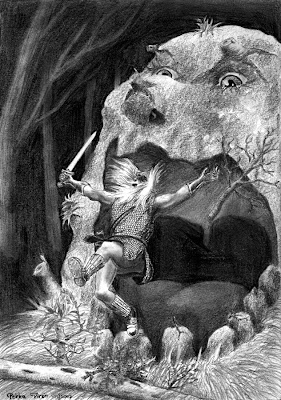
Another defining characteristic of Finn Myth, apart from the levity, is its emphasis on a very wild perspective similar to shamanism. Everything has a spirit, and everything can talk: there's a very famous part where iron itself speaks, which is vaguely reminiscent of certain Javanese myths where the metalworker's position has a mystical component. One of the more explicitly shamanistic images is when Väinämöinen descends into the open mouth of Antero Vipunen, a monstrous giant in the shape of a mountain.

Another characteristic of Finn myth is the sense of magic and the supernatural. This can only really be driven home by its contrast against something like the sheer realism of Homer's Illiad. Just about every hero in the Kalevala is a sorcerer of some kind. One of the most striking images in the entire epic is the Theft of the Sampo, where while escaping from the evil kingdom of Pohjola, Väinämöinen causes his ship to grow a face and sprout wings like a bird with his magical songs. Not to be outdone, Louhi transforms into a giant monster bird and attacks the flying ship with men on her back! This scene is understandably almost always in some form represented on the illustrations or painted covers.

Finally, the myths of Finland, though dating back to the early iron age, were only written down and organized in the 19th Century as a part of the Romantic awakening of the smaller nations of Europe. Try to imagine if French was the official language of England for 700 years, and the first poet to write in English was Byron. So important to the spirit of Finn nationalism, that in Finland, a national holiday is "Kalevala Day." When Jean Sibelius composed his symphonies in the early 20th Century in Helsinki, they were based on Kalevala themes, and his Finlandia is to Finland what the music of John Phillips Sousa is to the United States.
The canon of Finn myth was collected and compiled by the poet and nationalist Elias Lonrot, in a single work, the Kalevala. What's interesting about this is, because of the late date, Finn myth has the most explicitly Christian elements. The chief god of Finland, the sky-father Jumala, a cross between Odin and Thor who wields a hammer, is much more like the Christian god, remote and never active in His creation. Finally, in the last Rune, Maryätta (Mary) arrives in Finland and has a virgin birth.

The overall story of the Kalevala is rather like a Finnish Illiad, based on the conflict between Kalevala, land of heroes, and Pohjola, land of evil and ice magic ruled by an evil old witch. It's often been argued that Kalevala represents the Finns, whereas Pohjola represents the Lapps...which is a theory that sounds pretty unlikely to me. When in history were the Lapps powerful enough to demand tribute?
In any case, the conflict heats up when the Daedalus-like artificer-smith Ilmarinen forges an object of otherworldly wonder, the Sampo. Like the Holy Grail, the Sampo's exact nature is vague, but it generally is supposed to be a grain cover that changes anything worthless, mulch or dirt, to gold, gems and salt. Naturally the heroes of Kalevala mount an expedition to get it back. When Louhi sees the Sampo was stolen, she sends a three-headed monster that shoots plagues, a giant bear, and finally, even steals the sun. The heroes find a way to get around this, of course: the smith Ilmarinen builds in his workshop a new sun!

Connections to Other World Mythologies

The single most obvious connection is to the Estonians, who have a tradition that is very similar. The Kalevipoëig of Estonia was composed as a direct answer to the worldwide success of the Kalevala. In fact, one intriguing theory makes a linguistic connection between Talinn (the capital of Estonia) and Kalevala. Theories about Kalevala's "real" location are a dime a dozen, as common as grail myths in most of Europe. One town in Finland even renamed itself Kalevala for the purposes of tourist-grabbing!
Estonia was only converted to Christianity in the great Baltic Crusade of the 13th Century, which fit the pattern of the European Crusades: convert the heathens, but preferably the heathens that are not too far away. The conversion was undertaken by the Teutonic Knights, best known in modern times as the villains of Sergei Eisenstein's cinema classic, ALEXANDER NEVSKY, and it was done with the usual lack of style that made the child-sacrificing moustache-twirling antics of ALEXANDER NEVSKY look almost realistic.
Estonian myth even features the same protagonists as Finnish myth, just like the Romans shared the myths of the Greeks. Väinämöinen, for example, is worshipped in pre-Christian Estonia as a god of music.
There are a few connections to the Scandinavians as well. The Vannatar, or Air Maidens, are females able to fly who have great similarities to Valkyries. I've even heard an intriguing argument that there may even be a connection to Väinämöinen in Beowulf!
Where can I read more?
The absolute best translation of the Kalevala was in 1996 by Keith Bosley.
A version of the Kalevala translated in the 19th Century into English is available here, at sacred-texts.com.
Monday, July 7, 2008
Alternate Superman Outfits
The cutest thing I've seen
Friday, June 27, 2008
Thursday, June 26, 2008
My ride in the Weinermobile
In January, when I get my teacher's certification, I'm leaving either to accept a teaching position with either the Peace Corps, or a "roadless" school district in rural Alaska (depending on who responds to my resume).You'd think that fulfilling one lifelong dream (teaching abroad) would be enough.
Oh, no!
This year, I got to actually ride in the Oscar Meyer Weinermobile!
A dream since I was six years old. The current spokesperson for Oscar-Mayer is Magaly Estrella, a good friend of mine and an FIU student, so the Weinermobile was at the FIU parking lot.
For those that have never been in the Weinermobile, it was incredible. The whole inside had that new car smell. The interior was brilliant red and yellow, like a box of french fries, with rich airplane-style leather seats. You're even higher up than on most Grayhound buses; the windows are huge and panoramic, like a fighter plane. Even the glove compartments are sculpted to look like hot dog buns!
Wednesday, June 25, 2008
Seven of Nine is responsible for Obama!

Saturday, June 14, 2008
Englehart's Doctor Strange and the British New Wave

One of the best characteristics of good adventure comics and good comics writers, the most literate and intelligent (Englehart, Gerber, et. al.) is their ability to use their comics to have a discussion, to interact with the forces around them. If the nation is in malaise from Watergate, the comics should reflect that. If Christian fundamentalism has become a frighteningly powerful force in our culture, the comics should show that, too.
One of Stan Lee's greatest realizations was how Marvel Comics reacted to the antiestablishment, antiheroic strains of Modernism, just as much as Arthur Penn and Frances Coppola would take Truffeaut and Goddard, and from inside the studio system, start the American New Hollywood Cinema.
This characteristic, of responding to the greater world, is (mostly) lost now because of how comics writers have come to look at superhero and adventure books as being nostalgia-oriented. They view it as inherently for children (instead of for older children, intelligent children, teens, adults, and intelligent adults) and as a consequence write books with a lot less sophistication and credit to the reader. These writers also view comics as unable to have a dialogue with the bigger world, so they write comics about comics. I'm talking about writers like Mark Waid, Grant Morrison, Jeph Loeb, and (at least post-1990) Alan Moore.
All this may sound a little weird when we're talking about fun, escapist adventure books. I'm not so sure, though. One of the interesting paradoxes about escapism is, the best kinds of escapism are based on experiencing emotions that we wouldn't ordinarily like to feel, but we enjoy in a story.

For instance, take Ben Grimm. He's an ugly monster, alone and alienated from the human race by his grotesque appearance, a character capable of great self-pity and who depends on his strength because he feels he doesn't have anything else to offer anyone.
Obviously, this isn't escapism in that, for instance, people want to BE Tarzan, because of his freedom, physical prowess, and exciting life. But it still is escapism! The defining characteristics of that most escapist of all literature, romance novels, is that at the end one of the lovers dies of cancer.
The greatest adventure comics writer of all time, Steve Englehart, realized how important it was for his work to interact with the world around him. Englehart's CAPTAIN AMERICA AND THE FALCON was about the malaise of the Nixon years, conspiracies involving corporations that usurp American democracy, and the ruthlessness of energy/oil companies.

At the same time, Englehart's DOCTOR STRANGE was the first time that the good Doctor was influenced by the counterculture-spirited, British New Wave of science fiction and fantasy writers, personified in the magazine NEW WORLDS and represented by writers like Norman Spinrad and Michael Moorcock, and had an influence on writers like Roger Zelazny and Frank Herbert. Briefly put, the spirit of the British New Wave was the following:
1) The importance of Jungian symbolism, and the reality and significance of symbol becoming personified or real. This was the first science fiction for which psychology was important. This is also the first science fiction for whichthere was significance to dreams and the collective unconscious. Also, where the events of the story in the outer world were identical to what was going on in a character's inner mind.

2) An emphasis on non-Western, non-scientific cosmologies and means of measuring time. The idea of the "multiverse" was new to science fiction but not to Hinduism. The idea of a spirit world where real consciousness happens, for instance. This was the first science fiction where
3) Hallucinogenic drugs as the secret of the universe, as seen in Norman Spinrad's stories about a "true" drug culture, or Moorcock's Jerry Cornelius.
4) A fascination with alternate sexuality, hermaphroditism, homosexuality.
5) A rejection of fascism, right-wing politics, Toryism, anti-imperialism, antiracism, and an embracing of radical politics and the counterculture.
6) A rejection of the escapist adventure story.
All of the above are present in Englehart's rock n' roll DOCTOR STRANGE, with the exception of #4, which couldn't be delved into because of the restrictions of the comics code. Sounds like the punchline of a joke, doesn't it? The Comics Code was at first a tragedy and then it became a farce. But apparently there are still some things that, even in the crazy 1970s (when Americans still had balls) a mainstream comic couldn't do. Englehart made up for #4 in a very, very big way with his sex-filled COYOTE, the main character of whom had a sexuality almost as oddball as Jerry Cornelius himself.

But hey, let's go down these one by one.
#1) Englehart was fascinated by representing symbolic figures. He featured Death heavily, for example, as well as Eternity. Englehart did not create either one, but the way he used them, as a journey of self-discovery and enlightenment, WAS new. In one story, Englehart has Doctor Strange go through every period of his life. Every period of his life taught him something. In other words, the external events of the story were related to the character's inner world and mental state. He could never win externally because the problem was internal.

#2) Everything about Englehart's work priveledged and valorized non-Western, Indian, Shamanistic and Chinese means of thinking. This is obvious enough, but what's interesting is how Englehart applied this perspective. The best example of non-linear thinking would be in Englehart's treatment of time in the battle against Sisi-Neg.
#3) HAHAHAHAHAHA. Oh boy! The biggest not-so-secret secret of the Marvel Universe is that Doctor Strange has a lot of great shit. Why do you think the Defenders hung around the Sanctum Sanctorum all the time? Englehart had to approach this subject very carefully considering how mainstream what he was writing was, but the best example would be DOCTOR STRANGE #6, where Englehart and Clea were in Central Park and a junkie approached them. "In my time, in my studies...I have dealt with many drugs to free the body and mind..."
#5) Fascinatingly enough, DOCTOR STRANGE was Englehart's least political work, though his works made Englehart's political leanings clear, along with his distrust of hysterical patriotism and corporate power. Doctor Strange had the fascination with Eastern mysticism, rejection of materialism, and distaste for violence that the counterculture had. There are only a few hints of politics. In DOCTOR STRANGE #11 the good Doctor encountered a figure that represented repression and authority, who wore a Nixon mask. There too was the villainous Silver Dagger, an insane, fanatical witch-hunter that ironically, was a student of magic. He wasn't as memorable as Gerber's Foolkiller, to be sure, but he condemned Christian religious fundamentalism.

#6) Doctor Strange, under Englehart, were not stories about the exilaration of power. Doctor Strange was ineffective when applying power, because he managed to overcome obstacles by understanding and realizing their true nature. Yes, Doctor Strange was adventure, and yes it was escapist, but what's interesting is what Englehart could accomplish within the structures of traditional comics.
By the way, everything I'm talking about here goes a million for Englehart's COYOTE, which had the essence of his DOCTOR STRANGE and MARVEL PREMIERE work boiled down, but it was done in a different context...well, it's worth a post in and of itself!
Finally, it seems rather pointless at this point to point out that Englehart, like Spinrad and Moorcock, had a giant beard and did a lot of drugs in the sixties and seventies.
.