Showing posts with label Novels. Show all posts

Sunday, December 11, 2011

Review: Heinlein's "Rocket Ship Galileo"


Rocket Ship Galileo was written in 1947 and yet it spoke to me for many reasons.

The book is about some American kids who, with traditional Yankee know-how, develop a rocketship in their own backyard to travel to the Moon. As astounding as that premise is, Heinlein makes you believe in it and here's why:

The boys are shaped by a defining event that changed their entire worldview. A couple years before, they heard about the atomic weapons used on Hiroshima and Nagasaki.


The boys are "bitten by mathematics, science and engineering like it's a bug," with a rapacious, devouring hunger and greed for knowledge. As a person with a science background I've never heard it put better.

The boys have clueless parents that just don't get it, though. It's not that their parents are stupid, it's that they don't understand how the world changed in 1945 with the power of the atom and still have that old way of thinking that means they just don't "get" the boys.

The book was written in 1947 but it's easy to see how a lot of people today can identify with it. I certainly can. I have absolute genius and brilliant parents with PhDs…but who need help plugging in their wifi network and they think everyone on the internet is some kind of rapist. People that are older and younger than myself probably had and (are having) similar epiphanies about science and technology those more set in their ways don't get.


In fact, when I went to visit older relatives for Thanksgiving, I remembered it's been a while since I've seen anybody with actual DVDs in their home. The technology seems so old fashioned. Not because it's been superseded by some other format like HD-DVD or Blu-Ray, which are just steps sideways and equally old-fashioned. But because of streaming, technology like the iPod, and online software purchases, it seems downright retro to require a physical format at all to "own" some media.

Reading Rocket Ship Galileo, Heinlein's first novel ever, is a little shocking because it's hard to imagine Heinlein as a young person. I'm so used to him being the dignified, classy old man of science fiction not unlike his wise old man characters. For one thing, it's one of the few stories of Heinlein's to show the energetic fan-boy enthusiasm and influence of E. E. Smith, with the plot having some similarities to Smith's Skylark of Space, another novel about All-American amateurs who build their own rocket ship.

Smith had a lot of passion but he was very amateurish – Skylark was an awkwardly written adventure story. "Rocket Ship Galileo," even at that early stage of Heinlein's career, was about something.

(Interesting side note: Smith published "Skylark of Space" in the same issue of Amazing Stories as Phillip Francis Nowlan's "Armageddon 2419," the first Buck Rogers novel. In fact, Buck Rogers even got the cover over Skylark!)


Even Heinlein's usual stock character of the wise old man the hero bonds with and learns from was (are you ready?) a recent college graduate, a cool, hip younger relative who "gets it." You know how they say old age is always 15 years older than you are now?

The main plot comes when arriving on the Moon, where there are Nazis who used advanced rocketry and went to the Moon to plot their return and revenge, which isn't farfetched considering how advanced Nazi rocketry was towards the end.

Recently, I saw the proof-of-concept special effects reel trailer for "Iron Sky," a low budget movie about the Nazis returning from space, a project the creators are trying to get money to fund. This reminds me a little of Sky Captain and the World of Tomorrow, another big budget movie that started as a five minute special effects reel, a film that was tragically overshadowed by the release of Sin City a few months later.

I'm withholding an opinion on Iron Sky because…how can you have an opinion based on nothing? A special effects/proof of concept reel, even a viral one, is just that.


Still, a few warning signs jump out at me from the trailer. One of which is, there aren't any characters in it. Who's the main character, the hero we're supposed to root for? His girlfriend? Is there like a main Nazi leader, like a "Darth Vader" type?

We don't see that, and that tells me the people making this are too much in love with the idea of the story (Nazis from the Moon, an idea which was cribbed from Rocket Ship Galileo anyway) as opposed to the stuff you need when something becomes an actual movie as opposed to a demo reel.

Thursday, August 18, 2011

Review: Olaf Stapledon's "Last and First Men"


A lot of people have criticized Stapledon's "Last and First Men" for having no characters, but that doesn't mean it has no characterization, because his characterization is of entire races and peoples. That's the ambitious sweep of Last and First Men, which gives us the entirety of human history, over 2 billion years worth.

Robert Bloch once described horror as a kind of mystery story where God is the detective. If that's true, then "Last and First Men" is a tragedy where the main character is the entire human race. Not just one human race, but several: in the enormous span of time the book glibly and speedily covers, the human race assumes many weird forms, some naturally evolved, but others as the products of genetic engineering (though that term is never used) by the previous race.

Here's my favorite part of the story, and it is not only one of the high points of the book but also typical of its storytelling, and based on this you can determine for yourself if the book is for you.

After the destruction of the earth and mankind moves to Venus, the Seventh Men develop, a carefree, child-like race of graceful fliers with arms that have batlike wings. Of all the races of humans, the Seventh Men emerge as the most sympathetic: the most content, pleasant-spirited…no matter what terror happened, the sheer exultation of flight made them forget their troubles.

After thousands of years, because of an environmental problem, many Seventh Men are born without wings. This crippled race are sent to do hard work, but as they're of a race psychologically made for flight, the flightless crippled race were bitter, angry sorts cooped in labs incapable of happiness, a race of miserly industrialists who clutter up every inch of watery Venus's land space with their factories, who over time vow to eliminate flight as a pointless, dead-end future.


The final conflict is an awful genocide, with the carefree flying men mowed down as they futiley attempt to escape enemies in speedier airplanes with machine guns. The last of the Flying Men were a slave race to jealous masters who ordered all winged infants destroyed.

The defiant rebellion of the last Flying Men ended in tragedy, as related here:

Their leaders, conferring together, saw clearly that the day of Flying Man was done, and that it would be more fitting for a high-souled race to die at once than to drag on in subjection to contemptuous masters. They therefore ordered the population to take part in an act of racial suicide that should at least make death a noble gesture of freedom. The people received the message while they were resting on the stony moorland. A wail of sorrow broke from them. It was checked by the speaker, who bade them strive to see, even on the ground, the beauty of the thing that was to be done. They could not see it; but they knew that if they had the strength to take wing again they would see it clearly, almost as soon as their tired muscles bore them aloft. There was no time to waste, for many were already faint with hunger, and anxious lest they should fail to rise. At the appointed signal the whole population rose into the air with a deep roar of wings. Sorrow was left behind. Even the children, when their mothers explained what was to be done, accepted their fate with zest; though, had they learned of it on the ground, they would have been terror-stricken. The company now flew steadily west, forming themselves into a double file many miles long. The cone of a volcano appeared over the horizon, and rose as they approached. The leaders pressed on towards its ruddy smoke plume; and unflinchingly, couple by couple, the whole multitude darted into its fiery breath and vanished. So ended the career of Flying Man.

In the middle of all this there are some outright fantastic bits of imagery, like for instance, an era when a subspecies of man devolve into baboons, or a weird speciation on the high-gravity of Neptune which forces men to all fours, one primitive race of quadrupedal men who have tusks and another quadruped human race hunts them to extinction for their ivory. The most nightmarish were the Fourth Men, a race of superintelligent, immortal and terrifyingly unsentimental, coldblooded and casually genocidal brains the size of Volkswagens.


Because there are different human species, and the book takes a lengthy "God's-Eye-View," the book does not concern itself with even the character of individual civilizations, but rather the character of entire races.

For instance, the God's Eye View reduces the history of our own race, the First Men, into a story about the conflict between our brutal, animal nature and our better and more civilized instincts. Just when one is about to be prominent, some accident of history results in the other side of our nature taking over.

The person giving us this story is a being of tremendous intellect billions of years in the future. I was absolutely dreading this, because an author's true philosophical and personal views are ironically, never more on display when they try to write a person above human understanding giving a comment on modern times – these beings may be above human limits in thinking, but their writers sure aren't. That is, 19th Century novels with characters of this type always come off laughable because their "like unto an amoeba" beings are still tight-assed 19th Century people to the eyes of modern readers.

In fact, it's often difficult to read for this reason, of all things…the Bible…and not come away with the idea that God is a cruel and vindictive bully. But then, what do you expect from Bronze Age nomadic cultures?


In "Last and First Men," sometimes this perspective works and sometimes it doesn't. It was written at an interesting time in history, when the Western neurosis about sex was obvious for what it was and actually could be talked about. A gigantic world war between France and Britain for instance, began again when a beautiful young Princess was the victim of an airplane accident, which brought from the British a cry for revenge against the totally innocent French. In essence, the sensationalist press used sexual imagery to create fear and a desire for aggression and revenge, in much the same way "missing white women" are overhyped in Fox News and other media.


The idea this kind of primitive sexual fascination is a really a primeval rage trigger-instinct would never have occurred to a Victorian mind, and is often invisible to easily provoked people today; it does sound like an observation a more intelligent being from the distant future would make.


Then again, there was the usual Brit science fiction stuff about how a world dominated by Americans (by 1932 a foregone conclusion) would be awful, cultureless and money-mad. This is a British Isles prejudice as petty as their nursery-hatred of Catholics, which I can't imagine any superior mind from the future ever subscribing to – it's bleed over into the character from the author, the literary equivalent of spotting a zipper in a monster movie.

Judging by the writings of their intellectual class across the political spectrum from Tory V.S. Naipaul or liberal Roy Arundhati to C.S. Lewis (whose petty fixations and snipings at the American education system prove what I've always thought: he was an innovative storyteller but a very limited mind), no other nation hates America more, and yet no other nation is considered a close American bosom buddy despite the fact the Brits had one of the evilest empires in history, invented the concentration camp (what, you think it was the Germans?), and in their front and center writings available in public for anyone to read, hate us like poison actively to this day in a way that makes the endearingly contrarian French mind's prejudices look downright innocent in comparison. Maybe those limey bastards are right: Americans don't really read much, or else we'd know how much they loathe us.

On the other hand, a few other details are so forward thinking it's almost shocking to imagine this book was written in 1932. For instance, the ultimate disaster that destroys our technical civilization is the end of fossil fuels. Also, he laughed at the idea World War I would be the "war to end all wars," and even called it one of the least destructive of the later conflicts, put forth a scenario where Americans and Chinese dueled over world influence, and in the days before the atomic bomb, put forth the idea of a superweapon that would destroy all mankind. And all that's in the early chapters dealing with us, the First Men.


Some of the alien-minded human races in the distant future had incredibly inhuman cultures and thought-processes. For instance, the Second Men were doomed by a sort of existential crisis and lack of confidence that honestly, I actually don't even understand.

The most fascinating of the human species - other than the childlike Flying Men and their tragic final fate at the hands of their more pragmatic, industrialist-minded yet bitter and envious brethren – was possibly the Eighteenth Men, or the Last Men, who look not like one race, but many, and have an incredible diversity of appearance.

We are both more human and more animal. The primitive explorer might be more readily impressed by our animality than our humanity, so much of our humanity would lie beyond his grasp. He would perhaps at first regard us as a degraded type. He would call us faun-like, and in particular cases, ape-like, bear-like, ox-like, marsupial, or elephantine.

Moreover, if our observer were himself at all sensitive to facial expression, he would come to recognize in every one of our innumerable physiognomic types an indescribable but distinctively human look, the visible sign of that inward and spiritual grace which is not wholly absent from his own species. He would perhaps say, "These men that are beasts are surely gods also." He would be reminded of those old Egyptian deities with animal heads.

I wonder if the idea of the Last Men possibly inspired Stan Lee and Jack Kirby's the Inhumans from Fantastic Four. After all, both read widely and it is possible to see a lot of early 20th Century science fiction influences in them.


Like John Carter of Mars, this 1932 novel is a book of incredible influence to early generations of science fiction writers and is due anyday to be rediscovered. Though some could be accused of missing the point, like C.S. Lewis, who loved this book but felt the need to talk back to it with "Out of the Silent Planet." Lewis even called the book Satanic – a laughably embarrassing insult for a 20th Century person to slug, right up there with accusing someone of being a witch.

In a part of the book that Lewis did not like, the Fifth Men – a race of moral and intellectual supermen – discover the earth will be rendered uninhabitable, and so they construct a plan to move to Venus. The trouble is that Venus already has an aquatic intelligent inhabited race who fight against the human attempt to make it habitable, as that would be the death of them. Therefore, in a choice prompted by survival, the extremely moral Fifth Men are responsible for the crime of exterminating an entire intelligent race, a black deed that weighs on their guilty consciences.

It was an awful situation – extermination or survival - especially for a race as enlightened as the Fifth Men, and a crime that Stapledon presents without judgment or comment. It was far from presented to the audience as a "correct" course of action, but a bad situation. Nowhere in the book was it presented as a "good" thing to do.

This is a common mistake made by people that choose to police our culture who have no understanding of how art works. They're so used to moral judgment they assume that merely by having something in a story the creators must be in favor of it. A story with violence? They must be gorehounds. A story with rape? The creators must be sickos that like violence against women!

I'm looking squarely at you, Gail Simone. You have great storytelling gifts and your comics are a delight, but your "Women in Refrigerators" site (to which I am not linking because that site does not deserve even any miniscule traffic I can create) is pointlessly incendiary, and presented out of context, all this so-called violence is as meaningless as mentioning the existence of violence or sex in movies. Context tells us whether sex is drama or pornography.

C.S. Lewis was against genocide motivated by greed, eh? Well, I'm sure he had plenty to say, then, about the artificial famines created in India which killed millions in times of plenty to drive up the cost of British grain, or the entire history of abused Ireland, or the hundreds of thousands of Dinka killed to clear settler rights in Kenya, right? No? Didn't say a peep? Well, that's the Brits for you – buttinsky critics of every empire except their own, which ironically (or perhaps predictably) is the worst one of all.


In Out of the Silent Planet, an overly ambitious scientist wants to save the human race by killing all the Martians and settling humans on Mars. The book portrays him as not a very nice person and tries to condemn this viewpoint – except it's not one that Stapledon had!

Sheesh, Lou. You gotta read what the guy says. And that's advice for everybody else. This book is definitely worth reading.

Friday, December 10, 2010

John Maddox Roberts


John Maddox Roberts may be one of my favorite historical novelists. When he wrote about Rome in his SPQR series, I always had the feeling that, of all the versions of Rome we've seen or experienced, that JMR's was the closest to how it really was: noir before its time, bustling with criminal cartels, prostitutes that knife-fight each other over turf, where even a Senator's life was cheap if he went into the wrong part of town at night, a place of pug-nosed gladiators, where the line between being a gangster/mob boss and being a politician was so thin, the two jobs were practically interchangeable. John Maddox Roberts's Rome was not a nice place to live, but it was cool.

And best of all, JMR always had sense of humor about things. This was in great contrast to many other stories about antiquity that take themselves way, way too seriously. In general, Sword & Sandal and Roman epics are dead serious, with dead being the operative phrase.

JMR also wrote some speculative (what-if) history with his book "King of the Wood," and it's a real relief to read an alternate history that somehow doesn't involve the Nazis. In "King of the Wood," the Vikings reached America, but this time they came to stay. The northern kingdom, from Canada and so on, was Treeland, whereas the southern kingdom was Thorsheim, founded by pagans fleeing religious persecution.

It doesn't surprise me that John Maddox Roberts wrote Conan novels, because the main hero of "King of the Wood" was basically a Conan-type hero that did Conan-type things. A noble from Treeland, he was cast out from his country for the crime of kin-slaying, becoming a "Wolf's Head." The hero is pretty boring, although there is one sequence where he trips balls-out on hallucinogenic drugs that is all the more entertaining because I can imagine it happening to Conan.

Along the way, he encounters the inhabitants of the Americas, including the Aztecs, who are presented, as usual, as a profoundly sick society fascinated by imagery of stillborn babies and human sacrifices in retch-inducing industrial quantities. From what I understand of history this is not that far off the mark.

The book is overall entertaining and chock full of alternate historical goodies in a world that Roberts obviously thought through, but if it is guilty of anything, it's guilty of taking a bit to get to the point. The Mongols are the heavies of the book, and they don't show up until two-thirds of it are done. To JMR's credit, the Mongols are scarier here than anywhere else: imperious, commanding, tactical geniuses in hordes of tremendous size that dwarf lesser armies, with advanced technology for the age and brute toughness...it's great to see the Mongols as history's most frightening villains, a real world hyperpower, as opposed to the goonish cartoon barbarians seen elsewhere.

Thursday, April 29, 2010

Avatar: you loved the movie, now read the books!


In a world of people that make movies as products without passion, it's great to see someone like James Cameron. With Titanic and the Abyss, it was obvious he had a lot of enthusiasm for the ocean, marine biology, and for history. With Avatar, he showed a real and profound love for science fiction to the point where it is actually able to trace the geneology of some of his ideas.

MANTA'S GIFT. Timothy Zahn.

"Manta's Gift" is the story of a quadriplegic that is placed into the body of a flying manta-ray like creature that lives in the dense atmosphere of Jupiter, with the secret mission of observing them and reporting their technical secrets.

Manta's Gift has various elements in common with Avatar: a quadriplegic given a second chance by the opportunity to become an alien, an earth company that wants a spy to get something they want from extraterrestrials, an emphasis on creating a well-developed and thought through ecology and biology as opposed to an emphasis on physics and new gadgetry. It's really hard to talk about Manta's Gift in a spoiler-free way, but like Avatar, it deals with a problem of conscience.

What's interesting and extraordinary about "Manta's Gift" are not the similarities to Avatar, but the differences: the quadriplegic hero was actually placed into a body in the womb and so he "grows up" in this race and later learns of his connection to earth.


Leigh Brackett's Mars Stories

Brackett's stories are like a reverse War of the Worlds: humans go and conquer Mars. They're stories about the colonial experience and the resentment of have-nots for haves, the resentment of ancient traditional societies for new arrivals and corporations and vice-versa. There's a lot of influence in Brackett of Clark Ashton Smith and the Weird Tales writers, in the sense that her Mars is atmospheric, dead, and eerie. For instance, Brackett's Mars has a winged race, a staple of adventure science fiction, but instead of awe-inspiring they're creatures of terror: batlike night-shadows that live in a crumbling city.

As much as the premise of Leigh Brackett's Mars stories sound like Avatar (mining companies against native people) the differences are even more interesting. For one, while, Brackett's Martians look human in the time-honored Burroughs tradition, her Martians are too weird to possibly be jack-off fodder for nerds the way Zoe Saldana's character was. Heroines of the stories tend to be gutsy earth-women. And it should be said, Brackett's females were very interesting, more like tough two-fisted girl spies that can shoot a gun if called for.


H. Beam Piper's "Little Fuzzy"

"Little Fuzzy" has many of the themes of Avatar: a scientist trying to protect the dignity of an alien race against a company that wants to exploit the resources of a world and deny the humanlike status of the primitive natives. Because whether the Fuzzies are sentient or not is a real question that has to be successfully argued and communication isn't possible, the hero has to prove their rights as beings...a common science fiction theme going back to Isaac Asimov. At some level, science fiction is about affirming the dignity of beings different from ourselves. The applicability to the real world speaks for itself, and it's something that always made me argue that SF is a forward-thinking genre.

It's actually pretty shocking that, considering the paucity of the public domain, that something written in the 1960s would already be expired, but "Little Fuzzy" is available entirely online. Though the reason is actually quite hideous: HBP committed suicide in the 1960s (supposedly to screw his ex-wife out of his life insurance by voiding it) and so his copywrights were allowed to lapse.

Wednesday, April 7, 2010

Long-Dead Cliches That Are No Longer Used


I was recently reading Edmond Hamilton's "Star Kings," a pulpy novel that is easily one of ol' Planet Smasher's best, when I realized that this story pretty much had the same exact plot as "Prisoner of Zenda."

"Star Kings" made me want to go back and read "Prisoner." What startled me about "Prisoner of Zenda" is that this book was the starting point of cliches, but cliches that are no longer referenced or used today. As surprisingly humorous and complex a book as "Prisoner of Zenda" was, it was oddly melancholic to read now...perhaps because the idea of something as crucial and influential to adventure novels, that spawned so many imitators, has mostly evaporated from the pop culture stage. It goes to show the short lifespan of adventure and escapist fiction.

For every adventure writer like Jules Verne that is constantly discovered by new fans, there are others that have been forgotten: J.H. Rosny, for instance, the pen name of a pair of brothers that were once considered in their native France to be the equal of Verne in the development of science fiction, best known for three books: "The Xipehuz" (which featured some of the most frightening, non-anthropomorphic, incomprehensible and otherworldly aliens ever), "The Death of the Earth" (mostly worth reading only for the moving last three pages, which describe the last being on earth winking out of existence) and "Quest for Fire" (best known for becoming a truly awesome film by a visionary genius director like Jean-Jacques Annaud).

There are other examples of cliches that were once exasperatingly universal but now are nowhere to be seen:


The Small European Country Adventure Story

In this story, typically identified with "Prisoner of Zenda," a tiny postage stamp sized central European country is under threat, and there is usually a problem with succession to the throne, a position that is offered to a foreign adventurer (who usually looks like one of the royals). There are lots of picturesque Disney castles and gallant fencing duels. One of the best such "Zenda" imitators is "The King Maker," one of the greatest of the Doc Savage novels, where Doc is offered the biggest bribe of his entire career: the throne of a tiny country. One can even argue that Doctor Doom's tiny nation of Latveria owes a lot to this now-forgotten subgenre.

It's not particularly hard to understand why this genre isn't seen much anymore. There aren't any more tiny European nations with royalty.


The Evil Chinaman

The mystery and crime novel market was once so utterly and totally choked with Fu Manchu imitators that by 1929, a prominent mystery guide wrote that "in a mystery, no Chinaman should be involved." It's not hard to understand why this cliche went by the wayside: it was mean-spirited and racist, paranoid about an immigrant ethnic group. It's hard to understand how hysterically paranoid white people were in the early 20th Century about an impotent non-power like the Chinese, surrounded on all sides by colonial rulers. Typically, the evil Fu Manchu character was such a genius, with such great planning ability and Oriental style, that he totally dominated the books that were written about them. Typically, the Fu Manchu genius had a sexy daughter, who was usually implied as promiscuous and sexually perverse, as warped and evil as Dad himself. One can even see Ming the Merciless as a sort of Evil Chinaman, in a sense: he certainly had the facial hair for it.


She-Who-Must-Be-Obeyed

Like Fu Manchu, an entire library could be filled with nothing but books that are inferior imitators of She-Who-Must-Be-Obeyed, the title character that was the beautiful, brainy and hypnotic sorceress of H. Rider Haggard's jungle adventure novel She (incidentally, Sigmund Freud's favorite novel). The beautiful, immortal, intelligent Ayesha was a white queen that ruled over an African tribe. She inspired a diversity of characters including Tarzan's archnemesis, La, High Priestess of Opar.

Startlingly, the evil, forbidding native queen has mostly vanished off the radar of pop culture. Perhaps she went offstage, hand in hand, along with the only man truly worthy of her: Fu Manchu.


The Stone Age Regression Novel

The best known example to modern audiences may be Jack London's "Before Adam. " The essence of this sort of book is one where a modern person, typically through the dubious mechanism of past-life regression or the collective unconscious, re-experiences the experiences and memories of a person alive in the Stone Age. Professor Challenger did this as well in one of the more ugh-inducing of the Lost World sequels - a series that jumped the shark pretty laughably when Arthur Conan Doyle converted to spiritualism. A better known example may be "Allan and the Ice Gods," featuring Allan Quartermain...incidentally, it was this book''s use of the past-life regressive hallucinogen Tanduki that suggested to Allan Moore that Quartermain might become a drug addict, a big plot point in "League of Extraordinary Gentlemen."


The Lost Race Yarn

This one took quite a bit to die out, but the Lost Race Yarn typically featured protagonists that discovered a hidden or secret society or civilization that is long thought extinct in a distant, unexplored region of the world: the Himalayas, the African Congo, the Antarctic, etc. The civilization that is most commonly found in Lost World yarns are almost always Ancient Roman, to the point that a lost city of Ancient Romans that survive to modern times is practically a sub-sub-genre in and of itself.

The best written book of this type, though not the most famous, is easily A. Merritt's "The Moon Pool," which I wholeheartedly recommended for its horror and humor.

Sometimes, though, the Lost Races aren't even human. Inspired by crackpot beliefs in cosmic evolution like Theosophy, many stories feature a hidden or underground cavern world. The most famous of these is Edward Bulwer-Lytton's "The Coming Race," about a blond race of superpowerful giants. Edward Bulwer-Lytton, incidentally, is best known as the writer who actually invented the cliche opening line, "It was a dark and stormy night."

What happened to the Lost Race Yarn? Well, the world became so well explored that the belief in a lost race or two became downright implausible to people in the later years of the 20th Century. So much is the pity. Of all the reasons for a story to go out of style, this troubles me the most: a story type that died because our world is mapped, explored and understood totally and completely.

Thursday, February 25, 2010

Aaron Allston's "Doc Sidhe"

I should go a little easy when reviewing this book, because it was written in 1996, a year after "The Golden Compass" (published as "The Northern Lights" in Britain) and at the time, there was something very trendy and novel in the idea of alternate worlds that look a lot like a post-industrial past. Nowadays, this trend has been pretty much played out, and the Steampunk craze has run its course. "Doc Sidhe" does have something to offer, however, because the characters are so interesting and Aaron Allston is very good at extremely poignant moments.

In short, "Doc Sidhe" is about a down on his luck kickboxer that discovers a portal to the fairy world, an alternate universe that progressed to the cultural and technological level of the 1930s. The fairy world has human-sized fairies that live in cities with skyscrapers, but with a weirdly fairy tale edge: giant stone chimera and dragons adorn the art deco buildings. "Doc Sidhe" is a wizard/inventor from the fairy world, who befriends Harris.

If you want to make a checklist of steampunk elements this world has, you can take it almost beat by beat:

Airships. Check! I cut them some slack here because airships are cool, so I can understand the fascination.

Referring to things by old fashioned names, so you know it's an alternate universe? Check! One day, someone somewhere will visit an alternate universe where chocolate is called chocolate, but thus far, no dice. Spain is called "Castillan," Britain is "Cretanis." Like the Golden Compass, chocolate is called by a weird, Mesoamerican and historically accurate name, "xioc au lait," or "xioc with milk." Everything in fairy-ruled America is called by British names, like "lift" for elevators and "lorry" for trucks, and people drive on the left side of the road. This is to be expected in British-written fiction, but Anglophilia is one of the most bizarre American characteristics, and one that I unfortunately can't blame the South for, like I usually do with traits in my own country that I don't like (anti-intellectualism).

An aristocracy surviving to modern times? Check! Why do people find this exotic and interesting, anyway? The Star Wars or Dune-style resurrection of noble houses and monarchies in future or alternate societies always struck me as one of the more bizarre choices that writers make, since that particular stage in human development is behind us, even in places that historically had aristocracies like Sweden and Russia.

There are lots of cynical little details that make the world feel a lot less romantic, and thus more interesting, but frankly, not enough for my tastes. Darker-skinned fairies are unfortunately treated as shabbily in the fairy world as they were in the real 1930s for instance.

There are a few really great ideas in the story, among things that feel cliche for readers of industrial fantasy. The first is a superpower that, to the best of my knowledge, I have never seen anyone use before anywhere. The second is that, as a society becomes more complicated, "magic" becomes something that is technologically harnessed and studied. In the Fairy world, even the term magic itself is a discredited one.

What's more, the single most interesting thing about the plot is the main character, Harris, a down on his luck kickboxer. He's the classic textbook definition of the audience identification protagonist. He actually adds a lot to the story as a point of view character, something many pulp influenced stories are generally missing. When he goes on a mission with Doc's gang and has to plug a criminal, he feels horrible, something that a traditional hardboiled character wouldn't. His relationship with his girlfriend, who dumps him at the very beginning of the book, is the most interesting part of the story. Harris is a really nice guy, which is his problem: he lacks his own needs and wants of his own, and the reason his girlfriend left him is that she felt he wasn't a real person - just putty in the hands of anyone.

The character of Doc Sidhe only really becomes interesting at the very end of the novel, with a shocking twist that comes in the last 20 pages. Doc Savage was a great character, but like Tarzan, he's very distinctive, so anybody that is even slightly influenced by him shows his imprint. The way Aaron Allston created Doc Sidhe was to write him in a way that we think Doc Sidhe is identical to Savage...then, suddenly, have a sharp reversal that has all the more entertainment value because we don't see it coming. For instance, towards the end, we learn to our great surprise that Doc Sidhe has a girlfriend, a sexy Aztec fairy that is crazy, foreign, extroverted and says whatever comes to mind.

Aaron Allston is a supremely gifted writer at characterization. He creates people you like, and everyone had a personality trait, and you could never confuse dialogue from one character with dialogue from another. This book gives the feel of something written in a single draft, and believe it or not I mean that as a compliment: Allston was obviously figuring out who these characters are in the middle of the story, which is interesting to watch. It certainly means that unlike other books, it isn't something that starts off strong and then falls flat at the finish line; the book is "meh" in the middle and then quickly speeds up to a very, very strong finish.

Aaron Allston is extremely skilled at squeezing very powerful emotions. The death of one major character is much more profoundly moving than one would expect. One of the characters is Joseph, a golem-like monster made of clay created by a criminal that is a gentle being that in the past, was compelled to perform murders. Needless to say, his story does not have a happy ending.

In terms of action and adventure, Aaron Allston's characters aren't immortal and assured of victory. You get nervous for them because of their mortality, and how much you find you care about the characters.

In short, I'd recommend it.

Sunday, September 20, 2009

A.E. van Vogt's Slan

What's incredible about van Vogt's Slan is that unlike almost every single other work written during science fiction's golden age, it is still read (and cared about) today and periodically discovered by new fans. Take for instance Slan's page on Television Tropes and Idioms, or the fact that the basic plot of Slan was borrowed by the recent film, Ultraviolet with Mila Jovovich. In fact, while watching Ultraviolet, friends were astonished that I could make predictions about the events of the story. How did I know? "Well, that's what Slan did."

What's even more sensational is the fan-support that exists online. Check out the near encyclopedia-complete guide, "Slanology," available online from an eager-beaver fan who put an impressive amount of work into it, including detailed analysis of the Slan world, history and technology.

Part of the reason Slan is still read today is that it isn't about any of the other silly themes of the Golden Age. It isn't about a monster of some kind, like Theodore Sturgeon's Killdozer! It isn't about a Heinlein or DC Comics style cigar-chomping badass father figure that solves his problems with a dubious engineering concept.

Slan is a story about prejudice. In the distant future, Slans emerge, a race of humans with tendrils on the foreheads with greater intelligence and telepathic powers, who are hunted and pursued by normal humans. The book opens up with a young Slan child, Jommy Cross, who watches as his parents are murdered by the secret police. Jommy Cross has to grow up alone.

The most fascinating part about Slan is the world background. Unlike other novelists, van Vogt doesn't lay it out flat before the reader, but there are conflicting tales, outright lies and propaganda, and Jommy has to discover it all for himself. Part of the reason Slans are so hated is because of the widespread belief among humans they capture human babies, for instance, which Jommy refuses to accept as true. There were also rumors of human/Slan wars that ended in human victory, but the true history of the world is entirely unknown to the characters, who have to unravel it for themselves.

There's one great reason to read A.E. van Vogt's Slan, and that's for it's villain, the absolute dictator of earth, Kier Gray, easily one of the greatest villains in all of science fiction. I don't feel this character receives enough respect. Since when does any review of Slan ever spare any praise for what an extraordinary creation Kier Gray is? It is true that Kier Gray is the reason to read this book, just like Captain Nemo is the reason to read 20,000 Leagues Under the Sea.

A magnetic, awe-inspiring and tigerish man of obvious and keen intelligence and animal magnetism, Kier Gray is a master tactician and thinker that is almost always several steps ahead of everyone else, with contingencies in case things go wrong, as well as a master manipulator and orator. Kier Gray operates mentally at almost a totally different level than anyone else in the series. While many of his underlings engage in unthinking anti-Slan prejudices, these attitudes are far too petty for a pragmatist who thinks big-picture like Gray. At one point, he wonders what it would be like to have a few Slan scientists on his side. Unlike the others in earth's government, who believe their own propaganda thickheadedly, Gray has a more realistic view, that most likely the Slans will win in the conflict unless they get a leg up.

When the aptly named chief of his secret police, John Petty, shows ambitions to take over, Kier laughs off his plan. "He is only feared. I am both worshiped and feared." The sequence in Chapter 3 where Kier Gray prevents a coup to dethrone him is one of the most awe-inspiring sequences.

Incidentally, it's worth mentioning that, found among A.E. van Vogt's papers, there was actually an outline for a sequel to Slan, known as Slan Hunter. If ever there was a standalone novel crying out for a sequel, it would be Slan. Personally, I'd prefer to think of Slan's sequel as one of the great unfinished science fiction novels ever written, including the last of E.E. Smith's Lensman books. Supposedly, Robert A. Heinlein, who near-worshipped Smith, knew all about the last Lensman book, but refused to give details even after his friend's death because "it was his story to tell, not mine."


Nonetheless, after the mania that were the posthumous Herbert Dune prequels, a publisher with half a brain, when hearing about the story did a ca-ching ca-ching cash register sound and rustled up some ghost writer to actually create Slan Hunter, an unmade sequel to one of the most famous science fiction novels ever written. The story actually has an air of tragedy, as van Vogt actually contracted Alzheimer's and couldn't finish it.

To my great astonishment, I didn't absolutely hate Slan Hunter, as it had a few great twists, like having a character be a woman that gives birth to a Slan baby, who goes on the run to protect it. But there was so much there that I didn't like. Kier Gray was easily overthrown, and it seemed as if everyone's IQ dropped substantially. John Petty the Slan Hunter was a vicious bigot, but he was nonetheless competent and brainy...in this novel, he needed very basic things explained to him. And there were elementary details about the world that were changed, like the notion of Kier Gray, instead of being a ruthless dictator, was a democratically elected president. (WTF?).

Monday, August 10, 2009

L. Sprague de Camp's Viagens Interplanetarias, the Krishna Stories


"Tarzan" was nothing short of an extraordinary creation. No wonder he was so popular: he went down a feral path that made him different from the rest of the human race. A lot of effort was spent by Burroughs getting us into Tarzan's inner life, his attitudes and prejudices to mankind, animals, religion. When I was a kid, I ate and drank Tarzan; his stories were pure romance and adventure, with hordes of Arabs, spy saboteurs, Tarzan hunting beside beasts, and images like Tarzan smoking cigarettes and drinking absinthe while going to art galleries in Paris, just before tossing aside his fancy duds to swing on a streetlamp to escape police.

John Carter of Mars, on the other hand, was a dud; a boring 11th-level Fighter with a nonexistent personality besides alpha male valor, an irritating Gary Stu. It's no wonder Tarzan went on to fame and fortune as a pop culture icon, whereas the duller J.C. is far less famous.


It wasn't just that John Carter was a total bore, but that his world of Barsoom was downright insane. Guns were available, but everyone fights gallant duels with cutlasses and sabers. There were a few occasions where it was just a little too "Duck Dodgers in the 24th and a half Century" to possibly be taken seriously: for instance, the idea that to avoid intrusion, at night houses on Mars have giant columns that raise their homes up hundreds of feet into the air (!) and how the mass transit system of Martian cities were based on shooting people out of giant guns (!). There was even one scene where, God help me, I couldn't stop laughing at the mental image: in Warlord of Mars there's a tower that turns into a giant magnet, which despite the best efforts of Burroughs's baroque prose sounds like nothing quite so much as a gigantic free-standing dildo. The giant tower magnet, when turned on sweeps a whole fleet from the air, all the battleships stuck to the surface like fridge magnets!

As a Heinlein-loving kid (Heinlein being a guy that, like all good science fiction writers, realized suspension of disbelief had to be earned and so he concerned himself with science and plausibility), I always had a feeling there was something screwy about John Carter's world and physics. For instance, his improbable hundred-foot leaps into the air "under Martian gravity." This is the kind of misunderstanding that happens when you barely hear an idea, like how when you were a kid, you heard that you would only weigh 1/5th your current weight on the Moon, and you actually thought you would lose weight! Not to mention the absence of armor from Martial society; even Stone Age people use coconut husks and tortoise shells for shields! And finally, most implausibly of all, John Carter had a baby (an egg!) with his Martian wife. Ask any genetic scientist and they'll tell you it's easier to cross a human with a geranium than an extraterrestrial.


So, along comes one of the most talented writers of science fiction's Golden Age, L. Sprague de Camp, with the determination to do a "Sword & Planet" story, but to "get it right," without technological or biological absurdities, a world that is every bit as exciting as Barsoom but which actually makes sense. And lo, the Krishna stories were created! While reading the Hostage of Zir, I have to say I was delighted for nearly every moment.


Krishna is a planet with technology in the Middle Ages range, whose primary inhabitants are antennaed green-skinned humanoids. Because of the dangers of exposing a warlike, primitive planet high technology, explorers and other human visitors are limited to the local weaponry, bows and armor and sailing ships. It's interesting to note that FTL travel is impossible in the universe of Krishna; it takes eleven years (in "real time, " though not relativistically) to jaunt to the planet and back, although because of the increase in the human lifespan that isn't a catastrophic absence. I always thought this was a great touch of realism; in many ways the freewheeling ability to zip through the cosmos in a lot of space opera really makes you forget how huge and overwhelming space actually is.
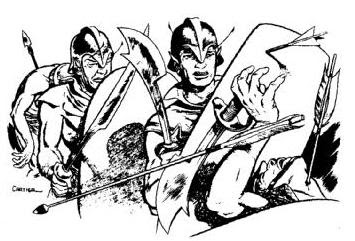


My all-time favorite of the Krishna stories is the Hand of Zei. In it, Dirk Barnavelt, a ghost writer ruled over tyrannically by his aged mother, is sent by the publishing company to find the actual explorer their works are based on, who disappeared on the low-tech world of Krishna while searching for a group of pirates that smuggle janru, a narcotic that makes men subservient to women.

What's especially interesting is that the planet Krishna has actually changed as a result of contact with human beings. At dive bars on Krishna, the singer was heard performing earth songs like "Jingle Bells" and the latest pop hits. Worse, one of the more popular games on Krishna is Chinese Checkers, although the natives call it "Chanichekr" or "Chanichekash."

To reach the legendary Sunqar, a floating island made entirely of giant mats of seaweed like the Sargasso, Dirk Barnavelt traveled in disguise as a legendary to Qirib, a country ruled by amazon warriors, with a horrible old virago of a queen that reminds Dirk of his domineering mother. In one memorable scene, he rides the mass-transit rail system linking cities and countries, which instead of locomotives, on the low-tech world are instead pulled by gigantic bishtars, two-trunked alien elephants.


The Princess Zei of Qirib is captured by the pirates, which means Dirk has to rescue her whether he likes it or not. I love the Princess Zei. She has a big nose, talks with her mouth full, and gets off on men telling her what to do, and yet somehow she is far more fascinating and loveable than the flawless and boring Dejah Thoris.

Dirk Barnavelt leads a ship into the Sunqar, a pirate realm nearly the size of a kingdom who live on a floating island of giant ship choking seaweed mats. Someone call Doc Savage, that's the plot of the Sargasso Ogre! What's interesting is that as an American raised with ideas of equality, he has real moral problems with being the kind of brutal, authoritarian disciplinarian sort of sea captain that is required in that kind of society in order to maintain order. In addition to possible mutiny, he has to face a gvam, a hideous sea monster that is a cross between a swordfish and an octopus.

When he arrives at the Sunqar, Barnavelt finds the leader of the pirates is an alien from the planet Osiris, a giant velociraptor like creature with mental hypnotic powers, who far from being a sinister mentalist, is portrayed as a nervous, high strung hypochondriac. Dirk is able to rescue the Princess, only to find his ship beached in an escape attempt against a haunted island. The origin of the haunted stories are revealed to be brutish tailed men, who are related to Krishnans the same way Neanderthals are related to Homo sapiens.

(This is another thing I like about the Krishna books: L. Sprague de Camp's broad knowledge of everything, including paleontology. Krishna, unlike other Sword & Planet worlds, had a definite prehistory. Indeed, Krishnans themselves have a taxonomic category: Krishanthropus Sapiens, and the tailed men are Krishanthropus koloftus. There is even a Linnean explanation for why some creatures on the planet have six limbs and others four, as both families left the sea at different times.)


What I find most interesting about the burgeoning relationship between Dirk Barnavelt and the Princess Zei is, the problems that keep them from being together are real problems. One of the more irritating thing about Burroughs females, especially that useless pain in the ass Jane, is their tendency to do things that are illogical and wildly out of character for no other reason than to create the requisite conflict for the story. By contrast, in Zei's amazonian country, the husband of the queen rules for a year and then is ritually cooked and eaten. This could have just been another little side-gag to emphasize this planet's barbaric exoticism, along with the Krishnan love of attending public executions, but it is actually a major obstacle to their relationship. In fact, when the two are stuck in the Sunqar without food and are starting to starve, Dirk looks at his Princess and starts to shudder. When the two are necking, Dirk laughs and asks her if she's trying to get a little taste of him first.


In the end, Dirk returns with Zei a hero and leads a gigantic fleet against the Sunqar pirates, all of which will wear skis so they can run over the terpahla seaweed. Krishnan warfare is a beautiful thing: reconnaissance is done with hang-gliders given temporary boosts by explosive chemicals, who land on a flat-topped ship rather like a modern-day aircraft carrier with a rubber band like device for launching the gliders.

Dirk leads the army of amazons and gliders to victory, causing the pirates to honorably surrender. But when the virago Queen Alvandi, the mother of Zei who only wanted to go after the pirates as they cut into her percentage decides to maroon them, Dirk switches sides and teams up with the pirates. He thereafter discovers that his lovely Princess Zei is - surprise! Also an earthling in disguise, captured by the Queen Alvandi from slavers in disguise. The Princess knew Dirk was an earthman all along too. How? He had a belly button! As the people of Krishna lay eggs, nobody on Krishna has a navel.


Dirk Barnavelt in the end leads the pirates against the Qirib monarchy and restores equal rights for men. By standing up to Queen Alvandi, it's like he's stood up to his own mother too and declared his personal emancipation. Shortly thereafter he takes Zei, and forms a company in the Sunqar dedicated to soap production.

There's even a little sarcastic aside where Dirk Barnavelt's buddy, Tangaloa, a grossly overweight, tail-chasing Polynesian Anthropologist, warns him about the dangers of his Warlord of Mars dreams, which might as well be a chastising tut-tut to fans of all Sword & Planet stories:
"Ahem, Dirk, you know these earthly adventurers who run around backward planets exploiting the natives tend to be inferior types that can't compete with their own kind back home. They take advantage of earth's more sophisticated culture, which they themselves do nothing to create... " "Oh, foof! I've heard that lecture too. Call me an inferior if you like, but here I'm quite a guy. npt a shy schizoid Oedipean afraid of his Ma."

My summary above doesn't quite get across the marvelous sense of humor the stories have. I wouldn't be comfortable calling them parodies, the way some other analysts have, because they are first and foremost very boyish, fun adventure stories. But they do reverse expectations in a very amusing and wonderful way, and set about breaking the formula of the Burroughs narrative. The alien leader of the pirates that rules over them with mind control powers is a nervous, easily excitable velociraptor hypochondriac.

One of my favorite parts was when, as Barnavelt returns from the land of the tailed beast-men, his anthropologist friend chastises him for the destruction he wrought on a society anthropologists would like to study. Barnavelt rightly points out they were cannibals about to eat him. Tangaloa says that many Polynesian tribes in the South Pacific only became "savage to outsiders" because they were preyed on by slavers. This is an interesting observation since many tailed Krishnans were in fact, seen in the book series as slaves!

That's what I like about L. Sprague de Camp. Any other writer would have just stuck in some savage cannibals because that's what the story needs. He thought through exactly why these guys are such jerks, what would lead them to be this way historically. That's why Krishna fascinates me: this is obviously written by someone that is a world traveller, that has undergone the experience of going to a bar in Asia and then hearing the latest Top 40 song on the intercom, who knows what they're talking about when it comes to weapons and antique sailing ships.

The chapter where Dirk Barnavelt reconfigures his sails is so full of antique sailing terms that it is nearly incomprehensible jargon. Still, you can't help but be impressed, just as you would be with Tom Clancy's rapid-fire use of military acronyms and terms, because it shows this guy knows what he's talking about and has clearly thought it through.

I can't mention the Hand of Zei without mentioning how the interior illustrations are done by master pulp illustrator Edd Cartier, who also did most of the art for the original Street & Smith Shadow magazine. I tried looking for some Edd Cartier Krishna art, but none of it was online, so I scanned some from my copy and put them up here.

Man, mentioning Edd Cartier's name has got to at least double my google hits. So, here goes: Edd Cartier. Edd Cartier. EDD CARTIER.

The other Krishna stories are hilarious, full of eccentric, weird kings with unusual hobbies like clockwork toys. One of the best was the king of Kalwm in The Prisoner of Zhamanak.

In it, a big black Nigerian named Percy Mijpa hears of an earth girl xenologist held prisoner by a Krishnan. Despite being a black African, he looks down on Krishnans like a Victorian Englishman does on "the natives," and vows to rescue Alicia Dykman.


In one of the best scenes of the book, Percy and Alicia are captured by the ruler of Kalwm like zoo animals, wondering if the Caucasian and African races on earth can interbreed together. He even has their clothes removed as they're placed in the cage. This is made all the funnier by Percy's natural uptightness and attitude of devout monogamy to his fat, jolly little wife that he left back at the spaceport. Obviously the sheer awkwardness of this scene makes it to nearly every single cover of every single edition I've seen.

All in all, the Krishna works are science fiction classics and worth reading. In the words of Reading Rainbow's Levar Burton: "You don't have to take my word for it...but I'd be pretty pissed if you didn't."

Monday, June 29, 2009

Norman Spinrad's "The Iron Dream"


I've always loved science fiction and adventure stories, and I like them enough to take them seriously, to think about them, and occasionally, to be alarmed by some of the more disturbing assumptions built into them: the veneration at force, for instance, and the Totally Evil Alien Race, where we cheer the hero on when he kills them, often to the point of extermination.

This brings me to Norman Spinrad's "The Iron Dream," a book by counterculture "New Wave" author Norman Spinrad, who wrote one of my all time favorite science fiction stories, "A True Drug Culture," about an entire society that is under the influence of drugs near-constantly, tackling a taboo topic that receives blanket condemnation by censors, a subject it's hard to imagine John W. Campbell and his stable even considering. Norman Spinrad has always been one of my favorite science fiction writers, edgy and controversial the way people in the sixties and seventies often were, a real contrast to our play-it-safe culture. Another of my favorites was the politically loaded "Bug Jack Barron," which was about an American media pundit, sort of like a morally principled version of Bill O'Reilly, that encouraged political debate on his show.

In short, Norman Spinrad was the guy that best personified what was happening in science fiction in the 1970s: its ability to be experimental and edgy, defying the traditional science fiction stories that were penned by the hundreds in the 1940s and 1950s featuring cigar chomping, wisecracking badasses that use dubious engineering to solve their problems.

Norman Spinrad was one of the chief writers of Moorcock's "New Worlds" anthology, and it's interesting to compare Spinrad to Moorcock, not the least of which because in the late period of their career they started to write historicals as opposed to straight up science fiction: Moorcock with "Mother London" and Spinrad with things like "Mexica."

Spinrad's "The Iron Dream" is a novel with a twist: it is a book supposedly written by Adolf Hitler, who in an alternate history didn't go into politics and never became Furher of Germany, and instead moved to the United States where he was involved in early science fiction fandom first as a cover artist, and finally as a writer. In addition to the pulpy, intentionally bad novel "Lord of the Swastika" written by Hitler, the book also sports a parody of science fiction academic reviewers, and fake blurbs from other writers, like "Hitler, in his debut novel is electric!" There's even a fake ad for buying other books by science fiction novelist Adolf Hitler, all with malevolent sounding titles like "Tomorrow the World" and "The Master Race."

Here's the rub, the big joke, the giant irony behind Spinrad's book: it isn't different at all from any other adventure, pre-1960 science fiction or Sword & Sorcery novel! It has the same steely-eyed hero with big muscles, a magnificent and unwavering sense of destiny and purpose, with enemies that are vile, subhuman monsters.

As Ursula K. Le Guin put it: "The prose style is prudish and stiff. There are no women at all, no dirty words, no sex of any kind: the book is a flawless example of clean obscenity. It will pass any censor, except the one that sits within the soul." The book isn't so much a parody of Hitler and Nazism, but of the entire escapist adventure genre, which loudly claims to be without realism or political content but is nonetheless loaded with ideology, such as the role of the innately superior man, the superiority of militarism and muscular, authoritative action over careful intellectual consideration and diplomacy.

I'm sure the prudish Robert E. Heinlein fans and Alpha Male worshippers will find much to admire in "Hitler's" novel, as lots of people just don't get the joke, especially those prone to fooling themselves about how certain escapist and cynically produced adventure books have no political content or statement. There was one fanzine reviewer in the 1970s that talked about how "Lord of the Swastika" was a rousing adventure yarn, but spoiled by all this stuff afterwards about Hitler. The hero of "Lord of the Swastika," Feric Jagger, is a laughably invincible superman. That's the whole spirit of the book: Ferric Jaggar is an idealized "Mary Sue" wish-fulfillment character for Adolph friggin' Hitler, and yet, he is really no different than any other Sword & Sorcery or Sci-Fi alpha dog hero. That sort of discomfort is the most thought-producing aspect of the book.

Norman Spinrad really lays it on thick: at once point it describes the hero in such loving detail it was laughably homoerotic, talking about his large muscles and sexual presence. Here's the weird part: his intentionally homoerotic description is actually no different than the many times that Edgar Rice Burroughs lovingly describes Tarzan's "nut brown body with the curves of a Greek god."

It goes without saying that Hitler's book is intentionally awful. The violence is so lurid and over the top it's a type of war-porn. The book is filled with creatures like pinheaded mutants, malevolent, mind controllers and giant ameobas with hundreds of jibbering mouths and thrashing tentacles.


In the end, the book is interesting because it places moral demands on the reader, which many Westerns and other books don't: villains are villains and Must Be Killed. It also lampoons a mentality among fans of genre fiction that I just don't get. One of my ex-girlfriends that loved Romance novels but despised generic, formulaic bodice-rippers and stupid virgin female heroines, talked about how annoyed she was by other romance novel readers, how they always say something like "oh, I don't care much for realism, it's all supposed to be a fantasy anyway."

In the end, the political statement of "The Iron Dream" is intertwined with its parody/critique of genre fiction that goes beyond S&S and science fiction pulp. In the end, truly formulaic science fiction and adventure stories don't have any value. The greatest function of crap is to inure the reader to more crap...something I was just thinking about when I saw reviews for Transformers 2 where apologist critics knuckle under to the proles and teens that made that film a box-office hit and say it was a good example of formulaic genre fiction, and so forth.

Finally, I think it's worth noting that science fiction has really cast out the idea of the idealized, fifties style alpha male Heinlein father figure. I recently reread S.M. Stirling's recent novel, Island in the Sea of Time, about how the island of Nantucket finds itself transported back to the Bronze Age, and what struck me as extraordinary was the main villain of the novel, if it was written back in the 1960s, would have been its hero: he was a clear-eyed idealist, handsome and muscular, that never questioned his own actions or explained himself, and the very qualities that would have made him heroic in fifties fiction make him malevolent and frustratingly intransigent in modern times.

Monday, December 1, 2008

Isaac Asimov's Lucky Starr Series


This is kind of embarassing, but the first Asimov stuff I ever read was the fiction he wrote as Paul French - the Lucky Starr stuff, space opera adventure for young adult readers.


Lucky Starr is an agent for the Science Council of the Solarian League, accompanied by his sidekick, the 5'2" ironically named Bigman. Some of the gadgets range from the cool (Lucky Starr's identifying science council tattoo is invisible and changes form beneath his skin), influential (the Force-Blade, the inspiration for all the laser-swords in science fiction), to the just-plain weird (Lucky Starr's hopper, a pogo-car as ludicrous as it sounds).


What's really amazing about the stories is how Lucky Star uses his head: his stories are, contrary to their superficial appearance as Space Opera, science fiction detective stories and mysteries. For that reason, I'll never forgive the cover artist for LUCKY STARR AND THE MOONS OF JUPITER in the seventies series, which blew the ending to the book on the cover!


In this series, the crew is plagued by a Robot spy from the Sirius League, settlers that became cold-war rivals to Earth's solar system. The whole mystery of the novel is who the robot spy might be. In the end, it turns out to be the seeing eye-dog of the blind astronaut.

Lucky Starr manages to beat the robot spy the same way everything gets resolved in an Isaac Asimov novel involving robots: by creating a situation where there's a conflict or loophole in the laws of robotics, so the robot shuts down. This is, incidentally, the same technique that would be a trademark of James Tiberius Kirk years later: using logic problems to destroy evil computers.

What strikes me as interesting about the Lucky Starr books is how they are something that Asimov (and for that matter, most good science fiction writers) don't really do: they have a story that can be rewritten without any science fiction elements as another work of genre fiction. Replace the Orion Confederation with the Commies and the Science Council with the CIA and you've got a mystery/espionage thriller.

The best science fiction is the kind that you can't rewrite as another kind of genre story. Science Fiction's best works aren't Westerns with six-shooters and aliens replaced by ray guns and aliens; they aren't fantasy with laser swords and gizmos standing in for magic and swords. Science fiction is a type of story in and of itself. Science Fiction has problems and conflicts that can only exist in science fiction. By no means is this list complete:

1) Communication. How do you express meaning to something totally different from yourself? "Communication" stories include Harry Harrison's WEST OF EDEN, or all those Ursula K. le Guin stories about cooperating with an alien race.

2) A story that provokes a sense of wonder just by its scale. An example would be Bradbury's "You Just Missed Him," about a crew that goes to another planet and discover that someone of great religious significance (presumably Jesus Christ, but this is not explicitly stated) was just there, but they "just missed him." So they rocket to the next planet, only to learn they were too late, he just left there...and so forth.

3) A strong central concept based on real science. The ultimate example would be Niven's Ringworld. The physics textbook has yet to be made that doesn't have at least one work problem and sample test question involving the mind-boggling math of the Ringworld.

4) Sentience. What exactly is sentience and intelligence? Do humans have it? Robots? The best work of this kind would be H. Beam Piper's LITTLE FUZZY.

In fact, all the hoariest science fiction and space opera cliches are stand-ins for tired elements in other kinds of stories. Space Pirates, for instance, or the unstoppable space-Mongol horde that threatens everything (how many quasi-Oriental stand-ins have their been through the history of space opera?), or the cheeseball story type used to lecture us on the evils of prejudice when two alien races fight. As they're aliens, it's perfectly okay for us to be judgmental and shake our heads self-righteously about their tribalism and prejudice. After all, we're so much better than they are, and since they're aliens, we don't have to admit or confront any real flaw in ourselves!