
If you're a Finnophile like me, hearing about the 1960s movie SAMPO was mouth-wateringly exciting: a film dramatization of the Finn national epic, Kalevala (or at least a choice selection thereof). The film's American-edited version by American International Pictures cut over half an hour of footage from the film that has yet to be fully added. Most people are familiar with the shorter AIP cut when it aired in the U.S. as THE DAY THE EARTH FROZE, which aired on Mystery Science Theater 3000.
It's not hard to understand why this movie would look insanely, hilariously bad despite its generally high production values. Mostly because of a Kung Fu flick level terrible dubbing job by American International Pictures, but I think it might have been that the intended American audience lacked any social context for the story so it all just looked schizophrenically insane and random.
At least SAMPO fared a lot better than another AIP hatchetjob, where they redubbed a Soviet movie about a Russian folk tale with a blond main character as SINBAD'S MAGIC VOYAGE. (???)
Still, though. When spoofing THE DAY THE EARTH FROZE, they could have laid off the Swedish and Norwegian jokes. The confusion between Scandinavian and Finnish/Estonian culture is really annoying. I guess Mike Nelson, Joel and the rest were Midwesterners, so everything vaguely arctic-circle and European looked Scandinavian to them!
Here's a great selection of how the film looked in its original Finnish:
Here are a couple of the "lost" scenes from SAMPO, from the German version. These feature a plot cut from the first version of the film, namely the murder and resurrection of Leminkainen.
Showing posts with label Mythology. Show all posts
Showing posts with label Mythology. Show all posts
Friday, May 29, 2009

Thursday, May 7, 2009
Greek Mythology
Continuing the series on World Mythology, here's a take on Greece.
In the beginning, classical studies focused in on what made Greece so unusual and their stories so extraordinarily different from the cultures around them. The best book to typefy this was Edith Hamilton, whose perky insistence the Greeks were super-duper special was one of the most irritating parts of the otherwise splendid MYTHOLOGY.
This kind of triumphalism is unsurprising. Classical Studies have always been a darling of the conservative right, since after all, emphasizing the uniqueness of Western culture separates us from our two archenemies, namely the Godless Commies on one hand, and the assorted disgruntled darkie hordes of the Third World on the other.
When education forcused on Math and Science during the 1960s so America wouldn't lose her tech edge to the Commies, William F. Buckley Jr. urged us not to forget Classical Greece and the humanities, which may have been the only time the World's Most Articulate Asshole and his attack dogs in the National Review were ever in favor of anything that benefitted the human race. Likewise, don't forget Victor Davis Hanson, the Dick Cheney psycophant, discredited after his invocation of Greece to cheerlead Cheney's oil-grabbing misadventures. The truth is, there's nothing that could be less relevant to Iraq or Afghanistan than Classical Greece: the Greeks and Romans never had to deal with anything like an insurgency or asymmetrical warfare. Think of it like this: if a native population attacked Greek soldiers, what do you think the Greeks would have done...to the entire city?
Nowadays, the pendulum has shifted and classical scholars are looking at the similarities between the Greeks and other cultures around them. It certainly helps that we know a lot more about Greek prehistory, thanks to archeology revealing more about the Greeks Indo-European ancestors, the Bronze Age period, the Pelasgians (the non-Indo-European original inhabitants of mainland Greece), and the palace culture of Knossos. There was a wonderful travelogue book entitled ZEUS that traced the life's story and origins of Zeus in a Greek travel book, which investigated the Big Guy's origin in Indo-European and tribal belief.
With that in mind, there are a few things important to emphasize when reading Greek Mythology:
1. The institution of the hero came from Ancestor Worship.
In fact, the reason we are familiar with some heroes is because their cults were important at significant places...not the other way around! Castor and Pollux were a part of the state worship of Sparta, for instance. Some hero-cults were downright bizarre: on Samothrace, the Orphic Mysteries believed the hero-musician Orpheus emerged from the underworld with secret knowledge. Since the Orphic Mysteries were a secret society concerned with magic salvation, we know very little about them...but supposedly initiates in the Mysteries were protected from drowning.
In many ways, the Greek form of ancestor-worship was very similar to the Chinese, Aboriginal, and Sub-Saharan African version of the same practice. Ancestors weren't just the spirits of long-dead blood relatives, but superhuman figures from the distant past with real influence on present events.
It's important to note that Greece was divided into closely-related clans or tribes, called ethnos, rather like Scottish Highlanders. In some cases, being a part of one ethnos was, like the Clintons, Kennedys and Bushes today, a ticket to real political power. Each ethnos had its own hero that they claim descent from, which is what makes reading a lot of epics so dense and impenetrable: lots of little shout-outs to minor-league heroes that pop up just to give that portion of the audience a thrill.
The hero-ancestors had great importance for propaganda and political purposes. A hero's fame increased if the tribe he was related to came into power. After pan-Greek sentiment was the big uniting feeling after the Persian Wars, the previously unimportant hero Hellas was pointed to as a common ancestor for all Greeks everywhere.
2. Greek religion had a surprisingly dark flip-side with extremely ancient roots.
Called Cthonic worship, this type of worship was conducted underground and in caves, often with blood sacrifice to earth and death deities. Hecate, a moon goddess of magic and death, was one of the chief of the Cthonic gods. Hades was another. In fact, Hades was often associated with Zeus, either as a split personality or as a twin brother. The clear-cut separation between Zeus and Hades is a modern invention. Hades after all, was often referred to as Zeus Cthonios: the Cthonic Zeus.
3. The Greeks and Romans didn't take their myths seriously. They loved to lampoon, deconstruct, and usurp their own myths, even from the get-go.
The Byzantine Empress Theodosius, prior to marrying the most powerful man in the world, was a professional stripper who specialized in lewd and sexy reinactments of Greek and Roman myths.
This irreverence towards myth is typical of the classical world. It would be a mistake to call most Greeks and Romans atheists (a very modern attitude inappropriate for the Ancient World), but nonetheless the majority of them didn't believe in the literal truth of their myths and didn't take them all that seriously.
One of the great additions to Greek drama was the Satyr play, which were comic parodies of myths often performed in festivals to help the mostly drunk observers wind down after the super-pompous main performances generally shown at such festivals. The Satyr plays often remind me of the Abbot and Costello movies where the duo met Frankenstein or Hercules, with the goofy figures of the satyrs, horny to the point they sported comically oversized prop erections, were casually slipped into the myths like Forrest Gump. The only existing satyr play to come down to us in its entirety was by Euripides and featured a bunch of Satyrs caught up with Odysseus in his famous escape from the Cyclops. The most typical scene was one where the Cyclops threatened to capture and rape a satyr prison-style. Yes, the satyr plays are as totally hilarious as they sound.
In fact, the most readable and entertaining collection of Greek myth was Ovid's METAMORPHOSES. Ovid was wildly disliked because of this very humor, warmth and humanity. Augustus Caesar, like all prudes and snotty moralists the world over, had zero sense of humor and no tolerance for parody, and much preferred the boring, sterile and unreadable Virgil's AENEID (which not incidentally, kissed the ass of the ruling class and their values) rather than the subversive Ovid. Ovid was someone that actually did use humor as a deadly weapon to speak truth to power: aware of the corruption and indiscretion of the priesthood under Augustus (after all, one of the great ironies of human culture is how sexual perversion proliferates under repressed societies and becomes less frequent with more permissive ones) his book AMOR (which was ROMA spelled backwards!) mentions the Temple of Apollo as a great spot to pick up women. Apparently, the uptight Augustus was unamused: it's commonly believed Augustus Caesar ordered Ovid whacked. Of course, Ovid had the last laugh: his METAMORPHOSES is one of the most influential and widely read work in Western history, whereas Augustus Caesar is worm food. Presumably the devils in hell are right now ass-raping Augustus, and he's probably enjoying every moment of it.
Ovid's METAMORPHOSES is almost like a Mad-Magazine parody of Greek myth. When familiar figures in Greek myth appear, they are often bumbling, ineffective and entirely mortal. The only story featuring the Superman of Greek myth, Achilles, is one about the one time he proved himself impotent against the warrior Cygnus. In one humorous scene, after the battle with Cygnus, Achilles kills a guy just to see if he can still do it. Likewise, Apollo, god of reason and superhottie supreme, is shown as being irrational: crazy in love with Syrinx, a nymph that rejected him and turned into a tree to escape him. The only story with Hercules is one of his death. Nestor, the wise councilor of the heroes in the war against Troy, is shown in METAMORPHOSES as a senile Abe Simpson type that tells stories that go on weird, ranting tangents.
Ovid's stories are full of magnificent imagery, funny characters and imagery: the idea of dolphins swimming through forests after Zeus floods the world, for instance. METAMORPHOSES remains one of the only two books in college I didn't sell back to the bookstore after the course was over.
In the beginning, classical studies focused in on what made Greece so unusual and their stories so extraordinarily different from the cultures around them. The best book to typefy this was Edith Hamilton, whose perky insistence the Greeks were super-duper special was one of the most irritating parts of the otherwise splendid MYTHOLOGY.
This kind of triumphalism is unsurprising. Classical Studies have always been a darling of the conservative right, since after all, emphasizing the uniqueness of Western culture separates us from our two archenemies, namely the Godless Commies on one hand, and the assorted disgruntled darkie hordes of the Third World on the other.
When education forcused on Math and Science during the 1960s so America wouldn't lose her tech edge to the Commies, William F. Buckley Jr. urged us not to forget Classical Greece and the humanities, which may have been the only time the World's Most Articulate Asshole and his attack dogs in the National Review were ever in favor of anything that benefitted the human race. Likewise, don't forget Victor Davis Hanson, the Dick Cheney psycophant, discredited after his invocation of Greece to cheerlead Cheney's oil-grabbing misadventures. The truth is, there's nothing that could be less relevant to Iraq or Afghanistan than Classical Greece: the Greeks and Romans never had to deal with anything like an insurgency or asymmetrical warfare. Think of it like this: if a native population attacked Greek soldiers, what do you think the Greeks would have done...to the entire city?
Nowadays, the pendulum has shifted and classical scholars are looking at the similarities between the Greeks and other cultures around them. It certainly helps that we know a lot more about Greek prehistory, thanks to archeology revealing more about the Greeks Indo-European ancestors, the Bronze Age period, the Pelasgians (the non-Indo-European original inhabitants of mainland Greece), and the palace culture of Knossos. There was a wonderful travelogue book entitled ZEUS that traced the life's story and origins of Zeus in a Greek travel book, which investigated the Big Guy's origin in Indo-European and tribal belief.
With that in mind, there are a few things important to emphasize when reading Greek Mythology:
1. The institution of the hero came from Ancestor Worship.
In fact, the reason we are familiar with some heroes is because their cults were important at significant places...not the other way around! Castor and Pollux were a part of the state worship of Sparta, for instance. Some hero-cults were downright bizarre: on Samothrace, the Orphic Mysteries believed the hero-musician Orpheus emerged from the underworld with secret knowledge. Since the Orphic Mysteries were a secret society concerned with magic salvation, we know very little about them...but supposedly initiates in the Mysteries were protected from drowning.
In many ways, the Greek form of ancestor-worship was very similar to the Chinese, Aboriginal, and Sub-Saharan African version of the same practice. Ancestors weren't just the spirits of long-dead blood relatives, but superhuman figures from the distant past with real influence on present events.
It's important to note that Greece was divided into closely-related clans or tribes, called ethnos, rather like Scottish Highlanders. In some cases, being a part of one ethnos was, like the Clintons, Kennedys and Bushes today, a ticket to real political power. Each ethnos had its own hero that they claim descent from, which is what makes reading a lot of epics so dense and impenetrable: lots of little shout-outs to minor-league heroes that pop up just to give that portion of the audience a thrill.
The hero-ancestors had great importance for propaganda and political purposes. A hero's fame increased if the tribe he was related to came into power. After pan-Greek sentiment was the big uniting feeling after the Persian Wars, the previously unimportant hero Hellas was pointed to as a common ancestor for all Greeks everywhere.
2. Greek religion had a surprisingly dark flip-side with extremely ancient roots.
Called Cthonic worship, this type of worship was conducted underground and in caves, often with blood sacrifice to earth and death deities. Hecate, a moon goddess of magic and death, was one of the chief of the Cthonic gods. Hades was another. In fact, Hades was often associated with Zeus, either as a split personality or as a twin brother. The clear-cut separation between Zeus and Hades is a modern invention. Hades after all, was often referred to as Zeus Cthonios: the Cthonic Zeus.
3. The Greeks and Romans didn't take their myths seriously. They loved to lampoon, deconstruct, and usurp their own myths, even from the get-go.
The Byzantine Empress Theodosius, prior to marrying the most powerful man in the world, was a professional stripper who specialized in lewd and sexy reinactments of Greek and Roman myths.
This irreverence towards myth is typical of the classical world. It would be a mistake to call most Greeks and Romans atheists (a very modern attitude inappropriate for the Ancient World), but nonetheless the majority of them didn't believe in the literal truth of their myths and didn't take them all that seriously.
One of the great additions to Greek drama was the Satyr play, which were comic parodies of myths often performed in festivals to help the mostly drunk observers wind down after the super-pompous main performances generally shown at such festivals. The Satyr plays often remind me of the Abbot and Costello movies where the duo met Frankenstein or Hercules, with the goofy figures of the satyrs, horny to the point they sported comically oversized prop erections, were casually slipped into the myths like Forrest Gump. The only existing satyr play to come down to us in its entirety was by Euripides and featured a bunch of Satyrs caught up with Odysseus in his famous escape from the Cyclops. The most typical scene was one where the Cyclops threatened to capture and rape a satyr prison-style. Yes, the satyr plays are as totally hilarious as they sound.
In fact, the most readable and entertaining collection of Greek myth was Ovid's METAMORPHOSES. Ovid was wildly disliked because of this very humor, warmth and humanity. Augustus Caesar, like all prudes and snotty moralists the world over, had zero sense of humor and no tolerance for parody, and much preferred the boring, sterile and unreadable Virgil's AENEID (which not incidentally, kissed the ass of the ruling class and their values) rather than the subversive Ovid. Ovid was someone that actually did use humor as a deadly weapon to speak truth to power: aware of the corruption and indiscretion of the priesthood under Augustus (after all, one of the great ironies of human culture is how sexual perversion proliferates under repressed societies and becomes less frequent with more permissive ones) his book AMOR (which was ROMA spelled backwards!) mentions the Temple of Apollo as a great spot to pick up women. Apparently, the uptight Augustus was unamused: it's commonly believed Augustus Caesar ordered Ovid whacked. Of course, Ovid had the last laugh: his METAMORPHOSES is one of the most influential and widely read work in Western history, whereas Augustus Caesar is worm food. Presumably the devils in hell are right now ass-raping Augustus, and he's probably enjoying every moment of it.
Ovid's METAMORPHOSES is almost like a Mad-Magazine parody of Greek myth. When familiar figures in Greek myth appear, they are often bumbling, ineffective and entirely mortal. The only story featuring the Superman of Greek myth, Achilles, is one about the one time he proved himself impotent against the warrior Cygnus. In one humorous scene, after the battle with Cygnus, Achilles kills a guy just to see if he can still do it. Likewise, Apollo, god of reason and superhottie supreme, is shown as being irrational: crazy in love with Syrinx, a nymph that rejected him and turned into a tree to escape him. The only story with Hercules is one of his death. Nestor, the wise councilor of the heroes in the war against Troy, is shown in METAMORPHOSES as a senile Abe Simpson type that tells stories that go on weird, ranting tangents.
Ovid's stories are full of magnificent imagery, funny characters and imagery: the idea of dolphins swimming through forests after Zeus floods the world, for instance. METAMORPHOSES remains one of the only two books in college I didn't sell back to the bookstore after the course was over.
Wednesday, August 13, 2008
Georgia vs. Russia
It's a bizarre bit of synchronicity that the Russia and Georgia conflict should happen right in the middle of my series about world mythology, because the region of the current conflict - South Ossetia - is one of the most mythically significant bits of real estate in the world.
First, South Ossetia is right at the mouth of the Black Sea and is generally considered to be the site of the end of Jason's quest for the Golden Fleece. Also, the Ossetians are descended from the Alanii, cavalry barbarians that were frequently employed by the Roman Empire. The Alanii loved to make use of tactics like defeating horses with huge dogs not unlike modern great danes. But more significantly, an Alanii cavalry force was dispatched to Britain led by a fellow named Artorius, who may or may not have been the inspiration for King Arthur. I should go into my theories about the origin of Arthurian legend in the future, but it would suffice here to say I'm not as convinced of the Artorius origin as Hollywood is.
The conflict is shaping up to be a bloody mess. First, it has to be remembered there are THREE actors here: Russia (obviously), Georgia, and the Ossetians. The Ossetians are an independent tribe with a long history that want independence from Georgia, and they've cozied up to Russia, who have never liked the Georgians ever since they rerouted an oil pipeline to the West to compete with the Russians. Also, Russian politicians love to scapegoat Georgians and Georgian immigrants the same way American politicians love to pander to Mexiphobic sentiment. Georgia on the other hand, won't stand for a loss of its territory, and politically giving the finger to the Russians plays well with the voters.
In essence, both sides in the war have decided to be assholes, and it looks like this is shaping up to go the distance. Like the Lebanon conflict, this is a war where everyone sees the advantage in continuing, and it would be political suicide at the polls for Russian and Georgian politicians if they back down. The big fear here is, naturally, genocide: if the Ossetians are creating a problem, a solution, for the Georgian side, is just to wipe them out. In fact, the recent U.N. Security Council meeting used the most hilarious euphemism yet for genocide when they expressed "concern for future demographic shifts in the region."
First, South Ossetia is right at the mouth of the Black Sea and is generally considered to be the site of the end of Jason's quest for the Golden Fleece. Also, the Ossetians are descended from the Alanii, cavalry barbarians that were frequently employed by the Roman Empire. The Alanii loved to make use of tactics like defeating horses with huge dogs not unlike modern great danes. But more significantly, an Alanii cavalry force was dispatched to Britain led by a fellow named Artorius, who may or may not have been the inspiration for King Arthur. I should go into my theories about the origin of Arthurian legend in the future, but it would suffice here to say I'm not as convinced of the Artorius origin as Hollywood is.
The conflict is shaping up to be a bloody mess. First, it has to be remembered there are THREE actors here: Russia (obviously), Georgia, and the Ossetians. The Ossetians are an independent tribe with a long history that want independence from Georgia, and they've cozied up to Russia, who have never liked the Georgians ever since they rerouted an oil pipeline to the West to compete with the Russians. Also, Russian politicians love to scapegoat Georgians and Georgian immigrants the same way American politicians love to pander to Mexiphobic sentiment. Georgia on the other hand, won't stand for a loss of its territory, and politically giving the finger to the Russians plays well with the voters.
In essence, both sides in the war have decided to be assholes, and it looks like this is shaping up to go the distance. Like the Lebanon conflict, this is a war where everyone sees the advantage in continuing, and it would be political suicide at the polls for Russian and Georgian politicians if they back down. The big fear here is, naturally, genocide: if the Ossetians are creating a problem, a solution, for the Georgian side, is just to wipe them out. In fact, the recent U.N. Security Council meeting used the most hilarious euphemism yet for genocide when they expressed "concern for future demographic shifts in the region."
Friday, July 11, 2008
Mythologies of the World Part 1: Finnish Myth

For my first part in a series about the myths and folklore of the world (which I'd love to eventually include something on Basque myth, the Arabian Nights, Christian Europe, and Greece), I'd like to tackle the fascinating traditions of Finland.
Often, I'm asked how Finn myth is different from their neighbors, the Scandinavians and Slavs.
First, the main hero of Finnish mythology is Väinämöinen, a rascally, horny old man, one part culture hero, another part hobo, who challenges other musicians to musical fights not unlike modern-day rap battles. He's doomed to never find love: one of his most tragic stories is his pursuit of a younger woman, Aino (still a common female name in Finland today) who drowns himself rather than marry a man so much older than she is.

Väinämöinen invented the Kantele, a type of magical harp not unlike the cwyth of Wales, from the jawbone of the giant monster Pike of the North Sea. Väinämöinen also rides a flying wooden sawhorse, reminiscent of the witch's broomstick.

There's a type of picaresque humor about Finnish myth that makes it wonderful to read. Lemminkäinen, a hotshot young hero, lives with his Mother, and what's more, Mom has to rescue him on occasion and return him to life! (How many Scandinavian heroes lived with their Mother, I ask?) One of my favorite passages from the Kalevala was where Louhi, the evil crone that rules the Northland, turns a giant house-sized bear against her foes. Naturally Väinämöinen goes out to slay the monster. Instead, he has a change of heart:
"Otso, thou my well beloved,
Honey-eater of the woodlands,
Let not anger swell thy bosom;
I have not the force to slay thee,
Willingly thy life thou givest
As a sacrifice to Northland.
Thou hast from the tree descended,
Glided from the aspen branches,
Slippery the trunks in autumn,
In the fog-days, smooth the branches.
Golden friend of fen and forest,
In thy fur-robes rich and beauteous,
Pride of woodlands, famous Light-foot,
Leave thy cold and cheerless dwelling,
Leave thy home within the alders,
Leave thy couch among the willows,
Hasten in thy purple stockings,
Hasten from thy walks restricted,
Come among the haunts of heroes,
Join thy friends in Kalevala.
We shall never treat thee evil,
Thou shalt dwell in peace and plenty,
Thou shalt feed on milk and honey,
Honey is the food of strangers.
Haste away from this thy covert,
From the couch of the unworthy,
To a couch beneath the rafters
Of Vainola's ancient dwellings."
- Kalevala, Rune XLVI
In other words, as soon as Väinämöinen gets a look at the monster bear, he says, "nah, I can't kill him, he's too cool" and instead decides to take him with him back to the land of Kalevala for some drinking and picking up girls. Now, obviously this is not exactly how St. George or Siegfried would have solved the problem! The last time I saw this sort of sly humanity in a monster was in Beowulf, where the dragon, indecisive and nervous about his lost treasure cup, paced back to his hoard and looked for it to see if it was not misplaced.
This sort of picaresque levity that almost parodies the epic myth is one point of difference between the myths of the Finns and their neighbors. It's hard to imagine an Icelandic Rune with a hero makes a monster his drinking buddy. And the Slavs? Forget about it. Slavic mythology, with gods named Graak and Kog, is so dark that it makes Norse Myth look like Rainbow Brite.
There's only one occasion where the Kalevala gets extremely dark, and that's in the story of Kullervo. What's fascinating about Kullervo is, it's one of the few mythological stories that actually depicts the realistic effects of child abuse, and the very broken people it creates, trapped in cycles of self-destruction. In the end, Kullervo dies by his own hand when, after accidentally marrying his own sister, he mournfully wonders if he ever should have lived at all. Jean Sibelius, Finland's best composer, immortalized this moment in his opera, Kullervo:
Another defining characteristic of Finn Myth, apart from the levity, is its emphasis on a very wild perspective similar to shamanism. Everything has a spirit, and everything can talk: there's a very famous part where iron itself speaks, which is vaguely reminiscent of certain Javanese myths where the metalworker's position has a mystical component. One of the more explicitly shamanistic images is when Väinämöinen descends into the open mouth of Antero Vipunen, a monstrous giant in the shape of a mountain.
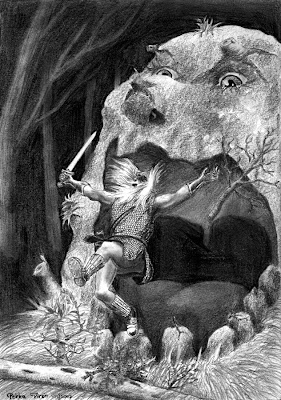
Another characteristic of Finn myth is the sense of magic and the supernatural. This can only really be driven home by its contrast against something like the sheer realism of Homer's Illiad. Just about every hero in the Kalevala is a sorcerer of some kind. One of the most striking images in the entire epic is the Theft of the Sampo, where while escaping from the evil kingdom of Pohjola, Väinämöinen causes his ship to grow a face and sprout wings like a bird with his magical songs. Not to be outdone, Louhi transforms into a giant monster bird and attacks the flying ship with men on her back! This scene is understandably almost always in some form represented on the illustrations or painted covers.

Finally, the myths of Finland, though dating back to the early iron age, were only written down and organized in the 19th Century as a part of the Romantic awakening of the smaller nations of Europe. Try to imagine if French was the official language of England for 700 years, and the first poet to write in English was Byron. So important to the spirit of Finn nationalism, that in Finland, a national holiday is "Kalevala Day." When Jean Sibelius composed his symphonies in the early 20th Century in Helsinki, they were based on Kalevala themes, and his Finlandia is to Finland what the music of John Phillips Sousa is to the United States.
The canon of Finn myth was collected and compiled by the poet and nationalist Elias Lonrot, in a single work, the Kalevala. What's interesting about this is, because of the late date, Finn myth has the most explicitly Christian elements. The chief god of Finland, the sky-father Jumala, a cross between Odin and Thor who wields a hammer, is much more like the Christian god, remote and never active in His creation. Finally, in the last Rune, Maryätta (Mary) arrives in Finland and has a virgin birth.

The overall story of the Kalevala is rather like a Finnish Illiad, based on the conflict between Kalevala, land of heroes, and Pohjola, land of evil and ice magic ruled by an evil old witch. It's often been argued that Kalevala represents the Finns, whereas Pohjola represents the Lapps...which is a theory that sounds pretty unlikely to me. When in history were the Lapps powerful enough to demand tribute?
In any case, the conflict heats up when the Daedalus-like artificer-smith Ilmarinen forges an object of otherworldly wonder, the Sampo. Like the Holy Grail, the Sampo's exact nature is vague, but it generally is supposed to be a grain cover that changes anything worthless, mulch or dirt, to gold, gems and salt. Naturally the heroes of Kalevala mount an expedition to get it back. When Louhi sees the Sampo was stolen, she sends a three-headed monster that shoots plagues, a giant bear, and finally, even steals the sun. The heroes find a way to get around this, of course: the smith Ilmarinen builds in his workshop a new sun!

Connections to Other World Mythologies

The single most obvious connection is to the Estonians, who have a tradition that is very similar. The Kalevipoëig of Estonia was composed as a direct answer to the worldwide success of the Kalevala. In fact, one intriguing theory makes a linguistic connection between Talinn (the capital of Estonia) and Kalevala. Theories about Kalevala's "real" location are a dime a dozen, as common as grail myths in most of Europe. One town in Finland even renamed itself Kalevala for the purposes of tourist-grabbing!
Estonia was only converted to Christianity in the great Baltic Crusade of the 13th Century, which fit the pattern of the European Crusades: convert the heathens, but preferably the heathens that are not too far away. The conversion was undertaken by the Teutonic Knights, best known in modern times as the villains of Sergei Eisenstein's cinema classic, ALEXANDER NEVSKY, and it was done with the usual lack of style that made the child-sacrificing moustache-twirling antics of ALEXANDER NEVSKY look almost realistic.
Estonian myth even features the same protagonists as Finnish myth, just like the Romans shared the myths of the Greeks. Väinämöinen, for example, is worshipped in pre-Christian Estonia as a god of music.
There are a few connections to the Scandinavians as well. The Vannatar, or Air Maidens, are females able to fly who have great similarities to Valkyries. I've even heard an intriguing argument that there may even be a connection to Väinämöinen in Beowulf!
Where can I read more?
The absolute best translation of the Kalevala was in 1996 by Keith Bosley.
A version of the Kalevala translated in the 19th Century into English is available here, at sacred-texts.com.
Subscribe to:
Posts (Atom)


