Sunday, May 8, 2011

Julian Perez At the Movies: Thor


It's weird to say, but Thor is a smaller personal story than you'd expect. Compared to how "big" Iron Man 2 was, for instance, it had relatively fewer battles and special effects scenes and worked at a smaller scale than one would expect for someone like Mighty Thor. I was surprised at how short and tight the movie was.

The Thor movie is a lot like the first Iron Man in that it is about a guy who changes from the start of the movie to the end because he gets put through the wringer and realizes he made mistakes. Thor starts off as a hero with a lot of flaws: he's a bolsterous guy with a big personality but he likes to fight way too much, which is a problem for a guy who might be King, because a wise king shouldn't look for trouble.

He's proud and easily offended and haughty, and like a lot of proud people he gets revenge for insults a wise person might just ignore. At the end of the movie, Thor shows how he's changed because he actually fights to save some former enemies because he figures over the top retaliation isn't right!


The Science Fiction Elements


One dirty little secret about Mighty Thor that even comic book fans don't get at times is that Mighty Thor was never, ever entirely Tolkien or Gaiman esque mythic fantasy, but was kept off-balance and interesting because it had unusual and incongruous science fiction and a cosmic element to it that felt more science fiction than fantasy. Thor was never "Lord of the Rings," it was something weirder and cooler than that because it had alien invasions, giant unstoppable robots, and science fiction villains like Ego the Living Planet, Zarrko the Tomorrow Man, and the High Evolutionary and his Dr. Moreau beastman city.

It was almost Joseph Campbell mindblowing, with moments like a guy on a horse galloping through space. Jack Kirby always drew shining Asgard less as a giant Viking town than as yet another secret society future city, just like the Inhumans' Attilan.


Though Thor started out as based on Ancient Pagan stories, it was always something altogether different and it says something that the most interesting characters even in Thor's world of Asgard were totally without precedent in folklore: Beta Ray Bill – an alien with the power of Thor, the Enchantress and the Executioner, the Warriors Three, and so on. Even when something was taken from folklore, it was juxstaposed with either modern New York (like that Walt Simonson story where Thor chased the indestructible dragon Fafnir through the subway system and then fought him on the Empire State Building) or outer space (like that one where Thor, the Lady Sif and Beta Ray Bill fought Surtur the Fire-Giant, but he was leading an invasion of an alien planet).


After Stan Lee and Jolly Jack left Might Thor, super-literate English lit major Roy Thomas tried slipping in some classic references to pagan stories, like how Mighty Thor actually had a chariot pulled by goats – a detail most other writers "forgot" about mostly because it looked pretty stupid. The more folkloric a character is in Thor, the more likely they are to be dull in the comics. Balder the Brave, who in Pagan belief was a sort of Jesus-figure who died and came back to life, had no real personality in the comics apart from being a loyal friend.


All that brings me to this movie. They went in exactly the right direction with Thor, which astounded me: I figured they'd "play it safe" and do Thor like "Lord of the Rings" or "Narnia." Here, they made Thor even more science fiction than before: the other dimensions are now planets (apparently the Frost Giants now have their own planet), and the Rainbow Bridge of Bifrost is now a wormhole gadget that looks like the Asgardians borrowed it from Doctor Who.


Loki is described as a "wizard," but that must mean something different to Asgardians than to us because his "magic" is mostly tricks like the hologram gadget from "Total Recall."

In the comics, though Thor often battled science fiction menaces, Thor was unambiguously exactly what he said he was: an immortal deity. Fighting him was more like taking on a force of nature than a person. Here, he's more like a superpowerful alien mistaken for a god by primitive humans.


Make no mistake: the science fiction elements were a theme of Mighty Thor that this movie just made more explicit than usual, a case of a movie "getting it." They pushed that angle front and center in the trailers, which is weird. I think it might have been to say, "I know he's based on paganism, but look! It's really science fiction! So, please, please, please don't skip out on our movie, people from the South!"

The Bad Guys: Loki and the Destroyer


The villain of the movie – Loki - is fascinating because he's so totally different from any other bad guy in superhero movies.

All the major twists and turns of the movie are due to him, which is why, despite the fact he's so great it's hard to talk about him without spoilers. Just when you think you've figured out his motivation, there's another level to his scheme in operation; you don't even really "get" the character until one last line he gives that explains everything.


In the end Loki comes off as strangely tragic because he wasn't evil so much as someone that went wrong somewhere. Loki is sympathetic because his motive is he has something to prove to everyone, despite the fact people accept and like him; he's insecure and sees distrust and hate where there just isn't any.

The costume was great, too: there was one shot that was just a shadow of Loki on a wall; with that curved horn helmet of his, Loki was immediately recognizable just by silhouette.


Loki must be Norwegian for liar, because that's exactly what he does, and everyone believes him. In fact, he's so good at lying and pulling strings, so subtle, that the first scene he manipulates other people it's possible to not even realize he did it. Loki wins fights by sneaking and cheating and playing on other people's emotions. In one scene he looks like he's about to fall to his death and asks his brother Thor to save his life. Surprise! It was a hologram trick that lets Loki stab Thor.

Loki lying can be more crushing and destroying than any proton beam: one of the worst, crushing scenes in the movie was one where Loki goes to Thor and tells him their mother doesn't want Thor to ever come back to Asgard.


The Destroyer was just about perfect in this movie. He was huge and unstoppable and totally silent and intimidating and reminded me of Gort, the robot from "The Day the Earth Stood Still." I saw someone at the premiere with a 7-11 Destroyer cup, which makes perfect sense: opening night of Thor is the only place in the world you can possibly be comfortable drinking out of a plastic robot in public. I totally expect that in the future, statues of the Destroyer will be sold at science fiction conventions next to busts of the Creature from the Black Lagoon.

The Comedy

One thing the trailers probably didn't tell you about Mighty Thor: it's funny. Just as funny as Iron Man, in fact, which is really a relief because if it didn't have a sense of humor it'd be insufferable. Thor bonds with a scientist because the pair of them drink heavily (and competitively!), and the pair come back stumbling drunk. The human characters help Thor become a decent person because he sincerely wants to help Jane Foster, as Thor knows she's right.


I was super-nervous about Kenneth Brannaugh because I thought it might be the Ang Lee "Hulk" all over again: another case of a "highbrow" director who makes a bad movie because he looks down on the material. This didn't happen here at all, and I'm delighted. Still, Brannaugh is a classy guy and he brought a lot of polish: notice that in all of his scenes all the actors are doing something instead of just staring blankly, and because of his direction he made some jokes work that should be unfunny on paper.


Nobody that really appreciates or understands Shakespeare could possibly be a snob. As genius as the guy was, Shakespeare wrote his plays like the better Hollywood blockbusters; there was plenty of stuff for the literate but his target audience was the lowest common denominator so there was always plenty of attention-getting sex, violence and functions comedy (farts and midgets). If Shakespeare lived today he'd be perfectly at home doing surprisingly high-quality stuff in the studio system.

The Casting


Kenneth Brannaugh is a color-blind casting guy; in "As You Like It" he made Keanu Reeves and Denzel Washington brothers.

A lot of people wondered about the Asian Hogun the Grim, which bugs me because that critique is actually downright comics-illiterate; even in the comics he was not from Asgard but was a bitter outcast from a country to the South, a sort of Mongol type pan-Asian place with genies and flying carpets. Hogun was the first of the Warriors Three to get a solo story because he was so popular: he had a lot of cool mystique as a quiet, antisocial guy who thought his life was cheap.

If I have a critique of that movie it's that the minor characters went underdeveloped. Surely some cute character bit, even if it was one line, could have been given to Volstagg (who seemed curiously thin in this movie), Fandral the Dashing was just there, as was someone as cool as Hogun.


Idris Elba did just fine. He got the best costume in the entire movie, bronze-gold space armor that looks like something Darth Vader would wear if he was a good guy. He has a great growly voice and accent, and together with oddball hazel-gold contacts, he let his voice and the costume do all the work. He doesn't look Asgardian but he sounds like it. I guess if you want an explanation for his un-Asgardian looks, Heimdall might have been a "naturalized citizen" to Asgard, originally from someplace else, like Hogun the Grim.

Friday, May 6, 2011

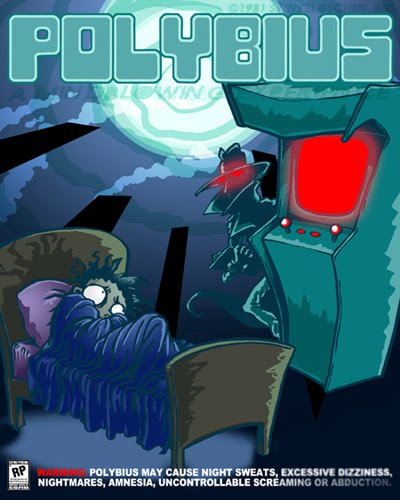
Polybius - the world's spookiest video game


One of my all-time favorite, spookiest urban legends involves a mysterious arcade game whose existence was never substantiated, Polybius. It's a great window into the early days of video games, a horror story that developed around the anxiety people have around a new, unfamiliar technology seen as scary, youth-corrupting and addictive.

It's easy to imagine the Polybius story as a schoolyard telephone game that got bigger and bigger, a pearl that formed around the sand grain of a real life scientific phenomenon that was poorly understood at the time: some people go into epileptic fits when certain lights flash in sequence.

These days we all know about how flashing lights and intense concentration lead to epileptic seizures, but imagine how terrifying it must have been to see something like that happen in the early days of video games. You're at an arcade with a friend and in front of dozens of witnesses he foams at the mouth and collapses to the ground in a fit after constantly playing a video game.

Imagine seeing all this and not understanding why it happened.

Because the game, Polybius, if it existed at all, was put out by a manufacturer that can't be traced and no machines exist, it's very possible there's no basis for it at all. Nonetheless, the fears the game played on were very real, and the story tells us a lot about what people were afraid of at the time.

The usual versions of the urban legend goes something like this: in 1981, seven arcades in rural Portland, Oregon received a mysterious black with green joystick, undecorated arcade game named "Polybius" after the Ancient Greek founder of modern cryptography. The company that produced it was the previously unknown Sinneslöschen Publishing (a German term meaning "sensory-extinguishing").

Introducing a game in limited quantities isn't suspicious in and of itself since it was normal to test market arcade games before a wider release, and because the gaming industry was very new at the time, it wasn't uncommon for unknown publishers to get into the action either. The game itself was innovative by all accounts: most people (supposedly) remember the game being a Tempest-like tunnel-shooter.


According to the urban legend, the trouble started immediately after the game arrived, those that played it suffered from feelings of dread, terrifying nightmares, night sweats, an inability to sleep due to constant screaming, and amnesia or memory loss. Different stories say that many people just stopped playing video games, and one became an anti-video game activist. One teenager first became moody and violent after playing Polybius constantly and even committed suicide.

Many people reported seeing men in black suits around the Polybius machines, not collecting quarters but removing data of some kind. A few reported the screen flashed with subliminal messages - "Obey," or "Work Eight Hours, Play Eight Hours, Sleep Eight Hours."

And mere weeks after it first appeared, Polybius machines were taken away and never heard from again. No arcade collector owns a Polybius machine, and the general consensus is that either Polybius never existed or the evidence is inconclusive about it ever existing.

What was Polybius, if it even existed? What's the truth behind the legends?

One of the more interesting theories is that Polybius might be a confused memory of the vector-graphics tube-shooter Tempest (interesting that the gameplay should be described as a lot like Tempest!), which had to be revamped because it gave vulnerable people seizures.

It is entirely possible that instead of some scheme by an X-Files agency, Polybius was just an ordinary game. According to this interview with a guy that claims to be the designer of Polybius, the game was test-released in Portland, Oregon, and as a result of a boy that got an epileptic seizure from the game, a panicky company, not used to selling something like video games that was a lightning rod for parents' groups, overreacted and pulled the plug on the Polybius's wider release and scrapped all the arcade machines that exist. The "men in black suits" were people from corporate that examined the machines for safety purposes.

Without a single working copy of the game it's difficult to take the story seriously, but nothing in it was all that outrageous or unbelievable: just a game a lot of people took time and effort to create that was the victim of a rumor mill because of a poorly understood real-world medical reaction, the litigation for which made the parent company overreact and yank all the machines out. The story of a kid who got sick from a game was passed around by a local rumor mill and became bigger and bigger, and the removal of the machines was seen as confirmation of all the scary stories.

Everything about this story, from the power the threat of litigation has on cowardly companies, to the tragic way creative people get trampled, to the lack of paranoia or conspiracy...it all has the unpleasant stink of believability. Without proof, it's all hard to believe especially with the way people try to attach themselves to a famous story like that of Polybius, but reading the interview, my bullshit detector never went off once. I sincerely hope Steven Roach's story will put an end to this over the top urban legend once and for all.

Tuesday, May 3, 2011

Champions (Hero System 5th Edition) Product Review Tuesday: Aaron Allston's "Champions: Superpowered Roleplaying"


Better late than never, right?

I'm proud to introduce a regular feature – Champions Review Tuesdays, which focus on the old 5th Edition, which is overrepresented in my collection. Every Tuesday I'll get another one up like clockwork of another Champions (Hero System) product.

Seriously, the necessity for reviews of this type dawned on me when I realized the quality of Hero System productions swung around so wildly that some books were must-haves and others were terrible to the point of absolute uselessness. I also realized that most of the webrpg reviews were done by sycophantic fanboys incapable of providing useful or thoughtful information.


Champions: Superpowered Roleplaying (By Aaron Allston)

When I first got this book I thought it was pretty friggin' useless, and a rip-off for the dough I forked over.

For heaven's sake, I already know how superheroes work, what a "brick" and an "energy projector" character are. I had a basic sense of how the genre worked, like the difference between a Master Villain (say, Doctor Doom) and a Henchman Villain (say, Whirlwind, Tigershark or the Wrecking Crew), defining characteristics of the Silver Age and Bronze Age, and things like skintight costumes and what a superteam government liason does. All of which, by the way, are explained in the book. I'm not joking – there's a whole page on how superhero costumes work. Take a look so you don't think I'm lying:


It felt like they were trying to explain superheroes to people on another planet where there were no superheroes. The book also suffers from things like an attempt to explain romance and comedy in superhero comics, which feels like word-count padding and filler, probably because it is.

Since then, though, I've played with enough people that don't "get" superheroes…and I've been on Champions Online, a game theoretically about superheroes ruined by a playerbase that instead creates furry weirdness like rainbow winged wolf-women and vampire faggotry for the no-longer-cool-or-relevant World of Darkness.

It was then that it dawned on me. The Champions Sourcebook is actually necessary because some people actually don't get superheroes and all this has to be spelled out for them.

It sounds weird, I know, but it reminds me of an anecdote told about Joe Orlando, a guy that was principally a horror and EC comics guy who transitioned into superheroes with great difficulty.

Joe Orlando once wrote a memo where he asked a plotter, "why does the Thing have to smash through a wall? Can't he use a door?"

To which the exhausted writer responded, "look, Joe, you either get this stuff or you don't."

It gets even more interesting when you consider that because Champions has been around for such a long time, there are people that play Champions and don't read superhero comics at all, just like there are people that play D&D and don't read fantasy novels. The Champions Universe started off as a store-brand version of Marvel Comics but acquired a life of its own. To an old school comics fan like me, it's inconceivable, and a perverse reversal of the natural order, that someone could be more familiar with Mechanon than Ultron or Doctor Destroyer over Doctor Doom. It reminds me of people that think Drow are really in world myth, instead of being a creation of Gary Gygax.


Suddenly I understood why, for example, the superteam in this book, the Champions, had powers, vehicles and bases that were so very generic: they're supposed to be that way, to work as "examples" of how you build, say, a Batman type hero, a brick-type invulnerable hero, a power armor hero, an energy projector, and so on. This is especially important and meaningful because the purpose of examples is to show what the system can do.

In an unusually prescient move that shows these people actually play their own game, there was even a Worf-type alien hero. I have almost never been in a group and not had at least one person not want to be a "today is a good day to die" Worf guy. They even give him a Phys Lim to represent unfamiliarity with earth culture. It's like the characters were created with a "how to do this" list in hand. If you're a newbie and aren't sure how to do something, this can be very, very helpful.

If you're an overworked dog of a man like I am, you can do what I do: steal the Champions' V-Jet and use it for whatever superhero team jet's in your own game (all superheroes need a jet, right?), borrow the stats for their wisecracking HAL 9000 AI computer and use it for the one in your superhero base (all superheroes have one of those, too). I hate to interpret designer intent, but I believe that's literally what they're there for, people!

That reminds me. Where the book really shines are the crunchy game bits, and there are a lot of them. The templates are huge packets that make superhero comics easier. They include game bits that are absolutely indispensable: team communicators. Comic book technology like blaster pistols, rocket packs, and character sheets for generic evil minions. Speaking from experience as a GM in a labor-intensive system who believes in working smarter, not harder, that evil minion sheet in back has literally been the henchman sheet for dozens of very different baddies.

The templates are a lifesaver because there's no reason to reinvent the wheel with basic character concepts like the Earth Control Hero, Growing Hero, Scientist, or Martial Artist. When you become a GM, these will be your best friend. Many of them even have things you didn't think of. My favorite was the Multipower for telekinesis heroes, which had Darkness (representing whirling local dust and debris to make a blinding smokescreen). I hadn't thought of that, but that's just cool.

There is also a no-frills Batmobile type supercar, and at least five types of bases: urban base, space base, and an underwater base complete with computers, all with pretty common options. If you think this will save you work, you'd be right. File off the serial numbers and you can pretty much Xerox this and hand them out to characters "right out of the box."

My advice? If you know superheroes, skip the flavor text in front and then go right to the crunchy bits, which you can then file the serial numbers off. I really hate to do "time is money" comparisons, but let's get cold and logical about this: how much would you pay to save yourself hours of unnecessary work? Seriously, let's attach a dollar amount to GM labor. If you say you'd pay anything from from $5-$20 an hour to save you the equivalent amount of work, this book will still pay itself off eventually if you run a campaign longer than a few weeks.

The optional rules are interesting, although they conform with intuition. For instance, the rules on the "Fastball Special" are basically what you'd expect: a character does a Move-Through maneuver based on the velocity of the inches of throwing. You can probably guess that's how it would work if you've ever been a GM for Champions for any length of time, but it's nice to have that in writing. The Directed Knockback rules measure what happens when knockback is used to hit one character into another: namely a second attack roll against a target in the path of the knockback, which gives damage based on inches of Knockback on a 1" = 1d6 basis. This is such an intuitive way to handle it that I'm not entirely sure this even counts as a new rule.

When building characters I always turn to the Vulnerability Frequency tables. How often do cold attacks come up in your average superhero world, anyway? Mental powers? Again, good to have it in writing. Though I notice there is a slight Marvel emphasis on a lot of these tables. For instance, Cold/Ice powers are judged as uncommon, and fire and heat powers as very common. That's one big difference between the Marvel and DC Universes: Marvel has tons of fire people and relatively few ice characters, while DC has tons of ice people and relatively few fire people.


Finally, in back there are some great classic villains for a variety of campaigns, in addition to the famous Utr – er, I mean, Mechanon. Green Dragon, a villainous kung fu expert, is a great character because he can with very few alterations be retweaked into the character sheet for literally dozens of "costumed athlete" martial arts types with very little effort.

It's at this point I ought to admit a prejudice I have that colors my appreciation of the book. I don't like "genre toolbox" supplements that give you an overview of a genre or milieu so you can create your own setting with them. Universal systems, or games like Champions that play-act at being universal systems, are pretty much plagued with books of this type. The non-crunchy parts of these kinds of books are irritating to read because as I said, they waste your time telling you things you already know.

The worst part is when toolbox books of this type take a view that genre simulation is the absolute top priority, and if simulation is the priority, things end up becoming parodies of themselves because they never break new ground.

The best and most interesting things ever done with superheroes, and with anything else for that matter, are the ones that "break the rules." The FF didn't have secret identities, for example, which was a pretty ironclad comics rule until then.

Because genre simulation is paramount, the books give frankly horrible and embarrassing advice I can't see any real GM taking. Typical of this is a section on fads and creating fad-themed superheroes with disco and skateboarding themed powers. Does it occur to anyone else that maybe accurately simulating the genre is ultimately not as important as not being retarded? Because having disco and skateboard themed characters sounds pretty retarded to me.


This gets even worse with other Hero System products. My favorite is another toolkit book, Pulp Hero which gave the most dysfunctional advice imaginable on handling race and sex. When it came to women, it said that "because pulps like Adventure made an effort to portray females as smart, strong and sensible, there are many examples to fall back on when creating as many heroines and capable female NPCs as you like."

Okay, fine, but later on, they discuss racism, and give three possible options for a game master and group, all of which are equally insane: the first is setting a game in the 1920s and ignoring racism and sexism as existing in society entirely (!); the second is making all characters white and male to "accurately simulate the pulps," (!) and the third is a "compromise" (their words) possibility where "Oriental" is used instead of "Asian" and "if there is a nonwhite player character, there should be only one."

What blows my mind about this is not how horrible the advice is (pretending racism and sexism didn't exist in the 1920s, or requiring players to make all-white male heroes?) but it never even occurs to them that maybe it's possible to create smart and capable racial minority heroes, or even an all-minority party, even if there is no precedent for that in the pulps themselves? In other words, the reason women heroes can be smart and not useless is only because Adventure magazine did it!

Another reason I don't like books of this type is that they take a backwards approach to how, in practice, the creation of settings work. They start with making someone ask big questions that in practice most people creating a setting, roleplaying game masters or otherwise, don't answer immediately, like what the status of superhumans and the law is, or the history of superheroes.


In a homebrew game, it's a very rare game master that has everything fleshed out from day one. Thinking about the history of superhumans isn't the first thing you should be thinking about when starting a game or a setting. I understand different GMs work in different ways, but is starting with a chapter like "Timeline" about the history of the entire world really the way most GMs do things? Is that even the most helpful way to think?

Monday, May 2, 2011

Heroes that worked for the bad guys


Mr. Moto

Talk about a supporting cast member that steals the show. Mr. Moto is a weird, funny looking little Asian man with bad taste in clothes and a tendency to wear golf suits. He never raises his voice or is impolite.


And he's Imperial Japan's greatest secret agent. He desperately tries to win and defeat huge swaths of territory for his masters, those friendly folks that brought us World War II and Pearl Harbor. He wants to help conquer China for Japan.

Despite his obvious affiliation with the forces of darkness (one book makes him a personal friend of Emperor Hirohito) Mr. Moto is interesting because you wouldn't expect a guy in a bad golf suit and glasses to have such a casually matter of fact, practical attitude to killing, execution and assassination. He's a supercompetent secret agent with a dozen skills, but he doesn't look it or act like it.

Once you figure out the real character of the unassuming Mr. Moto, you're always a little nervous about him because he's got his own agenda and sometimes that involves him helping you and sometimes it doesn't. If you have a conversation with Mr. Moto, he'll smile and be polite, but you'll come away thinking you just told him everything and he didn't tell you anything at all. He's patient, outwardly polite, and even tempered. He's a cryptic guy that never shows his real feelings; it's obvious "Mr. Moto" is a pseudonym; what his real name is, we just never learn. Even though he works for the baddies, it's impossible not to like a guy this cool.

By the way, it's worth pointing out for Martial Arts buffs that Mr. Moto knew and used Judo, which was given by name and its general properties accurately given (grabs, throws and joint-locks). The only earlier appearance of Asian martial arts in fiction I can think of might be Sherlock Holmes's use of Bartitsu, which barely counts because Bartitsu was created by a Brit.

Mr. Moto is obviously a take on Charlie Chan, but one who went far enough in his own direction to be interesting, in much the same way the start point for Conan the Barbarian was obviously Tarzan.

The Mr. Moto books have a great sense of humor, which is another thing to recommend them. In terms of unpredictability, there were some that a mystery buff like me can figure out all the twists well ahead of the author ("Your Turn, Mr. Moto") and others where I was genuinely surprised ("Think Fast, Mr. Moto").

If you've read one Mr. Moto book, you've pretty much read them all. Some down on his luck American/Western main character living in the Far East bumbles his way into international espionage and must be saved by secret agent Mr. Moto. There's usually the beautiful evil spy lady, of course, a vague MacGuffin, and some (usually) evil Chinese secret agent.

The books are filled with the usual claptrap "inscrutable east" Fu Manchu stuff that macho post-pulpsters will desperately try to tell you isn't racist. The phenomenon at work here is an attraction to the most sensational elements of a culture to the point a real place becomes a cartoon version of itself. I for one would love to read at least one detective mystery set in New Orleans that doesn't somehow involve voodoo magic, for instance.

There's an argument that lots of adventure stories rely on luridness and sensationalism. That's fine, luridness and sensationalism I don't have any gripe with. The problem with things like "inscrutable east" is that it shows a real laziness of intellect. Anyone that ever threw their hands up and said we can never understand the primitive mind in jungle adventure stories is being intellectually lazy - same thing with inscrutable "who can ever figure out these Orientals" stories.

The truth is, there's a difference between the unknown and the unknowable. If you want to make a good impression on some Chinese clients, for instance, buy a book of Chinese culture, manners and etiquette. Figuring out other cultures isn't hard if you decide to take the effort.

Before Pearl Harbor, the allegiance of a huge part of the mainstream American public, not just German American Bundist types, was with the Fascists. Sure, they were efficient and Anticommunist, but never underestimate the American public's ability to sympathize with winners and hate on losers. The Chinese, though conquered and horribly exploited by the Japanese, in the Mr. Moto stories, were overwhelmingly represented by backward and lawless Warlords.

By the way, the Mr. Moto books are a perfect example of what I think is one of the most insufferable characteristics of modern libraries: the insistence on good books over popular ones. John P. Marquand was an established Pulitzer prize-winner who dabbled in mystery, espionage and thriller novels, yet despite his credentials his most famous creation was Mr. Moto. I could never find any Mr. Moto novels growing up, but all of his dense Pulitzer-winning stuff nobody read today was everywhere in every library I knew. It was enough to drive a man crazy.

It reminds me of a story about one inner city girl that wanted to find Nancy Drew stories, but they weren't available in her own library. Librarians: I understand the library profession has a special obligation to make available the great works that make up our Western culture. But if some inner city kid wants to read some Nancy Drew books, for the love of God, let her have them!


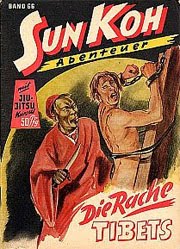
SUN KOH - The Son of Atlantis, the Man of Destiny


"Hey Jules...did you ever hear there was a pulp hero, published in Germany in the 1930s, that was like sort of a version of Doc Savage, except he was a Nazi that wanted to take over the world for Germany?"

I remember a fellow pulp-loving friend of mine told me that and I thought he was crazy because it sounded too weird to be true. But I looked into it and apparently Sun Koh actually did exist.

Even though the stories want us to think he's a noble heroic type, everything about Sun Koh is unintentionally sinister in the extreme. A Doc Savage type hero called "The Perfect Aryan" (creepy!) with blonde hair and big muscles, what sets Sun Koh as different, other than his allegiance to Nazi Germany, is that his backstory is filled with Nazi crackpot alternate history and mysticism.

Sun Koh fell from the sky, a legendary prince of the Kingdom of Atlantis (a land filled with blonde haired whites related to modern Germanic people, naturally - it's laughably mentioned he's related to "Mayan Kings"), sent to warn our time about a coming ice age like the kind that destroyed Atlantis, a cataclysm only the Aryan race can survive and therefore he is sent to ensure its dominance over the planet. He has a tattoo on his back of hidden kingdoms and mysterious places, and a lot of his stories involve going into weird lands in India and using Indian mysticism and yogic techniques. He performed acts like removing ice from Greenland (in accordance with Nazi myths about "Ultima Thule"), going into the Hollow Earth via a hidden ancient tunnel and also bringing sunken Atlantis up from the Hollow Earth so Aryan peoples have more living space.

By the way, I'm pretty sure reading that previous sentence gives you schizophrenia. Sun Koh's stories are so full of discredited racist pseudohistory that if he lived today he'd spend all his time fighting vaccination and looking for Obama's birth certificate. That kind of bothers me because Doc Savage's world was interesting but purely rational.

Incidentally, I've always found it an interesting trait of German science fiction that despite how the technology got incredibly over the top, there was very little space travel at all. After all, when you've got both that AND the Hollow Earth you're just getting greedy.

Sun Koh is a shockingly casual killer. He often rips off artifacts from ancient cultures and takes them without apology. He operates according to "protagonist centered morality," in the sense that what's right and wrong is determined by the main character; opponents are bad guys because they stand against him. In one story, he actually advocated enslavement of a native people at the Hollow Earth. In short, he was an absolute monster. What's creepy about these stories is not how different he is from pulp heroes, but how similar.

Sun Koh has a few allies: two sidekicks including a servile bellboy, as well as a big Negro prizefighter. Later on the pulp introduced Jen Mayen, a fellow inventor and mad scientist that is more his mental equal (and even got a spin-off dedicated to him and his vehicles), and Joan Martini, a sexy woman daughter of an archeologist who was thought to be a crackpot because of his belief in Atlantis and other hidden kingdoms.

By the way, the black American prizefighter sidekick died off a year after the strip started at the request of Nazi officials. The guy got a heck of a sendoff: Sun Koh gave Nimba great wealth which he used to support the Ethiopians against Italy, and he was eventually killed in battle. His last words? "Say hello to Atlantis for me." Not a bad fate for an ethnic sidekick with a lot more dignity than usual - but horrible that it had to happen at all. It's interesting to note this sidekick died the same year Jessie Owens embarrassed the Nazis at the 1936 Olympics.

Sun Koh was obviously a rip-off of the Doc Savage type technology and science hero. Both series lasted over 150 books long, and both started with him going to the Yucatan peninsula, finding a lost civilization of Mayans, and ends with our hero taking back enormous treasure that means he doesn't have to work a 9 to 5 and can just fight evil all the time. Except Doc Savage's Mayan friends gladly gave him the treasure in gratitude, whereas Sun Koh just took it.

What's exasperating about Sun Koh is that unlike Doc Savage, Conan, Tarzan and other far superior American adventure characters that fizzled out without the Gotterdammerung they deserved (damn - there's that Wagner imagery, I've got to stop reading these), Sun Koh actually got a "final story," an "ending" where he conquered the Hollow Earth and Atlantis, long since prophesized, rose from the sea. I want to never stop kicking this guy in the nuts with my all-kosher feet for this: this racist douche got something my favorite hero Tarzan never did.

Friday, April 8, 2011

The Law of Conservation of Ninjitsu - 2007's TMNT Movie


One thing about my viewing of the 2007 TMNT movie kept me from enjoying it fully. I used to think I'm not the type to get misty-eyed over dead famous people I never knew personally, but it was extremely difficult to hear the voice of powerful veteran character-actor Mako.

I had to turn the movie off and come back to it after a while because it was difficult to watch. The movie must have been his final performance, since it came out in 2007 and he died in 2006 (after a quick look at IMDB, apparently it was).

Anyone who pretends they aren't moved when actors they love die are lying. Through art you feel a connection to others.


In any case, I was surprised and delighted to see the new movie "got it." They knew what made the Ninja Turtles tick. Lots of teams like the Fantastic Four are described as a family, but with the Turtles that's literally true: all four of them are brothers, and they have the same camaraderie and competitiveness of brothers with strong personalities. Splinter, the wise old rat that trained them in Martial Arts, is even called Father by the turtles. When he isn't called Master or Sensei because he's that, too. Mako even used different tones of voice when Splinter was their Sensei and when he was their parent.


If the Ninja Turtles are a family like the Fantastic Four, like the Avengers, all the emotional stories and conflict is based around an axis of two characters: one is a leader-type that is responsible and principled, and the other is a wild, brash, proud and ferociously independent guy that bucks at being led. With the Avengers it's Hawkeye and Captain America and with the Turtles it's Leonardo and the angry, tempermental Rafael. Just like Boba Fett was based on Clint Eastwood, Rafael was based on the screen persona of James Cagney. Amazing how much screen time Rafael gets in the Turtles movies: he's not everyone's favorite but he's obviously the writers' favorite, just like Hawkeye was consistently every Avengers writers' pet character.


The movie feels like an actual Ninja Turtles movie, as opposed to what I was afraid it would be: a movie that shamelessly uses the fondness people my age have for the Ninja Turtles to knock off a cheap and fast flick. Yeah, sure, it's animated, but now that I think about it, I'm surprised none of the original Ninja Turtle movies were animated. Like Tarzan, the Ninja Turtles have an athleticism and physicality that only animation can actually bring to screen.

Animation was the best decision ever for this movie because it was filled with monsters and black magic like animated rock golems. Though the movie is a direct sequel to the original live action movies, it combines their New York street-toughness with the Ray Harryhausen weirdness that defined the lighter and softer animated TV incarnation, which had traditional superhero stuff like Dimension X and a scientist that turned himself into a fly monster.


Like Batman, there are several different tones the Turtles take over the years (and like Batman, the sillier things got the more science fiction there was), but this version the Turtles' goofier elements are more subdued and subtle. For instance, there is some pizza-eating, but it's in the background and the Turtles don't go too crazy, and some of their catch-phrases are alluded to but never outright said, like the Turtles have a license plate that says "DUDE-1." Michaelangelo in particular was like his late eighties/early nineties contemporary, Bart Simpson, in that he was pretty much a catch-phrase machine. Michaelangelo still likes to skateboard, which dates the Turtles a lot - but I'm not complaining because it made for some neat stunt scenes and is character-appropriate for a fun-loving, keep it hangin' dude like him.


There was no Turtle Van, Turtle Blimp or Turtle Communicators. The movie borrowed a lot of things from the 90s cartoon (which was to the Turtles what Adam West is to Batman), but apparently the idea of the cash-strapped turtles that live in a sewer having their own friggin' blimp was too over the top to believe. The height of Ninja Turtle high tech in this movie is smoke bombs, plastique and hang gliders. They don't even use that most comic book of all pieces of technology, the grappling hook gun! I guess they're too old school for even that.

The turtles are guys that love what they do: they like adventure and beating up evil Ninjas and it's hard not to like them back when you see them wiseass their way through fights. Why couldn't the relatively humorless Spider-Man movies be more like that?


Thank God (aka Frank Miller, in this universe) this movie wasn't a reboot or origin story. It's a straight up sequel, and it's great to see a movie that doesn't go through the motions and tries to legitimately continue the story. It reminds me of Superman Returns, in that TMNT straight up ignores the bad movies. Unlike Superman Returns we get an honestly new story.

For one thing, Shredder isn't the bad guy again, the way you'd expect of a cheap and easy movie that uses the familiar elements. Shredder is to the Turtles what Lex Luthor is to Superman: he's great but we're all sick of him. Get another villain, already!


Thank goodness they didn't use the villains from the animated cartoon, two borderline-retarded Dr. Moreau animal men named Bebop and Rocksteady with Brooklyn accents that were about as legitimately menacing as Bulk and Skull were.

The main villain is basically a straight lift of the DC Comics baddie, Vandal Savage. An immortal ancient Chinese warlord who uses his immortality to become a super-rich, influential tycoon. Did I mention he was played by Patrick Stewart?


They also did the single most obvious villain to do, but it's such a cool idea it deserves to be mentioned. The Foot Clan are now led by some evil Asian Dragon Lady mastermind, basically a lady Shredder.


This should come as no surprise. Every single Asian mastermind supervillain has a hot, evil daughter that knows karate and wears a catsuit, ever since Dr. Fu Manchu had his evil daughter Fa Lo Suee. Remember Ra's al-Ghul's daughter, Talia? It was downright criminal that the Batman movie with Ra's in it left Talia out since she was the single most memorable element about Ra's other than the Lazarus Pit. First Christopher Nolan mispronounced Ra's's name (it's said Raysh, damn it!), mangled his origin...and now this!


Other than their catsuit-wearing leader, the Foot clan follow the Law of Conservation of Ninjitsu: the more Ninjas there are, the less awesome they are, until a good guy can cut through a crowd of bad guy Ninja henchmen like butter.

The setting is New York. Where else would it be, right? The turtles are street-tough vigilantes, illegitimate children of Batman and Daredevil. The turtles even leave in the middle of conversations, just like Batman does, and they leave criminals tied up to lamp posts like Spider-Man. The comic started off as a parody of Frank Miller, who was so big he created a subgenre unto himself, full of bat-wielding vigilantes, street punks on every corner with colored spike hair, narration box overuse, Sais, Nunchaku, and ninjas, ninjas, ninjas.


By the way, what ever happened to ninja, anyway? Remember when every Martial Arts school switched to black uniforms for a little while because ninjas were so cool? They were a huge craze in America back in the eighties for a while thanks to two guys: Frank Miller and Orientalist novelist Eric van Lustbader. Van Lustbader wrote Ninja and Jian and other airplane thriller novels that were basically the P.F. Chang's version of Asian culture combined with adventure and espionage porno for men, sort of like a combination of Edgar Rice Burroughs and John Grisham and Memoirs of a Geisha, basically a male version of romance novels.


You know, I've actually thought about Lustbader a lot the past few weeks because the tone of all those BBC articles about the destruction in Japan reminded me of Lustbader: "experts" talking about Orientals and their culture in ways that emphasize their solemnity and stoicism in ways that make them stop seeming like real people and make their suffering no longer real, either.

Believe it or not I'm actually a big fan of Lustbader's thrillers because at least they were different; find a stack of thrillers published in the 1980s aimed at male readers and I guarantee two-thirds will be Tom Clancy imitators. Anyway, Ninja had one of the greatest opening "first victim" scenes ever, instantaneously killed by ninja.

Eventually the ninja craze was supplanted by the kickboxing craze, just like the ninja craze supplanted the first wave Kung Fu craze with Bruce Lee. That's a shame because ninja are incredibly supercool and near-superhuman. They have mystique as stealthy assassins from an exotic culture. I love watching old Samurai movies from the 1950s and 1960s where a typical meeting with a Ninja would go with a Warlord in an empty room, except for a shadow that suddenly appears next to him. The warlord would give his instructions to the shadow...the real person never shown and his voice never heard, ever...and then the shadow would vanish from the wall.

Don't get me wrong, the TMNT movie wasn't perfect. For one thing, there wasn't much of a central villain. The main Vandal Savage bad guy wanted penance for his actions and was ultimately a decent person. The Turtles could have walked away at any time; the story felt like it didn't concern them directly. Towards the end it becomes a "call the cops" movie, a film where the entire premise can be undone if someone just called the cops. Overall, it was tightly plotted and everyone got something to do, even Casey Jones and April, and the Foot Clan received one very interesting character-defining bit that showed they weren't just bad guy hirelings but had something to them.

Splinter in particular was very well used in this movie. He even joined the fighting at the end, which was a surprise. He didn't die at the end or disappear like all mentors and he didn't just show up to deliver expository dialogue.

A few things about the Turtle movie that surprised me:

The movie was a short and tightly plotted 80 minutes long. Compared to bloated, overlong comic book movies, that's practically a blessing and no scene feels useless. There are advantages and disadvantages to skewing your audience young and apparently a short length is one of the benefits.


Why is April O'Neil suddenly an expert in ancient cultures? Wasn't she like, a reporter? Like Chakotay from Voyager, a dull character that never got anything to do, Chakotay got skills as required by the plot so he'd have something to do. Also, in a surprise that left me laughing kept out of the trailers for obvious reasons, she joins the turtles in battle in a banana-yellow Ninja catsuit. Oooh, what a toughie! I don't know any TMNT fans...was this something people really demanded to see?


The opening of the film was identical to an obscure, years too late TMNT knockoff called Warriors of Virtue. In Warriors of Virtue, the leader of the Karate Kangaroo heroes, the guy that had his shit together the most, had to spend years in retirement in the jungle hounded by guilt, and the story was about him returning from retirement. No joke, the guy's color was even blue. Like in TMNT, he's even introduced as a shadowy "guardian angel" presence saving some kid in a jungle.

You can tell this movie company, Imagi, is a far Eastern studio (Korean) because when they have Asian characters, they don't look obviously Asian or different from the Caucasian characters. To Asian people's eyes, they don't look any different from us. Though I'm not sure what I was expecting, something that surprised me about Japanese cartoons was how the Japanese drew themselves looking identical to Americans.

Wednesday, March 30, 2011

Samantha Briggs - the "lost" companion


She helped the Doctor crack the mystery of an airport where people were disappearing and replaced by pod people, and she became fast friends with Jamie.

Yet, no list of companions I've ever seen ever counts her among their number at all! But for a while (one six-part episode, The Faceless Ones) Samantha Briggs was a companion of Doctor Who during the Troughton era.

(This one's for you, Eddie, the biggest Doctor Who fan ever.)

It's not surprising she's not better remembered because her debut episode, The Faceless Ones, is totally lost as a result of a mixup at the BBC. After Ben and Polly, the two most "swinging sixties" of all the Doctor Who companions, chose to leave together, there was a mad scramble for several episodes to find a companion to be "the girl."

Samantha Briggs was immediately chosen to be that girl, but unfortunately, despite a personal plea from man-candy Frazer Hines, she turned down a regular part on the series.

The character the show creators eventually chose as the new companion the very next serial was va-va-voom Victoria in the Evil of the Daleks, but not after some deliberation: the character they originally wanted was the Waterfield's maid, Mollie!


Samantha Briggs was groomed to be "the girl" in the very episode Ben and Polly leave, something that the actress's departure put a major crimp in. She was a tough, gutsy, ornery Liverpool girl from the 1960s. More than any other companion, she and Jamie had real chemistry right from their debut episode.

She couldn't have been more different from the sidekick they eventually went with. Victoria was a proper Victorian girl whose most distinctive attribute...other than the obvious, of course...was her Fay Wray scream. Samantha on the other hand was very "mod," a tough London bird and honestly, was a bit of a schnauzer-face. Victoria though, was quite possibly the foxiest companion, at least until that cave girl.


(The irony of Victoria being the prim and proper Victorian lady never ceases to amaze me since apparently in real life she was the Goodbye Girl for the Falkland Islands invasion.)

For the life of me I don't understand why Samantha Briggs isn't considered an official companion. She played a huge role in the resolution of the story, became friends with everyone, and was a scrappy engine for the events of the story. She was clearly groomed to be the big new companion. And even the fact she was only in one six-part serial isn't enough to disqualify her since Sara Kingdom was considered an official companion despite being an ally for only one episode as well! One that is also, by the way, lost.

I for one, would like to see Samantha Briggs restored as an officially numbered companion! That means, when numbering the companions, bumping everyone above her up one spot.

By the way, the actress that played Samantha Briggs, Pauline Collins, was far from done with Doctor Who when she turned down a part as a companion. She later on showed up in the new series playing, of all things, Queen Victoria! I believe she has the record for the longest absence of time between appearances on the series.


Monday, March 28, 2011

Everything you know about these figures is wrong!

There are some figures in pop culture that are no longer characters but are symbols, their names used as verbs. Here’s the problem, though: often everything we know about those characters is wrong, as the characters have been almost totally misrepresented.


The Perils of Pauline


The Perception:

Pauline, according to pop culture, was a silent film heroine who was usually captured and tied to train tracks or a saw mill. She was symbolic of the virginal damsel in distress (and light bondage).

The Reality:

Here’s the thing, though: Pauline often was placed into dangerous situations, but she usually got herself out of them.

It would be crazy to say she was a feminist character or even a really strong woman, but for the time she was a little naïve but smart, scrappy and competent and typically solved her own problems. There were some occasions that she needed a rescue but these were occasional, not constanty.

Pauline was an adventurous female that wanted to be a writer, independently wealthy, and when she got married, she wanted to see the entire world from China to Paris and everywhere in between. Her evil accountant wanted to rob her blind, so he ensured she always faced some mishap.

And while we’re at it, Perils of Pauline is often described as the first of the cliffhanger serials. Only it didn’t have cliffhanger endings! Pauline experienced a problem or life-threatening in an episode and at the end typically solved it. There were no episode cliffhangers.

Incidentally, check out this serial from 1919, featuring both Pauline actress Pearl White as an antiquities thief that duels with Werner Oland as a Chinese gangster. It’s interesting in that both characters are thieves unlike other serials, and also that it features Pauline and Charlie Chan matching wits.


Horatio Alger


The Perception:

Horatio Alger was an archconservative who wrote hoary “rags to riches” stories where scrappy urchin shoe shine boys pull themselves up by their own bootstraps and become wealthy by the end. His stories are fantasies that gloss over real inequality and create a very damaging American mythology.

The Reality:

Horatio Alger’s most famous works like “Ragged Dick” (ha, ha) were all about shoe shine boys and other scrappy underdog kids, but they were not rags to riches stories but have realistic endings where the kids get into middle class respectability in professions like clerk or accountant. He did not write any stories where a kid became Dale Carnegie!

And far from writing stories where a character achieves their status exclusively “by their own bootstraps,” the majority of Horatio Alger stories featured a mysterious wealthy stranger who takes notice, secretly, of some good deed the hero does and works to benefit him in secret.

Let me repeat that: even in Horatio Alger novels, getting ahead is all about who you know!

Seriously, guys! Sure, I am tired of privileged nepotism beneficiaries like Bill Kristol saying poverty and lack of education aren’t real problems because anybody can be a millionaire, so it’s basically the poor’s own fault and they don’t deserve pity. But don’t use imagery of Horatio Alger, who didn’t write the kinds of stories people think he did and if he was guilty of anything, it was being formulaic and a little lazy. Michael Moore wrote a chapter in his slacker-aimed political book “Dude, Where’s My Country?” called “Horatio Alger Must Die.” This was, by the way, also where Moore published his deeply unimpressive Saudi/Bush family connections, which he honestly expected to shock everyone in Fahrenheit 9-11, but instead got a big, fat “why is this important?” from everyone.

What’s more, Horatio Alger was far from an archconservative. He was a Unitarian Minister, which means if he lived today he’d drive a VW van. His later books were often Westerns that were often banned by Church groups because of their extreme and surprising violence. And finally, it’s very likely Horatio Alger was homosexual. Yeah, I know, that’s often said about a lot of figures, but with Alger it’s better substantiated than most: he had to leave the church because of allegations of sex with teenaged boys, not to mention many friends that he confirmed his sexuality with.


Rambo


Pop Culture’s Perception:

Rambo’s name is a byword for macho, testosterone fueled and brainless soldiery, and in foreign policy is often a symbol for right-wing aggression. In pop culture, Rambo is the ultimate pro-violence kill-crazy warhawk.

The Reality:

The actual character of Rambo, however, is nothing like that. In his first film, First Blood, John Rambo was a flashback-fueled veteran that went on a rampage as he was forgotten by society and unable to reintegrate into it. The final scene in the film was a vulnerable and somewhat pathetic Rambo breaking down crying about how he was a broken person that was the inevitable byproduct of war. It’s a mistake to say that the Rambo movies are anti-war, but Rambo was extremely cynical about it, even when he became a bow-wielding superman in the later films. Even in the violence-intensive later films, Rambo was still a tragic, pessimistic, doomed figure who had nothing in his life.

Rambo is the flip-side of Rocky Balboa. Whereas Rocky movies believed in America and the underdog, Rambo movies are always cynical and bleak, with Rambo as an expendable, Samurai-like, Zen figure that became war itself.

In the later films there was a lot of violence and mayhem and it’s easy to misinterpret that. Kurt Vonnegut once said that there was no such thing as an anti-war movie, because all war movies glorify war somehow.


Tarzan


The Perception:

In the movies and television shows, Tarzan is typically a monosyllabic caveman that lives in a crummy treehouse, a wild man that’s a little on the slow side.

The Reality:

Two things about reading the original Tarzan novels take everyone by surprise: Tarzan is intelligent, and Tarzan is violent.

Tarzan taught himself to read with books left by his castaway parents when he had no spoken language, and in the book series later learned to speak perfectly a dozen languages including French and German. He could pass for a distinguished gentleman (at least on the surface, anyway), which made his savage nature all the more dichotomous and surprising when he ripped his nobleman’s clothes off to rush into the primitive. Return of Tarzan had some shocking images of a heartbroken Tarzan spending time in Paris smoking cigarettes, drinking absinthe and going to art galleries.

And for that matter, Tarzan didn’t have a treehouse. He lived with Jane in a sizable and wealthy plantation house in Africa, a compromise Tarzan was extremely unhappy with, but which he did to keep Jane happy.

Finally, Tarzan was a superwarrior of tremendous strength with a surprising bloodthirstiness that was animalistic – nature red in claw and fang. In Beasts of Tarzan, he actually killed a deer by sinking his teeth in until he drew blood. Tarzan was explosive and strong and a little scary and intense. To my knowledge, these two attributes give Tarzan his mystique and make him intriguing, but I’ve yet to see ‘em in any TV or movie version of Tarzan.

By the way, what do Tarzan and Horatio Alger have in common? Both were published in the first pulp magazine in existence. The Argosy got its start publishing Alger's serials. By the 1910s it changed its name to "All-Story Weekly" where Burroughs printed, in serial form, the Tarzan novels.

Sunday, March 20, 2011

RPGs made under license

RPGs produced under license have incredibly stringent rules about faithfulness to content and that can result in odd and hilarious situations where RPG writers try to passive-aggressively undercut elements of the world they don’t like.

Screw Medichlorians!


I’ve yet to see anyone in a Star Wars RPG product (or, for that matter, any other bit of Star Wars lore like novels and comics) ever mention or utilize the terminally retarded Medichlorians concept.

This is especially strange because in Star Wars RPGs, I’ve seen detailed treatments of something as throwaway as the Kessel Run used as the basis of an entire product, complete with gameboard, map and tokens, not to mention elaborate and detailed RPG treatments of Cantina-scene background races like the Hammerheads and walrus-men.

Medichlorians were explicitly described in the Phantom Menace as part of a huge exposition scene, yet much more detail and energy was spent in the roleplaying game devoted to what the monsters in Chewbacca’s holographic chess game actually are! You can’t tell me that’s not passive-aggressiveness in action.

Here’s another case of Star Wars RPG writer passive-aggressiveness: the adventure module “Tatooine Manhunt” by Bill Slavicek and Daniel Greenberg.


Have a look at that cover. Doesn’t it sound like the coolest thing you can do at your gaming table…have your buddies fight against the awesome, ruthless bounty hunter enemies in Star Wars, like Boba Fett, the Terminator-esque unstoppable assassin robot IG-88, and the lizard guy Bossk?

But wait! Look on the inside.


That’s right – for some reason, the module couldn’t use Boba Fett, Bossk, IG-88 or the rest. But that sure didn’t stop them from doing what the writer wanted to do! He made characters that are so identical to the iconic Star Wars baddies that to call them knockoffs would be misleading, because at least a “knockoff” would imply distance, that in some way these are different people. What happened was, most likely someone told them the characters were unavailable so they went and wrote this.

Star Wars is an interesting case because in many ways, the RPG created the entire expanded universe as we know it. You see, the RPG was the first place to consolidate information about the setting and revealed information previously unknown…so therefore RPGs were for a long time, only Star Wars “reference books.” Because the RPG materials were Lucasfilm-licensed, everything in them was first vetted and therefore totally canon! People writing the novels and comics had to read the RPG books because they were actually the most complete sources of information available on the Star Wars galaxy.


She-Hulk in Fantastic Four


If you replace a member of the Fantastic Four, no matter how good of a character you are, people will hate you because these guys are so beloved. Remember that loathesome motherfucker HERBIE, who replaced the Human Torch in the cartoon?

That goes double for any character that replaces someone as awesome and universally liked as Ben Grimm, who is quite possibly the Morgan Freeman of the Marvel Universe: the guy everybody likes. Take the TSR Marvel Super-Heroes game module, which features the FF vs. Arcade.


The adventure module “Murderworld!” by Jeff Grubb had to use She-Hulk because the TSR game was set in modern continuity, and someone working under license can’t pick and choose. It’s not “cafeteria canon.” But it was obvious the writer wasn’t a big Shulkie fan. For instance, Ben Grimm’s statistics were prominently given in the back “for game masters that want to use him.” Uh, okay.


Notice his sheet is as big and prominent as She-Hulk’s despite the fact the character’s not even in the adventure module!

What’s more, when the FF arrives at the killer amusement park Murderworld, the She-Hulk’s ironic deathtrap was being on a simulator plane targeted by a gauntlet of traps and missiles and so on. The other heroes’ encounters were perfectly tailored for them in a traditional Arcade way. Placed in a plane? That’s something one would subject Ben Grimm to, since Ben used to be a pilot and war hero.


They mention briefly in the module that Arcade assumed the Thing was still in the FF. What does this mean? Two things:

1) The story as written makes no sense if used with She-Hulk but plenty of sense with Ben Grimm. Ben Grimm could fill in for Greenie and it would not require anything about the module to be changed!

2) Even in the story itself, the module writer made sure people are going, “hey, where’s the Thing?”


Women and the Lens


In the Lensman novels, Smith went out of his way to explain that women can’t use the Lens and have minds totally incompatible with the Lens in terms that are hilariously patronizing. There was one scene in First Lensman where it was deliberately stated that one female character went to Arisia and was outright refused to be granted status as a Lensman as she didn't have the mentality for it. This is canon, inarguable as gravity.

To say this creates a problem for gaming is an understatement. To REQUIRE a female player to play a male character against their will is pretty awful, and for the worst possible reason imaginable: because it’s impossible to enjoy being a woman in the setting that’s not a noncombatant nurse.

The Lensman RPG manual desperately tried to work around this limit in a way that could best be described as subdued panic. In fact the guy that wrote the guide once said in an interview that he was nervous about taking on the project because it would piss off his wife! The book contained a few sly, subtle hints slipped under the radar about how something like a female Lensman could be possible. One of them expressed a compromise possibility that perhaps Clarissa MacDougall needed to be the first female to use a Lens and after her, others were possible. That doesn’t make any sense, but it was something.