Wednesday, December 5, 2012

Explaining Fan Behavior: Why some things get devotion


Here's a question: why do some fictional worlds and properties attract incredibly devoted fans? I mean, some do, and others don't.

There are many, many reasons a fandom becomes big or assumes the form it ultimately does, including a combination of luck and visibility...although that's not quite what I asked. What is it about the properties themselves? What do they all have in common?


According to the unofficial history of Star Trek by Bob Justman, the first Star Trek convention was far from a spontaneous gathering. It was run by Gene Roddenberry himself and he rustled people in from all over. In other words, part of the reason Trek fans are so big and organized is (partially) because of talented huckster Gene Roddenberry's talent for self-promotion.

Lord of the Rings was a low seller in a niche genre that didn't even have a name yet for an entire decade, released at the same time as now-forgotten Thomas Burnett Swann's Minotaur books or Mervyn Peake... until LotR was rediscovered by the 1960s counterculture. The hippies found the story's themes of hostility to modernism, love of nature, and longing for an imaginary past were all right up their style.


Star Wars had the good luck to be a big studio distributed movie, so millions of butts were going to be in chairs to watch it no matter what. But it success is not just because of that. Part of the reason it was a big hit, a phenom we're still talking about now, was it was the right story at the right time. The Western was now passé, previously the #1 action genre and the single greatest American source of stories about ourselves and our self-concept as a country, as well as our battles of good versus evil. The entire 1970s were filled with grim, adult, director driven movies. Star Wars was a battle of good versus evil not seen since Errol Flynn stopped swashbuckling, with fairytale characters like a wizard and pirate. It was, in short, the right kind of story at the right moment.

And on a lighter note, part of the reason furry fandom is so oddly sex crazed and gay friendly, is because the first furry conventions in the early 1980s were put together by a flamboyantly gay swinger/S&M lover who actually invited just released prisoners from jail to show up! This jailhouse gay and S&M attracted others into the same scene, repulsed others that didn't care for it, and in general set the tone for years later.

Okay, okay, back to my original question: why do some fictional worlds inspire so much devotion and others don't? What do they all have in common that get people to still think about them?  After all, the hippies came and went, but Lord of the Rings is still around, and there are still kids in high schools today writing notes in Dwarf runes.

If you look at the really BIG fan groups out there, like Star Wars, Star Trek, Lord of the Rings, and the Marvel and DC Universes, you find that people are so obsessive about them because these worlds have built up enough detail that it's possible they're engrossing and "full" enough to capture the attention.


The more real a story feels, the more engaged you are. Just like significant descriptive details in a book bring a scene to life, the richer and more developed a world is, the more minutiae fans can collect like stamps, the more devoted your fans will be.

Here's a secret: hardcore fans like their world and devote so much time to it because they think it's real. 

…Okay, that's obviously not literally true, except for a tiny handful of seriously mentally ill people.

But really involving worlds and stories are set in places that make you FEEL like they're real, have verisimilitude, that the stories don't end the instant the book is closed or the movie ends. There's plenty going on to make you think about it later on, or talk about it with friends aneven have fights over nitpick details, and curiosity over some of its unexplained mysteries. This is why fictional worlds can be such an engrossing diversion. This is why people get very curious and so very passionate.

We fans do this not because we think the story is literally real, but because we like suspension of disbelief. Because when people tell us a story, we want to believe it. That's the difference between a liar and a storyteller: people are by default suspicious of liars, but want to believe a story.


This is also why adaptations can sometimes be frustrating for fans. Because we believe there is a reality behind these characters and worlds that do not vary or change. A reality that is independent of the free market, cultural, and business forces that take place in our own world.

Even disagreements and fights between fans are based on the idea characters are independent of us readers/viewers, solid and concrete. People have disagreements about whether Spider-Man would or wouldn't behave a certain way. This disagreement is only possible at all because everyone agrees there is a "correct" way for Spider-Man to act.

Okay, now, here, we've reached the first of definition of continuity:

Continuity (or canon) is just another word for verisimilitude, a consistency that makes the world feel more real, by making the world feel as if it continues beyond the boundary of the specific narrow focus of any one single story.

An individual story, by definition, have a laser pinprick focus and economy. Stories can't be "about" everything. Look at a map of Middle Earth and see how much of the place our heroes actually DIDN'T go, even in a story as sprawling as Lord of the Rings.

The purpose of continuity and consistent canon is to dispel the artifice of stories, that a world is not just a series of empty plywood "Potemkin villages" that live when tourists pass by and are yanked down just behind us when we leave.


This is why Sherlock Holmes fans are so fascinated by the tantalizing hints Sir Conan Doyle dropped about cases only mentioned in passing we never got to actually read about. Because it implies Sherlock Holmes and Watson are alive, are doing things when we're not looking. They have a reality independent of what they're doing when the "camera" is on them.


"It's just a story"

Contrary to popular belief, being a fan, even a detail oriented one, is a good thing for the same reason any hobby not pursued to the exclusion of responsibilities is a good thing: because you get out what you put in. Cool detachment eliminates the entire point of a whole story, where you want to be passionate and care about what's going on.


That's why I've always thought there's something oddly inhuman, so defeating to the entire purpose of fiction of any kind, with people who respond to certain kinds of criticisms with, "who cares, it's just a story. Consistency doesn't matter because it's all fictional in the end." It shows a kind of brutal cynicism I don't like, that whoever said it doesn't feel the world is real. It's all a put up job. If it isn't real, why get engrossed or involved?

Why care?

I don't get that argument. If you don't care, why read a story at all? Why read a series long term?

This is also why fans find continuity glitches so galling. They tatter and undermine the suspension of disbelief fiction needs and imply something doesn't have verisimilitude. They create a "trust" issue.

This is also why fans are fascinated by cross-overs. The fact that Spider-Man can swing on the rooftops of Marvel Manhattan and cross paths with Daredevil going the other way makes the Marvel Universe feel more real.


Why Do Fans Like the Obscure?

This is also why fans get tickled pink when obscure characters and minutiae show up, why Star Trek fans smile a bit when a Next Generation episode mentions the Tholians in passing, or when people are delighted to see a minor character like Stingray or D-Man in the background of an Avengers mission.


Those of us that aren't children know, but only at an intellectual level, that stories aren't real, and are artifices with a very narrow focus, that the Tholians were just created to be bad guys for one episode way back when in the old show, and Stingray was an Avenger only used in one story that needed an underwater guy, and that a good portion of super-villains, especially unpopular ones, will never be seen much again after their first story.


Mentioning obscuros again dispels that artifice we're intellectually aware is there ("this is just a story"), and reminds us, to our joy, that the world is real, that these characters are still around and doing something even when we're not looking. The Tholians are out there, somewhere, up to mischief. Stingray can be called up at any time by the Avengers when needed.

In short, the world goes from something we like to something we believe. 

And that's the difference between just liking something, and being a fan.

Saturday, July 21, 2012

How She-Hulk became the character we know her as today


It's interesting to read the David Anthony Kraft original, introductory Savage She-Hulk series, because the earliest take on the character is almost totally unrecognizable to how we know the character of She-Hulk today. When we think of She-Hulk, we see her as  confident, exhibitionist, aggressive, lives-life-with-gusto, who loves getting attention and being superstrong, and despite her shocking giant size and green skin is endearingly normal, an everywoman doing things like watching TV in bunny slippers while eating cheesecake.


She-Hulk, at least as we know her today, has whacked-out outer space adventures featuring beloved, eccentric, weird Marvel comics obscuros like the Toad Men, Mahkizmo, the return of the Living Eraser, Xemnu the Titan ("I have no mouth and I am mean"), and bizarre supporting characters like the space diner from forgotten space-trucker series US-1 (like the gimmicky Matter-Eater Lad from Legion of Super-Heroes, mentioning and using the canon of US-1 is the whole joke).


With Shulkie there's always a sense of humor involved. When Steve Gerber's writing, it's the kind of surreal, occasionally dark comedy we associate with Howard the Duck (in fact, not only was Howard the Duck a side character, but so was Gerber's Dr. Bong).

With John Byrne, there's broad comic plots like how he-man woman hater Mahkizmo's sinister plot to kill the female population stops when someone explains to him where babies come from. Not to mention some clever fourth wall breaking sight gags.

(I always figured the "in-universe" explanation for Shulkie at times believing she's a comic character is, she has an extremely weird sense of humor and talks to herself sometimes.)


In fact, the earliest series featuring the character is almost shocking compared to the character we know today. The biggest difference between the modern take on She-Hulk, and the "savage" She Hulk is that in her early stories, She-Hulk is a really a mean, intimidating, impolite person, who is very intense and scares people like the gray "Mr. Fixit" version of the Hulk, and constantly has to struggle against her own terrible, savage temper. Her instinct is brutality, but unlike the Hulk, who's just a creature of rage, her emotions and brutal instincts are something she has control over and can resist.


Just look at the image at the corner of her comics. That's a scary Grace Jones face of a lady you wouldn't mess around with, and who certainly wouldn't wear bunny slippers while eating cheesecake.


The Savage She-Hulk, unlike the Hulk, has to remind herself that she's no killer, and that killing would make her as bad as the enemies she fights. This is an illuminating insight into Jennifer Walters' psychology because, as all Hulk fans know by now, the Hulk could never kill because Bruce Banner could never kill.

Another difference is, when She-Hulk sees the cops, she runs away. Like the original Hulk and to a lesser extent Spider-Man, she was misunderstood and framed as a murderer, and when people see her they figure she's up to no good.


If I were to go for a no-prize explanation for She-Hulk's transformation, it would be as she received her powers from a blood transfusion from the Hulk, her initial transformations were similar to the Hulk: defined by Bruce Banner's anger, outrage, and alienation.


Finally, to someone used to the surreal Gerber take on the character, or the fanciful early Marvel silver age-inspired Byrne years, it can be shocking to discover how downright normal the first She-Hulk book's plots are. She-Hulk has a Spider-Man style supporting cast of perfectly normal people, from her Dad the sherriff who believes the She-Hulk is a public menace, unaware the She-Hulk is her own daughter. The standout, at least to Gerber Man-Thing fans, is Richard Rory, a Roy Thomas look alike who is easily the most unlucky guy in the world. This lends credence to my idea, incidentally, that David Kraft was a Gerber disciple: notice how similar the Scorpio arc in Defenders #48-50 is to Gerber's preceding work.


Most of the stories are about the emotions of perfectly ordinary people like Gerber's Man-Thing, and with She-Hulk's tube-friendly law background playing a huge role and the absence of real super-villains, make me suspect the original Savage She-Hulk seriesmight have originally been meant as a bionic-woman style television series instead of a comic book.

I wonder how the transformation of She-Hulk from Grace Jones "Ms. Hyde" to sex-bomb "everywoman" took place.

There are many examples of characters who get sexier, younger, and slimmer when nobody's watching (Miss Piggy and the Wicked Witch of the West come to mind), but what's unique about She-Hulk is what happened in popular culture between She-Hulk's first series in 1979, and what happened by the time she came back to her own series in the late-1980s: namely, the rise of female bodybuilding as a sport, advertised by very alluring cover girls, pushed by the Weiders as the "face" of a new industry like Rachel McLish and Gladys Portugues.


Ask most Baby Boomers about female bodybuilders and they'd probably tell you it isn't biologically possible. After all, Superman had both superstrength and a super-physique, whereas Supergirl was just superstrong.

\

In 1981, the same year the original version of She-Hulk was canceled, the Weiders started the first significant female bodybuilding contest, the Ms. Olympia. Bodybuilding as a sport exists as a promotional venture for the Weiders' fitness supplement and magazine empire, so the creation of female bodybuilding was an attempt to spread to a whole new "product demographic." Therefore, the women featured had to be glamorous, attractive girls…or else who'd want to be a bodybuilder and buy the Weiders' products?


Muscular women were not new (check out Abbye Stockton from the golden age of muscle beach!) but the importance of them as alluring cover model types was new. Bodybuilder Kike Elomaa, the only woman to ever beat Rachel McLish back in 1982, became a pop star in her native Finland and is currently a member of the Finnish Parliament. (I am NOT making that up.)

Female bodybuilders as models designed to sell the product of fitness came to a high point in the early to mid 1990s with Sharon Bruneau, a half-French, half-Canadian Indian who actually, literally was a former fashion model who switched to weightlifting for kicks.


Female bodybuilders were basically sex-sells advertisements for the Weider empire, and it's a funny thing about advertising: it creates demand where there wasn't any before. After all, the entire idea of halitosis was created to sell Listerine.

What was that line from Mad Men? "What you call love was invented by guys like me to sell nylons."


Come 1984, pro competitor Anita Gandol posed nude for Playboy magazine. The very year John Byrne brought back She-Hulk, 1989, the TV show American Gladiators debuted, and one of the selling points and most memorable trait were the foxy lady bodybuilders.


The fun, cheesecake-y Marvel Swimsuit Illustrated had a great text piece about Shulkie written just like a female bodybuilder physique piece in Flex or Muscle & Fitness.

And didn't anybody else notice most covers of Shulkie from 1981 on basically have her in a pose and build that looks like it was traced from a Rachel McLish magazine cover?


To be clear, in the telephone game that is superhero comics, no one single person is responsible for the change-over to the "funny exhibitionist" She-Hulk, which is my point: the change in thinking about the character was gradual as pop culture changed around them. Typically, Roger Stern gets credit in his Avengers run for the modern She-Hulk as a glamour gal who enjoys having superstrength and isn’t an antisocial outcast (a take Byrne and Gerber inherited and rolled with) but even by the end of the David Kraft version, She-Hulk did occasional things like have fun at the beach with her powers, and described being the She-Hulk as addicting.


In conclusion, the principal reason She-Hulk went from an intense and oddly Grace Jones-like asexual character to being a much more popular sex bomb over time was because after the original series ended, advertising forces made female bodybuilders attractive and glamorous figures in order to sell products, a marketing force for which Shulkie was an accidental beneficiary. For the first time ever, a character like She-Hulk could have sex appeal as a major part of her character.


The surest way to cure yourself of naivete is to read up on the history of marketing. Don't think you can be manipulated by advertising? Great. That just means you don't know how it works and can be played like a fiddle by it.

Sunday, June 24, 2012

File-Sharing as a Culture-Preserver: the case of the FASA Star Trek Combat Simulator


From the perspective of somebody with a background in digital archiving, copyright is a squatter's right, defined by the ability to deny content to others.

The overwhelming majority of works are not Harry Potter, still sold, published, and making money. Most materials under copyright are not reprinted, not available, not distributed, with the rights no longer belonging to those responsible for its creation. But if an archivist tried to digitize it and make any of it available to their patrons without permission…wham! Infringement lawsuit.


This is a real problem because of the paucity of the public domain, which as a result of lengthy copyright durations, excludes nearly the entire history of motion pictures and music; in other words, the entire culture of the 20th Century. 

The interests of digital archivists responsible for making information and materials available, and the interests of copyright holders, are directly at odds with each other.


This is very strange, because computer technology has advanced to the point that information and content are infinitely reproducible via computers. To use a Star Trek metaphor (both for accuracy and to get everybody in the right mood) a computer is like a food replicator. With enough power, it can make infinite copies.

 To quote lawyer/advocate Eben Moglen, who may or may not have been a Star Trek fan:

"The great moral question of the twenty-first century is: If all knowledge, all culture, all art, all useful information, can be costlessly given to everyone at the same price that it is given to anyone — if everyone can have everything, everywhere, all the time, why is it ever moral to exclude anyone from anything? 
If you could make lamb chops in endless numbers by the mere pressing of a button, there would be no moral argument for hunger ever, anywhere. 
I see no system of moral philosophy generated by the economy of the past that could evolve a principle to explain the moral legitimacy of denial in the presence of infinite profusion."

"Copyright maximalists" who take the most extreme and controlling view of the function of copyright, try to phrase copyright as a moral issue, and make an overly simplistic comparison of copyright infringement to "stealing" a physical object, and argue that downloading is denying compensation to the creators.


This doesn't work because there's no 1:1 comparison between a downloaded copy and a lost sale. By that logic, a checked out library book equals a lost sale, and lending a book to a friend is a lost sale. Most of us discovered our favorite books not because we bought them outright but because someone lent them to us. In that sense, online copying serves the same function lending a book to a friend does: discovery. 

As Cory Doctorow put it: the greatest enemy of creators isn't copying, but obscurity.

The "file sharing is stealing" argument gets even stranger when, in the case of some copywritten works, it makes you ask, "stealing from who?" 


A perfect example would be the FASA Star Trek Starfleet Tactical Combat Simulator game, made under license by the game company FASA, printed between 1981 and 1989. The STCS occupies a strange niche between wargame simulation, board game, and roleplaying game, where, on a hex map, players take the role of competing starships battling each other.

These days, not only does FASA no longer exist, but it lost the license to print Star Trek materials. In other words, there is no way I could ever directly compensate the makers of the FASA Star Trek game, mostly because FASA ceased to exist. They no longer have the license and the materials are out of print. I could buy the game secondhand on ebay or find some dog-eared copy at an old game store, but in either case, FASA would receive no money for the same reason textbook publishers don't receive money for the sale of used books.


At the same time, I am very pleased to have found copies online of the FASA books and I have run the game with some friends and printed counters on a dry-erase hex grid. To put my discovery into context, keep in mind that I am not exactly this game's target audience. As someone who was not alive when the game was originally published and in its heyday, I first discovered and picked up a copy of the rule set because it was possible to do so online. 


To my great delight, there are still some people keeping the Star Trek: Space Combat Simulation Game alive, almost entirely those who remember its heyday back in the 1980s. For instance, visit this website for the Star Trek Tactical Combat Simulator Database and Archive. The STCS archive explains its purpose like this:

Think of the STSTCSOLD&A as a nature preserve, designed to harbor a vanishing species of pencil and paper amusement. In a world now dominated by advanced computer games, the STSTCS is a beloved relic, akin to classic automobiles or vintage wine. In creating the OLD&A I am doing something similar to restoring a car, combining new parts with an old chassis, repainting the body panels and polishing the glass. As with most car restoration, the entire OLD&A project is a labour of affection, done solely for the sheer satisfaction of the thing. With my STSTCS game books slowly falling into shreds, I hope to preserve the essence of the STSTCS in a medium that cannot be dulled, dimmed, smudged, ripped, or otherwise folded and spindled by time. I also hope to bring a new generation of Trek fans into the Old World of gaming where mental activity, not processor speed, powers the action.

When copywritten material is totally lost, you're not just losing the material, but the culture around that material begins to disappear. Preserving materials is like preserving a culture. Mystery Science Theater 3000 can't obtain the rights to reprint some of the movies they licensed to spoof, so a longstanding piece of advice by Mike Nelson to his fans is to "keep on circulating the tapes." It's copyright infringement, sure, but it keeps a huge chunk of a fandom alive and saved from total oblivion. There are hundreds of episodes of Doctor Who that were thoughtlessly erased by accident by the BBC in the 1960s, which are only preserved now because fans saw fit to audio record the episodes as they watched.


Despite all that, the STCS Archive keeps away the one thing that really would play a role in new players rediscovering the game, which allowed a person not present at its heyday to get involved and become an active participant in the community.

Sadly, the one item most fans want most is the one item I cannot provide. At least half of all the letters I get are from relatively new and/or returning Trek fans who are just finding out about the game, or are rediscovering the game after a long time away from it. In both cases, people are desperate to try and get their hands on the game rules themselves, either because they never owned a copy of the game or because they were foolish enough to get rid of the game at some point in the past. While I would love nothing more than to provide each and every fan with a verbatim transcript of the entire STSTCS rules book, it came to my attention in 2001 that a third party purchased the rights to the rule system that the STSTCS is based upon. This third party is jealously guarding these rules and has already contacted other, older STSTCS sites in an effort to get them to take down any and all portions of the rules that have been posted on the web. So far nobody has been hauled into court, but I don't want to be a trendsetter in this regard so I am steering clear of this known legal iceberg.

That was written, by the way, in 2001, when FASA stopped printing and started licensing their intellectual properties (including famous pen and paper RPGs like Shadowrun). Since then, the company in question, which incidentally did not even create the rules and game system itself, has done absolutely nothing with the property. Does anyone still doubt me when I say copyright is at times a squatter's right?

This strategy is even more shortsighted when one considers that the future of any business model in the digital age is to directly create a personal relationship with fans, communicate with them, and give them a reason to buy. What possible reason could there be to get litigious with those who might be your greatest customers?


This is a shame, because if the FASA game was reprinted I would absolutely pay real money to buy a copy now that I know it exists. For one thing, rules are easier to consult at a gaming table if they're in printed book form, and it would be great to have "official" playtested game statistics to represent Next Generation and later era starships (due to the timeframe of FASA, only the original series is really well represented and detailed). Also, there haven't been any new FASA miniatures made since the 1980s, something people will pay for because there is a real scarcity, not an artificial one.


Because I got my hands on STCS files, a customer now exists in me (and my friends) that didn't exist before, and I am proud to talk about and promote the STCS.  


What does all of this mean for digital archivists and information science professionals? Only good things, if they understand their changing role and required skill set. Institutions, like academic libraries and historical databases, should stop thinking about building their "collections," considering the spread apart, decentralized nature of modern content on the internet, and instead emphasize the reference skills of their own IS professionals to get patrons in touch with what they want, wherever it is and wherever it can be found.

The end result of all this is that file-sharing can play a role in preserving culture from oblivion, and expose new audiences much more thoroughly than inflexible squatting can. Somewhere out there, the teenage or 20-something Star Trek fan who will end up becoming the biggest fan and ultimately paying customer for the FASA STCS is only a click away from having his mind blown.

Monday, March 12, 2012

Julian Perez Goes to the Movies: "John Carter" Review


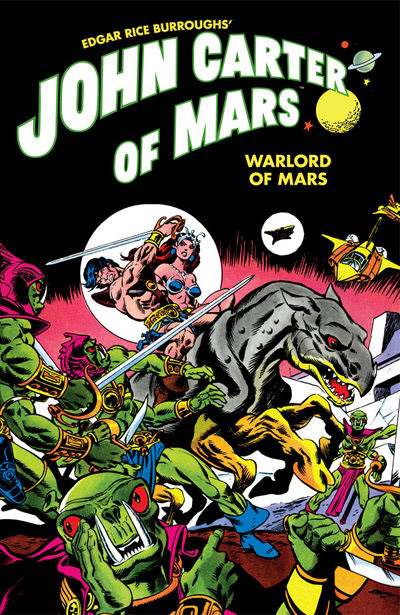
Short review: a good old fashioned swashbuckler movie with a lot of humor, but one that's dragged down by giving testosterone hero John Carter a "sad" backstory. Stay for Woola's cuteness, Dejah Thoris kicking butt, John Carter leaping, the flight scenes in 3-D, and the surprisingly warm father-daughter subplot. As far as a Burroughs adaptation goes it's very good but not perfect, but it's got everything your inner eleven year old wants: the coolest dog in the world, a four armed best buddy, and winning the hand of a gorgeous princess with swordfighting.

After a whole century without an adaptation...am I the only one bugged by how they chose to pronounce things? I always pronounced Issus as Aye-sus (same as Isis), and Dejah Thoris as DEE-juh Thor-Us.

Long review:

The movie's take on Dejah Thoris, the original work's greatest dragging liability, is a success. She had to be changed somehow and what they did worked.


Not only is the leggy, muscular, exotic, bronzed Lynn Collins a twelve year old boy's dream girl, she's also a scientist and a warrior, heroic and intelligent. She's a princess, but her princess persona is a put on she can slip on and off to cover her personal anxieties. Unlike other newly upgraded martial heroines, the story actually commits to her being a great fighter, and she plays a role in the end of the story and doesn't lose her martial skills when they're inconvenient to the plot (unlike Maid Marian in Prince of Thieves), and she actually wins fights (unlike Kate Beckinsale's fake action girl in Van Helsing).

She actually uses her great intelligence in several scenes to figure out Thern technology and translate inscriptions. She's less a movie girlfriend and more a Spock-like smart sidekick.


She's also a scientist and…well, ask yourself this. When was the last time in comics or pop culture you saw a FEMALE inventor or supergenius?

Making Dejah Thoris a supergenius is actually a pretty good substitution in the story. Previously, Dejah Thoris was captured all the time because she was the world's most beautiful woman and often did things that were self-destructive or moronically out of character, like suddenly insist she was going to marry Sab Than out of nowhere. If Dejah Thoris was a scientist on the verge of a great discovery, it makes sense villains trying to stifle that discovery would try to have her killed or captured.


By the way, when I first heard Dejah was going to be a scientist in the movie version, I was totally shocked because she was so useless. But actually, Dejah being a scientist is a pretty legit interpretation of what she was actually doing. Take this selection from Chapter X of "A Princess of Mars."

“What is your name?” asked Lorquas Ptomel, addressing the prisoner. 
“Dejah Thoris, daughter of Mors Kajak of Helium.” 
“And the nature of your expedition?” he continued. 
“It was a purely scientific research party sent out by my father’s father, the Jeddak of Helium, to rechart the air currents, and to take atmospheric density tests,” replied the fair prisoner, in a low, well-modulated voice. 
“We were unprepared for battle,” she continued, “as we were on a peaceful mission, as our banners and the colors of our craft denoted. The work we were doing was as much in your interests as in ours, for you know full well that were it not for our labors and the fruits of our scientific operations there would not be enough air or water on Mars to support a single human life. For ages we have maintained the air and water supply at practically the same point without an appreciable loss, and we have done this in the face of the brutal and ignorant interference of your green men."


The idea she might be a scientist is a perfectly legitimate interpretation of these events, although most people figure Dejah was just there as a royal administrator.


Taylor Kitsch, surprisingly, did a good job as John Carter. He brought to the character a kind of Eastwood-esque serious manliness, and a very Southern chivalry that's the core of the character. He politely refers to everyone as either "sir" or "ma'am." Even the bad guys.

The scenes where John Carter jumps around like a rubber ball under low Martian gravity were really effective and infectiously exhilarating and fun.

One of the things I always thought was unique about John Carter of Mars is, John Carter goes native and adapts to Barsoom really fast, and because Mars is so darn cool, prefers to stay there rather than go back to boring old earth. I never understood why Dorothy Gale wanted to go back to drab, black and white Kansas when she was a universally beloved heroine in the much cooler fantasy world of Oz. To its credit, the movie gets this totally right: when John Carter is forced to leave Mars and the girl he loved we feel the wrenching pain as he returns to Earth a million miles away, never knowing if he'll ever return. The painful removal from Mars, something that later became the emotional core of the Adam Strange series, was perfectly captured here.


Unfortunately, Kitsch's solid performance is undercut somewhat by the fact the script  "fixes" a problem: John Carter doesn't have an arc as a character. This "problem" is solved in the most hackneyed way possible: instead of making John Carter the testosterone-personified, energetic he-man hero we know he was, he's saddled with a "sad hero" backstory. Would I shock you if I told you there were lots of flashbacks to a lost family?


The idea John Carter was a bitter, cynical veteran who constantly insisted he shouldn't get involved and didn't want to go back to Earth chews up and wastes the movie's time, and doesn't play to Taylor Kitsch's strengths.

The movie's strongest and surprisingly emotional subplot is Tars Tarkas's father-daughter relationship with Sola, the only Martian female to know her real father and family. Tars Tarkas is protective of her, and love for her motivates everything he does. Since Sola knew love and family among otherwise loveless and unsentimental creatures like the Tharks, Sola stands out as a screwup who doesn't fit into society perfectly. This is the only time the otherwise drab "sad hero" backstory for John Carter is actually used to really good effect. Because he recognizes something of himself in the big Thark.


Woola of course, was downright perfect and steals every scene he's in…but that's obvious. You can tell the guy who did this movie also did Wall-E, because its best character is a silent little monster.

There was one moment in John Carter of Mars that got an ERB-fanboy charge of excitement out of me.

While in the wilderness, gentleman John Carter and his friends were chased by the hordes of Warhoon, a type of Green Martian more savage and ferocious than others of their kind. The creators of the movie totally nailed it. They looked the part: feral, cruel, covered in bones, scarred and fearsome. It was something I'd waited to see brought to life since I read the books as a Tarzan-loving kid. The presence of the hordes of Warhoon was an indulgence that, according to an interview, Andrew Stanton fought for, to the point he "traded off" an appearance by banths, saving the fierce, distinctive Martian lions for a sequel.


Strictly speaking, the presence of the hordes of Warhoon wasn't entirely necessary to the story, but it showed a fannish gusto to bring Barsoom to screen. I wish there had been more moments like that because there were so few. This was also why Green Lantern and Percy Jackson were such empty movies despite coming from such innovative source material: they saved everything interesting for the sequels, assuming they had all the time in the world.

The lesson here for future film-makers is, even when doing movies intended to be franchise starters, treat every movie like it was the last one. Because there's a heartbreaking chance it just might be.


It feels like a dick move to criticize a movie by mentioning all the things it didn't have, but was it impossible to show some people in the background playing Jetan? No reference to even the merest hints of the existence of the First Born, Kaldanes and the Okarians? No ulsios or soraks scuttling around in the background? A huge chunk of the movie was set around Zodanga. So, no background appearance by someone who is undisguisably Rapas the Ulsio, Zat Arras or Fal Sivas? Nobody swearing "by their first ancestor?" No shots of mastodon-like zitidars? (Thoats are the only beasts of burden used in the movie version of Barsoom.) No one person in the background in a diamond harness who might be a Gatholian? No dropped hints of a lost Ptarthian princess who would later be revealed as Thuvia in the next movie?


All this sounds fannish and nitpicky and I understand that. But I was under the impression from all the press materials I was going to get a movie by lifelong Barsoom fans bringing Barsoom to screen for the first time after literally an entire century of waiting, given gobs of money and freedom. I was expecting the Martian equivalent of the fan friendly, easter egg filled Marvel movies or Peter Jackson's accurate Lord of the Rings. I was led to believe, somewhat deceptively, I was going to get continuity porn instead of a sanitized Hollywood adaptation. If Stanton and Chabon and the rest really were the Barsoom aficionados they say they are, wouldn't they have known Helium's defining skyline and physical characteristic is it's defined by twin mile-high towers? If Barsoom is a world of eternal youth, why is it Dejah Thoris's grandfather Tardos Mors looked so visibly older than she did?


There was a scene in world-traveler John Carter's study filled with parts and objects from around the world…and they couldn't have crammed in a reference to Tarzan, La, Opar, or Caprona? At least the army situation room in Captain America has a map of Wakanda.

At least they used the Martian standards of measurements: xats, karads, and so on...and remembered Kaor, the Martian greeting, and that Earth and Venus were respectively called Jasoom and Cosoom.  That was something!


The 2009 Star Trek had references to the Klingons, Rura Penthe, Cardassians (…surprisingly, since the Cardies were unknown in the original series era), Sulu fencing, the Vulcan mind-meld, an in-joke about redshirts dying, heck, there was even a tribble if you look hard enough – all of which was done without hampering the momentum of the movie. The Lord of the Rings movies were both simultaneously accessible and beloved by the couch potato idiots of the world, and by Tolkien fans for their accuracy and fan-friendly details (anyone else notice Galadriel wearing the ring Nenya?). When the android Human Torch showed up in Captain America, it drew gasps from the audience I watched the movie with.

The notion that something is either for the hardcore fans OR for a general audience is a false, nonexistent dilemma, and a sign of a limited thinker. A characteristic of the successful adaptation is how "full" they feel.


Maybe I'm spoiled rotten by the Marvel movies and by Lord of the Rings and so I expected something unfair from this movie. After all, the norm for adaptations of beloved geek properties is for them to be visibly made by people that just don't care.

There were some changes to the material in adaptation from the book to the movie, but like all the changes in the recent Star Trek movie, they were ones I saw happening when the movie was announced: there were three evil Green Martian chieftains, and so economy insisted they be reduced to just one, played wonderfully by Thomas Hayden Church.

A lot of people said that the new early appearance and prominence of the Therns was rewriting Burroughs's Mars mythology. It all made perfect sense to me, though. We learn in Warlord of Mars that the Therns, as a result of their false religion, come and go as they please on Barsoom, and after the destruction of their culture, Matai Shang, Hekkador and Father of the Therns, hid in the city of Kaol where their cult still had power.

The idea of the Holy Therns as a behind the scenes power cynically exploiting people and present at the beginning of the John Carter story was totally in character with the Therns' modus operandi. On the other hand it's unlikely there is going to be a race of Black Pirates (or the First Born), because Barsoom doesn't need two races of false gods.


At the same time, the Therns are able to shapeshift and have advanced science, something I wish they didn't have. The whole point of the Therns is that despite their claims of godhood, they are just a bunch of liars running a hustle and dodge on the entire rest of Barsoom; giving them superpowers kind of negates that idea.

The Therns here are totally bald, just like in the books. I missed the humanizing touch of vanity they had where they wore elaborate blonde wigs to disguise their baldness.

Making the Therns major baddies gives the movie a strong central villain, something not in the original novel, and more closely ties the Edgar Rice Burroughs finds the journal frame story into the rest of it. I'd count that as a success.

Zodanga is now a "predator city" on legs able to move around. I have to give the writers credit for this. It's the most Burroughs-esque idea Burroughs never had a colorful, exotic and improbable locale. And it led to a great flying scene that was the most successful use of 3-D in the movie.


I wish all I could do is just talk about the John Carter of Mars movie, but unfortunately movies don't happen in a vacuum.

A lot of Paleolithic movie critics and entertainment reporters raised in the days before nerds took over the world deeply resent the sudden dominance of genre fiction in pop culture and hate writing about science fiction, comic books, pulp novels and video games. Even so, the sheer disproportionate, fanged viciousness directed toward "John Carter" is shocking.

Because they hate writing about nerd stuff, many entertainment reporters take a jeering, cowardly, jackal-like glee in tearing down a member of the herd that looks weak and limping. Nobody can be crueler than the cowardly, thwarted, and passive-aggressive.

This is why I don't listen to people who say science fiction or the superhero movie "is dead." They write that not because they think it's true, but because they desperately wish it was.


The effect of all the rooting for John Carter to fail and pronouncing it a dead on arrival bomb leaves me angry, hurt and heartsick. Imagine there's this book series you've loved for a lifetime. Imagine there's a movie version coming out, and before it's even released, it's proclaimed a derivative waste nobody will like, with source material forgotten by time nobody remembers or cares about anymore. Taking a risk on believing in something you love is seen as a laughably foolhardy misstep that the studio in question will be punished for doing.


How do you respond to the jeering masses who think of something you love and believe in, as an irresponsible disaster bigger than Ishtar and Dune put together, one that the people of the world will reject? All of which are independent of the quality of the movie itself. It makes me angry just thinking about the injustice of it.

As for the quality of the movie? Definitely worth seeing. After all, John Carter of Mars adaptations don't come along every year  - or every hundred years.